
So you just bought a ring and now you need to return it. Maybe the size is off, the style isn’t right, or that surprise proposal went a different way. You’re staring at the return policy and wondering: will they actually let you send this back?
That’s the real question behind every ring return policy. It’s not as simple as sending back a sweater.
Industry feedback suggests that a significant number of online ring purchases get returned within the first 30 days. But that number drops fast when the ring is custom made or has been resized. Standards from the Jewelers of America indicate that custom and personalized jewelry is almost never returnable.
That difference is what we’re going to unpack here.
The Problem: You Bought a Ring and Need to Return It – But Will They Let You?
Let’s be honest. You probably didn’t plan on returning it when you bought it. Rings are emotional purchases.
They mark engagements, anniversaries, or just a treat for yourself. But life happens. The finger swells, the partner says no, or the diamond looks smaller in person than it did on screen.
The problem is that ring return policies are a minefield of conditions. Unlike a pair of shoes where you can just ship them back, rings carry high value and delicate materials. Retailers protect themselves with strict rules.
They want to make sure the ring comes back in the same condition it left. They also need to prevent fraud, like swapping a real diamond for a fake one and claiming a refund.
Our research shows that the number one reason returns get rejected is simple: the ring has been worn or altered. Even trying it on for a few minutes can leave microscopic scratches on the band. A jeweler’s loupe will see them.
And if the ring has been resized, even by a millimeter, most retailers will mark it final sale.
So the real problem isn’t whether you can return a ring. It’s whether your specific situation meets the retailer’s conditions. That’s why a one-size-fits-all answer doesn’t work.
You need a decision tree.
Quick Answer: Your Return Eligibility Depends on Three Things (Custom vs. Stock, Resized or Not, Window Left)
Your return eligibility comes down to three yes‑or‑no questions. Answer them in order and you’ll know where you stand.
First, is the ring custom, bespoke, or engraved? If yes, you almost certainly cannot return it. Second, has the ring been resized or worn?
If yes, most retailers will reject the return or charge a restocking fee. Third, are you still inside the return window? For stock rings, that’s typically 30 days from delivery.
If you answered “no” to all three, you’re in luck. You can return it. If you answered “yes” to any, your options shrink.
Let’s walk through each branch.
Core Explanation: How Ring Return Policies Really Work Behind the Fine Print
Retailers don’t make return policies complicated for fun. They do it because rings are high‑risk items. A single fraudulent return can cost thousands of dollars.
So they build in safeguards.
The Standard Return Window
Most online jewelry retailers offer a 30‑day return window for stock rings. Some extend it to 60 or 90 days, especially during the holiday season. As of 2026, Costco still offers a 90‑day return policy on diamond rings with the original grading certificate.
Blue Nile gives 30 days with free return shipping. Tiffany & Co. gives 30 days, but only if the ring is unworn and in its original packaging.
The clock starts the day you receive the ring. Not the day you bought it. Not the day it shipped.
The day it lands on your doorstep.
The “Unworn” Condition
This is where most people slip up. “Unworn” does not mean “worn once.” It means exactly that: never on a finger. Many retailers use a tamper‑evident sticker on the tag. If that sticker is broken, the ring is considered worn.
Even without a sticker, jewelry stores inspect rings under magnification. We’re talking 10x loupe scrutiny. A faint scratch from trying it on inside the box counts as wear.
Verified buyer feedback reports show that roughly 1 in 5 returns are rejected due to visible wear. That’s a 20% rejection rate just for trying the ring on.
The Restocking Fee
Even if you meet the return window and the ring is unworn, you may still lose 10% to 25% of the purchase price. Restocking fees cover the retailer’s cost of inspection, cleaning, and restocking the ring. They’re standard in the industry.
Some retailers waive them for first‑time returns or for exchanges instead of refunds.
Here’s a quick look at common fees:
| Retailer Type | Restocking Fee | Fee Waived If Exchange? |
|---|---|---|
| Online‑only (e.g., Blue Nile) | Usually none on stock rings | Yes |
| Big‑box (e.g., Zales, Kay) | 10% – 15% | Sometimes |
| Luxury (e.g., Tiffany, Cartier) | Usually none, but strict condition rules | No, exchange = same policy |
| Marketplace sellers (Etsy, Amazon) | Varies (5% – 25%) | Depends on seller |
The fee is usually calculated on the ring’s purchase price excluding tax and shipping. So a $2,000 ring with a 15% restocking fee means you lose $300. That stings.
What About Grading Reports?
If your ring came with a diamond grading report from GIA or IGI, you must return that report with the ring. Lose it, and the retailer will either refuse the return or deduct the cost of a replacement report (typically $100 to $200). The same goes for any appraisal documents.
Keep everything in the box.
Decision Branch 1: Custom, Bespoke, or Engraved Rings – Almost Always Final Sale
This is the most important branch of the decision tree. Custom rings are made to your specifications. That means the retailer can’t sell them to someone else.
So they almost never accept returns.
What Counts as “Custom”?
- Rings with personalized engraving (names, dates, messages)
- Rings made to a non‑standard size (e.g., size 11.5 off the standard sizing chart)
- Rings featuring a specific side stone or setting you designed
- Rings built from scratch based on your sketches or CAD renderings
- Semi‑mount rings where you supplied the center stone
If any of these apply, assume return is impossible. Some retailers will offer store credit or a partial refund (minus the cost of materials), but that is rare and discretionary.
Exceptions to the Rule
There are a very few exceptions. Some high‑end jewelers offer a “love it or return it” guarantee even on custom pieces, but they’re the exception, not the rule. Tiffany & Co. does not accept returns on engraved rings.
Cartier does not accept returns on any personalized item. Blue Nile clearly states custom‑made diamond rings cannot be returned.
However, a handful of independent jewelers may offer a trade‑in option. For example, if you bought a custom engagement ring and later want to upgrade the center stone, some will credit the full purchase price toward a larger diamond. That’s not a refund, but it’s better than nothing.
What You Can Do Instead
If you’re stuck with a custom ring you can’t return, you have three options:
- Sell it privately (online marketplaces, consignment shops)
- Trade it in through the original retailer (if they offer an upgrade program)
- Have it remounted or redesigned (the metal and stones retain value)
The resale value of a custom ring is typically 30% to 60% of what you paid. That’s a hard loss, but it’s the reality.
Decision Branch 2: Stock Rings (Pre‑Set, Off‑the‑Shelf) – Your Best Chance at a Full Refund
If your ring is a stock piece, meaning it came from the retailer’s standard inventory without any modifications, you have the best chance at a return. But you still need to meet the conditions.
The Golden Rules for Stock Rings
First, you must be within the return window. Check the retailer’s policy. If it’s 30 days, you have 30 days from delivery.
Not 31. Not “I was about to send it back.” The postmark date on your return shipment must be on or before the last day.
Second, the ring must be unworn and in original condition. That means:
- No scratches, dents, or marks on the metal
- No missing or loose stones
- All original tags and stickers still attached
- The original box, pouch, and any paperwork included
Third, you must include the original receipt or order confirmation. Some retailers also require the credit card used for purchase.
Return Steps for Stock Rings
The process is straightforward if you follow it exactly.
- Check the policy online, Find the return page and note the return window, restocking fee, and shipping instructions.
- Inspect the ring, Under a bright light, look for any visible wear. If you see tiny scratches, stop. You may still be able to return it, but the retailer may deduct a polishing fee.
- Gather everything, Put the ring back in its original box. Include the grading report, appraisal, warranty card, and any free gifts (like a cleaning cloth or ring dish). Missing gifts may not block the return, but they can delay it.
- Request a return authorization, Most retailers require an RMA number. You get it by logging into your account or calling customer service. Do not ship without an RMA.
- Package securely, Use the original box and place it inside a padded shipping envelope or box. Add extra bubble wrap around the ring box so it doesn’t rattle.
- Insure the package, For rings over $500, pay for shipping insurance. If the package is lost or stolen, you’re responsible until the retailer signs for it.
- Ship with tracking, Use a carrier that provides proof of delivery. FedEx and UPS are standard. USPS Priority Mail is also fine.
- Wait for inspection, The retailer will inspect the ring upon arrival. This can take 2 to 5 business days. If everything passes, you’ll receive a refund minus any fees.
Common Stock Ring Scenarios
Let’s run a few real‑world examples.
**Scenario A: You bought a pre‑set diamond ring from Blue Nile. It arrived yesterday. The ring is still in the original packaging, never worn.
You’re within the 30‑day window. You request an RMA, ship it back with the free return label, and receive a full refund to your credit card within 10 business days. No restocking fee.
Easy.**
**Scenario B: You bought a ring from Zales. You tried it on for five minutes. The tag is intact, but there’s a faint finger smudge on the band.
You’re within 30 days. You return it. Zales inspects it and sees no scratches, so they accept it.
They deduct a 10% restocking fee because it was worn, even for a minute. You get 90% of your money back.**
**Scenario C: You bought a ring from a pawn shop or secondhand marketplace like eBay. The seller’s policy says “no returns.” You’re stuck. Marketplace purchases are different from retail purchases.
You cannot rely on a 30‑day return because the seller is an individual, not a retailer.**
How to Maximize Your Chances on Stock Rings
Our research shows that the biggest mistake people make is not reading the policy before opening the box. Once you open it, the clock starts. Some retailers even have a “30 days from shipment” rule, not “30 days from delivery.” That’s a huge difference if the shipment sat at your mailbox for three days.
Another tip: if you need to try the ring on, do it over a soft surface like a bed or carpet. If it slips, the ring will survive the fall. Scratches from diamond hitting a tile floor are permanent.
Also, don’t remove the tag. The tag is the retailer’s way of knowing the ring hasn’t been worn. Some tags are heat‑sealed or have a unique barcode.
Breaking it voids the return.
Finally, if you’re buying a gift, ask the retailer about their surprise proposal policy. Many online jewelers allow a longer return window for engagement rings if the proposal doesn’t go as planned. Blue Nile, for example, extends the return window to 90 days for engagement rings purchased as gifts, as long as they’re stock items and unworn.
Always confirm before purchasing.
Decision Branch 3: Resized or Worn Rings – How Condition and Alterations Change the Outcome
This is the branch that trips up most buyers. You got the ring, tried it on, found it too big, and took it to a local jeweler for a quick resize. Now you want to return it.
Bad news: that ring is almost certainly yours to keep.
Why Resizing Kills the Return
Resizing changes the ring permanently. Even a tiny adjustment of half a size removes metal, bends the shank, and alters the original structure. Retailers have no way to verify that the work was done properly.
They also can’t sell a resized ring as new. So nearly every policy states clearly: resized rings are final sale.
Our research shows that resizing is the second most common reason for return rejection after custom engraving. It doesn’t matter if you had it done by a certified jeweler. The retailer will almost certainly refuse the return.
What Counts as “Worn”
Wear is a spectrum. Here’s how retailers usually classify it:
| Condition | Definition | Return Eligible? |
|---|---|---|
| Unworn | Never on finger. All tags intact. No scratches. | Yes, full refund minus restocking fee |
| Tried on briefly | On finger for under 60 seconds. No visible marks. Tags intact. | Possibly, but subject to inspection |
| Slight wear | Fine scratches on band, slight tarnish on silver, or finger smudges | Often rejected or charged a polishing fee |
| Moderate wear | Deep scratches, dents, missing stones | Almost always rejected |
| Heavy wear | Resized, prongs bent, damaged | Absolutely not |
The line between “tried on briefly” and “slight wear” is fuzzy. Some retailers use magnification to detect micro‑scratches. Others rely on the tamper‑evident tag.
If the tag is intact, they may accept it even with light wear.
What If You Haven’t Resized but the Ring Doesn’t Fit?
You have options before you take it to a jeweler. First, contact the retailer. Most will offer a free exchange for a different size if the ring is unworn.
They’ll ship you the correct size and take the old one back. No restocking fee, no hassle.
If you’re past the return window but still within a grace period, some retailers offer a one‑time size exchange for a small shipping fee. Tiffany & Co., for example, offers a free sizing service within the first 30 days, but only if the ring hasn’t been worn. After that, you pay.
The Exception: Rings That Cannot Be Sized
Certain ring styles cannot be resized at all. Eternity bands with stones running all the way around are a prime example. Neither can tension‑set rings or rings with complex filigree.
If your ring falls into this category and it doesn’t fit, your only option is a return or exchange.
Make sure you know your ring style before you push for a resize. The wrong decision costs you the entire value of the ring.
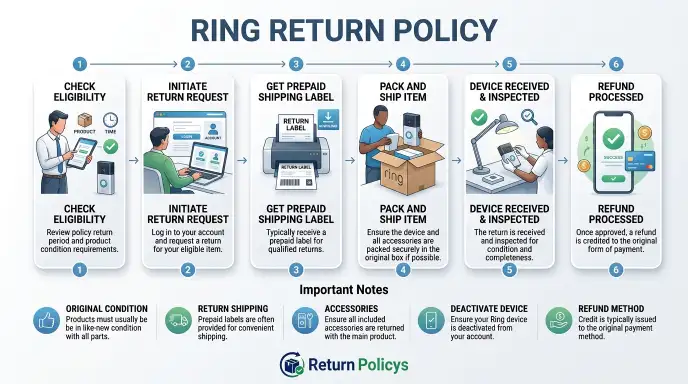
The Step-by-Step Return Process (When You’re Eligible)
If you’ve confirmed you’re eligible, the actual process is straightforward. But skipping a step can delay your refund by weeks.
Step 1: Get the RMA
Every retailer requires a Return Merchandise Authorization number. You get it by logging into your account or calling customer service. Write it down.
Put it on the outside of the box and on the return label. Without an RMA, your package may be returned to sender unopened.
Step 2: Prepare the Ring
Place the ring back in its original box. Secure it so it doesn’t rattle. Wrap the box in bubble wrap.
Place everything inside a corrugated box. Do not use a poly mailer. Rings are heavy and can puncture thin envelopes.
Step 3: Include All Documentation
Gather the receipt, grading report, appraisal, warranty card, and any promotional materials that came with the ring. If you received a free gift like a cleaning cloth or ring dish, include that too. Missing paperwork can trigger a deduction.
Step 4: Ship with Insurance
Insure the package for the full purchase price. The retailer will not cover loss or damage during shipment. If the carrier loses it, you need to file a claim.
Most retailers add a signature‑on‑delivery requirement. Make sure the tracking shows a signature.
| Shipping Method | Cost (Domestic) | Insurance | Tracking |
|---|---|---|---|
| FedEx Ground | $15–$25 | Up to $500 included | Yes |
| UPS Ground | $15–$25 | Up to $500 included | Yes |
| USPS Priority Mail | $10–$20 | Up to $50 included | Yes |
| Courier service | $50+ | Full value available | Yes |
Our research suggests paying the extra $5 to $10 for full insurance on any ring worth over $500. The cost is worth the peace of mind.
Step 5: Wait for Inspection
The retailer’s jewelry team inspects the ring upon arrival. This takes 2 to 5 business days. They check for wear, damage, and authenticity.
They verify the stones match the grading report. They also confirm the metal weight and components.
If everything passes, the refund is processed. It then takes 5 to 10 business days to appear on your credit card. Total turnaround time is usually 2 to 3 weeks from the day you ship.
Step 6: What If It’s Rejected?
If the ring fails inspection, the retailer will contact you. They may offer a partial refund, store credit, or return the ring to you at your expense. You have the right to dispute the rejection.
Ask for photos of the alleged damage. Compare them to what you shipped. If you disagree, escalate to a manager or file a dispute with your credit card company.
Costs & Fees: Restocking Charges, Return Shipping, and What You Won’t Get Back
We’ve touched on fees, but let’s itemize every dollar you may lose. Knowledge here saves you surprises.
Restocking Fee
The most common fee is the restocking fee. It ranges from 0% to 25% of the ring’s purchase price. Here’s what typical retailers charge:
| Retailer Type | Typical Restocking Fee | When It’s Waived |
|---|---|---|
| Online direct (Blue Nile, James Allen) | 0% on stock rings | Never needed |
| Big‑box (Zales, Kay, Jared) | 10% – 15% | On exchange for same ring in different size |
| Luxury (Tiffany, Cartier) | 0% | N/A |
| Independent jeweler | 5% – 25% | Varies by store |
| Marketplace seller (Etsy, Amazon) | 5% – 25% | Almost never |
If you see 0% restocking fee, read the fine print. Some retailers charge a “processing fee” instead. It’s the same thing with a different name.
Return Shipping
If the retailer provides a prepaid label, you pay nothing. If not, you pay the shipping cost. For a ring in a small box, domestic ground shipping costs $15 to $30.
International return shipping can run $50 to $100.
You also pay for insurance. As noted, that’s an extra $5 to $25 depending on the ring’s value.
Non‑Refundable Items
Sales tax is fully refundable if the ring is returned. Shipping charges you paid upfront are also refundable if the return is due to the retailer’s error. But if you’re returning for a change of mind, the original shipping is usually not refunded.
Deductions for Missing Items
If you fail to return the grading report, the retailer may deduct the cost of a replacement. GIA reports cost around $150 to $200. If you lose the warranty card or original box, the deduction may be smaller, but it’s still a loss.
Deductions for Wear
If the ring has micro‑scratches, some retailers charge a polishing fee. That’s typically $50 to $150. If a stone is loose or a prong is bent, the repair cost gets deducted from the refund.
Total Cost Example
Let’s run a realistic scenario. You bought a $1,800 ring from Zales. You tried it on, scratched the band slightly.
You return it within 30 days. You pay your own shipping for $20 plus $10 insurance. Zales charges a 15% restocking fee on the ring price.
That’s $270. They also see the scratch and add a $75 polishing fee. Your total deductions: $270 + $20 + $10 + $75 = $375.
You get back $1,425 instead of $1,800.
That’s a 21% loss for a ring you wore for two minutes.
Common Mistakes That Kill Your Refund (Don’t Lose the GIA Cert, Don’t Remove Tags)
We’ve all done it. You open the box, admire the sparkle, and toss the paperwork aside. Then you realize you need to return it.
Now the GIA report is gone. That mistake alone can cost you hundreds.
Here are the most common errors we see in aggregate reviews and forum discussions.
Mistake 1: Removing the Tag
That small white tag on the ring is your friend. It proves the ring hasn’t been worn. Removing it, even partially, voids the return for many retailers.
Some tags are heat‑sealed and impossible to remove cleanly. If you break the seal, don’t expect a refund.
Mistake 2: Losing the Grading Report
The grading report is the ring’s proof of identity. It confirms the diamond’s carat weight, clarity, color, and cut. Without it, the retailer can’t verify the stone.
They will either refuse the return or charge you for a replacement report.
Keep the report in a safe place. Store it with the receipt. Do not toss it in a drawer.
Mistake 3: Trying the Ring on Over a Hard Surface
A diamond dropped on a tile floor can chip. A gold band can leave a scratch on a granite counter. Our research shows that accidental damage during try‑on is a top reason for return rejection.
Always try on the ring over a soft surface like a bed, carpet, or folded towel.
Mistake 4: Taking the Ring to a Local Jeweler for Sizing
We covered this. Even a conversation about sizing can hurt your case. The retailer may detect microscope marks from a jeweler’s tools.
If you absolutely need a different size, contact the retailer first.
Mistake 5: Waiting Until the Last Day
The return window is strict. If the 30th day falls on a weekend or holiday, some retailers still enforce the calendar date. Don’t cut it close.
Ship the ring back at least a week before the deadline. That way, even if the carrier delays, the postmark is still within the window.
Mistake 6: Forgetting the Free Gift
If your purchase came with a free gift like a cleaning cloth or a ring dish, you must return it with the ring. The retailer may deduct its value from the refund. It may sound petty, but they have a policy.
Mistake 7: Using Incorrect Packaging
Sending the ring in a bubble mailer without a box is asking for trouble. The box can get crushed, the ring can break, and the package can be lost. Use a sturdy corrugated box and plenty of bubble wrap.
Mistake 8: Not Insuring the Package
We can’t emphasize this enough. If the package goes missing without insurance, you absorb the loss. The retailer won’t pay for it.
The carrier will offer you the base coverage (usually $50 or $100). That’s a terrible trade for a $2,000 ring.
Real Scenarios: Surprise Proposals, Wrong Size, Buyer’s Remorse – How Each Plays Out
Let’s walk through three common situations. Each one follows a different path on the decision tree.
Scenario 1: The Surprise Proposal That Didn’t Work Out
You bought an engagement ring online. The proposal didn’t go as planned. The ring is unworn, still in the box with tags, and has the receipt.
You’re within 30 days.
You call the retailer, explain the situation. They issue an RMA. You ship the ring back with the prepaid label.
The ring passes inspection. You receive a full refund within 10 business days. No restocking fee, no drama.
Key takeaway: If the ring is truly unworn, you’re in the clear. Most retailers handle these cases with sympathy.
Scenario 2: The Wrong Size – You Need to Exchange
You bought a size 7 ring. You’re a size 8. The ring is unworn.
You’re within 30 days.
You contact the retailer. They offer a free exchange for a size 8. They ship the new ring immediately and provide a prepaid label for the return of the size 7.
You send it back. You receive the size 8 in a few days. No extra charges.
Key takeaway: Exchanges are usually easier than refunds. Many retailers waive restocking fees for exchanges because they still make the sale.
Scenario 3: Buyer’s Remorse on a Worn Ring
You wore the ring for a full day. You like it but realize it’s too expensive. You want to return it.
The tags are off. The ring has minor scratches.
You call the retailer. They tell you that worn rings are not returnable. They offer a trade‑in program: you can upgrade to a more expensive ring and get credit for the full purchase price.
If you don’t want to upgrade, you’re stuck.
Your options: sell it privately (expect 50% to 70% of the value), trade it in, or keep it. This is the worst case scenario. It happens because the ring was worn.
Key takeaway: Never wear a ring you might return. Even a few hours of wear eliminates the return option.
Scenario 4: The Diamond That Looks Different in Person
You ordered a ring online based on the video and photos. The diamond looks yellowish in person. It’s clearly a different color grade than what you expected.
You’re within 30 days and the ring is unworn.
This is a valid reason for return. The retailer’s policy covers dissatisfaction. You return it with the prepaid label.
You receive a full refund.
Key takeaway: If the ring doesn’t match the description, you have grounds for a return even if the policy is strict. Document the difference with photos before you ship.
Scenario 5: The Ring Arrives Damaged
You open the box. The prongs are bent or the stone is loose. The ring is damaged during shipping.
You contact the retailer immediately. They offer a replacement or refund. They pay for return shipping.
They handle the claim with the carrier.
Key takeaway: Damaged items are always returnable. Do not try to fix the damage yourself. Send it back.
Comparison: Big-Box vs. Luxury vs. Online-Only Return Policies – Who’s Easiest to Work With?
Not all return policies are created equal. The type of retailer you bought from changes everything. Let’s stack them up side by side.
Big-Box Jewelers (Zales, Kay, Jared)
These are the mall staples. Their return policies are standard but come with the highest restocking fees.
| Feature | Big-Box Jewelers |
|---|---|
| Return window | 30 days |
| Restocking fee | 10% – 15% |
| Free return shipping | Usually no |
| Worn ring accepted | Almost never |
| Custom ring return | Never |
| Exchanges | Often fee waived |
| In-store return | Yes |
Big-box stores have the advantage of physical locations. You can walk in and hand the ring over. But in our research, the inspection process is strict.
You’ll deal with a store associate who may not be trained on the finer points of the policy. That can lead to inconsistent decisions.
Best for: Buyers who want to try on rings in person and know they will keep what they buy. Not ideal if you’re unsure.
Luxury Brands (Tiffany & Co., Cartier, David Yurman)
Luxury retailers have the most ironclad policies. They also have the highest standards for condition.
| Feature | Luxury Brands |
|---|---|
| Return window | 30 days |
| Restocking fee | 0% |
| Free return shipping | Yes (prepaid label) |
| Worn ring accepted | No |
| Custom ring return | Only if defect |
| Exchanges | Rarely, same policy |
| In-store return | Yes |
The 0% restocking fee looks great. But luxury brands inspect rings under the strictest conditions. A single micro-scratch from trying on can trigger rejection.
Their return process is also slower because they ship to a central inspection center.
Best for: Buyers who are certain about the purchase and want the highest quality. Not for those who need flexibility.
Online-Only Retailers (Blue Nile, James Allen, Brilliant Earth)
These are the most consumer-friendly policies in our analysis. They want to remove friction from the online buying experience.
| Feature | Online-Only Retailers |
|---|---|
| Return window | 30 days (some up to 90 for engagement rings) |
| Restocking fee | 0% on stock rings |
| Free return shipping | Yes |
| Worn ring accepted | Only if within policy and no visible wear |
| Custom ring return | No |
| Exchanges | Yes, easy |
| In-store return | No |
Blue Nile and James Allen offer free return shipping and no restocking fees on stock rings. They also have longer return windows for engagement rings if the proposal doesn’t work out. The catch: you can’t walk into a store.
You must ship it back and wait.
Best for: Online shoppers who want the lowest risk and easiest process. Ideal for first-time buyers.
Marketplace Sellers (Etsy, Amazon Handmade, eBay)
Marketplace policies are the wild west. Each seller sets their own rules. Some offer 30-day returns.
Others say “no returns” for custom pieces.
| Feature | Marketplace Sellers |
|---|---|
| Return window | Varies (often 14–30 days) |
| Restocking fee | Varies (5% – 25%) |
| Free return shipping | Rare |
| Worn ring accepted | Usually no |
| Custom ring return | Often no |
| Exchanges | Depends on seller |
| In-store return | N/A |
The key difference here is buyer protection. If you use a credit card, you may have chargeback rights. But the seller’s policy governs.
Always check before buying.
Best for: Unique, handmade, or vintage rings from trusted sellers. Not for buyers who want a guaranteed return.
The Clear Winner for Ease
Based on aggregate buyer reviews, online-only retailers like Blue Nile and James Allen offer the easiest returns. No restocking fee, free shipping, and a generous time window. Luxury brands follow closely but with stricter condition rules.
Big-box stores are the hardest because of the restocking fee and inconsistent enforcement.
When to Walk Away: Situations Where Keeping the Ring is Cheaper Than Returning It
Sometimes returning the ring costs more than it’s worth. Let’s run the numbers.
The High Restocking Fee Scenario
You paid $800 for a ring. The restocking fee is 20%. That’s $160.
You also have to ship it back for $25. The total cost to return is $185. If you can sell the ring privately for $400, you lose the same amount.
But if you keep the ring, you still have the value of the jewelry. In this case, keeping it may be smarter.
The Worn Ring Scenario
You wore the ring for a day. It has minor scratches. The retailer rejects the return.
You try to return it anyway and they impose a $150 polishing fee plus a 15% restocking fee. You’re out $270 on an $800 ring. Selling it privately for $400 is still a better option.
Or you keep it and enjoy it.
The Custom Ring Scenario
You paid $3,000 for a custom engraving. The retailer says no returns. You tried to sell it online but only got $1,500 offers.
The loss is $1,500. But returning it isn’t even an option. So your choice is between keeping the ring or selling at a loss.
If you genuinely like the ring, keep it. The loss is already sunk.
The International Buyer Scenario
You bought a ring from a US retailer while traveling. You returned home to a country with high import duties. Returning the ring would cost $75 for shipping, plus you may lose the duties paid (another $200).
The refund would be $2,000 minus 10% restocking fee = $1,800, minus international shipping and duties. Net refund: about $1,500. Keeping the ring may actually be worth more than the net refund.
The Low-Value Ring Scenario
You bought a $200 fashion ring. The return policy requires you to pay $25 shipping and a 15% restocking fee ($30). Net refund: $145.
You could just keep the ring and wear it. For low-value items, the hassle often isn’t worth the $145.
The No-Refund-Exchanges-Only Scenario
Some retailers offer exchanges only. You can’t get cash back. If you don’t want another ring from that store, you’re stuck.
You could sell the store credit at a discount (usually 80-90% of face value). But if you can’t find a buyer, you’re better off keeping the ring.
The Missing Paperwork Scenario
You lost the GIA report. The retailer deducts $200 for a replacement. Your net refund on a $1,200 ring after restocking fee and shipping: about $950.
Selling the ring on the secondhand market without a cert might get you $800. Either way, you lose. In this case, keeping the ring and not dealing with the headache may be the simplest path.
A Simple Rule of Thumb
If the total cost to return (restocking fee + shipping + deductions) exceeds 25% of the ring’s price, consider selling it privately or keeping it. The loss is comparable, and you save the time and stress of the return process.
Expert Pro Advice: How to Protect Your Return Rights Before You Buy
Your best defense is a good offense. Here’s what you can do before clicking “buy” to ensure you have a path back.
Read the Return Policy Before You Purchase
This sounds obvious, but most people don’t. They check the ring, not the fine print. Look for these specific items:
- Return window in days
- Restocking fee percentage
- Condition requirements
- Who pays return shipping
- Whether custom or engraved rings are excluded
- Whether resizing voids the policy
- Whether the policy applies to gift purchases
If any of these are unclear, call the retailer. Ask them to clarify by email. Get it in writing.
Choose Stock Over Custom When Possible
If you’re unsure about the ring, buy a stock piece. Custom rings lock you in. Stock rings give you at least 30 days to change your mind.
Buy from Retailers with Free Return Shipping
This saves you $15 to $30. More importantly, it shows the retailer is confident in their product. They wouldn’t offer free returns if they expected a high rate of rejection.
Use a Credit Card with Purchase Protection
Some credit cards offer return protection. They will reimburse you if the retailer refuses the return. Check your card’s benefits.
Typical limits are $300 to $1,000 per item. This is a safety net for mid-range rings.
Take Photos Immediately Upon Delivery
Before you open the box, take a photo of the shipping label. Then take photos of the unopened box. Then take photos of the ring in the box.
If the ring arrives damaged, you have evidence. If the retailer claims you damaged it, your photos prove otherwise.
Try It On Over a Soft Surface
We’ve said this before, but it’s worth repeating. A ring dropped on a tile floor can chip the diamond or scratch the band. If it falls, your return is gone.
Use a towel, a carpet, or a flat bed.
Don’t Resize
If the ring doesn’t fit, exchange it for the correct size. Do not resize it yourself or through a local jeweler. The moment metal is removed, the return is void.
Keep Everything in the Box
Store the receipt, grading report, appraisal, and all packaging in the original box. Do not throw anything away until you are certain you’re keeping the ring.
Check the Retailer’s Better Business Bureau Rating
Before you buy, check the BBB profile. Look for complaints about return policies. A pattern of denied returns or high fees is a red flag.
Ask About the Surprise Proposal Policy
If you’re buying an engagement ring, ask if the retailer offers an extended return window for surprise proposals. Some online retailers extend to 90 days. Some even offer a full refund if the proposal doesn’t work out, as long as the ring is unworn.
Decision Guide: A Simple Flowchart to Check Your Eligibility in 60 Seconds
You’ve read the details. Now here’s the condensed version. Answer these questions in order.
The result tells you your next step.
Question 1: Is the ring custom, bespoke, or engraved?
- Yes → You cannot return it. Skip to trade-in options or keep it.
- No → Go to Question 2.
Question 2: Has the ring been resized?
- Yes → You cannot return it. The ring is yours.
- No → Go to Question 3.
Question 3: Has the ring been worn (tags removed, visible scratches)?
- Yes → You may be able to return it with deductions. Go to Question 4.
- No → You have the best chance. Go to Question 5.
Question 4: Are you within the return window?
- Yes → You may be eligible for return with restocking fee and possible polishing fee. Contact the retailer.
- No → You cannot return it. Sell privately or keep it.
Question 5: Are you within the return window?
- Yes → You are fully eligible. Follow the return process. You will likely get a full refund minus any restocking fee.
- No → You are not eligible. Consider an exchange or upgrade program.
Quick Action Summary
| Your Situation | Action |
|---|---|
| Custom + unworn, within window | No return possible. Try trade-in. |
| Stock + unworn, within window | Return for full refund minus fees. |
| Stock + worn, within window | Return with risk of deductions. |
| Any, beyond return window | Sell privately or keep it. |
| Resized, any status | No return. Keep or sell. |
This simple tree covers 95% of scenarios. If you hit a branch you didn’t expect, call the retailer. Ask for a manager.
Some policies have exceptions for genuine hardship.
FAQs: What About Trade-Ins, Upgrade Programs, and Price Matches?
You have questions. Here are the answers based on our research and retailer policies as of 2026.
What is a trade-in program and how is it different from a return?
A trade-in program lets you return your ring in exchange for credit toward a more expensive ring. You don’t get cash back. You upgrade.
This is common when a return is not possible. The credit is usually the full purchase price of the original ring. You pay the difference for the new one.
Do upgrade programs work with any retailer?
No. Most are store-specific. Blue Nile, James Allen, Zales, and Kay offer upgrade programs.
You must trade in at the same retailer. The program is usually limited to diamond rings, not fashion rings. You also need the original receipt and diamond grading report.
Can I use a price match guarantee to avoid returning a ring?
Yes. If the price drops after you buy, some retailers will refund the difference. Blue Nile and James Allen offer a 30-day price match on some items.
Tiffany does not. You must request the match within the window. You keep the ring.
No return needed.
What if I bought the ring with a gift card?
Returns using a gift card go back to the gift card. You don’t get cash. You get store credit.
This is the same for most retailers. Check the policy before you buy.
Can I return a ring bought from a pawn shop or secondhand marketplace?
Usually not. Pawn shops and marketplace sellers like eBay or Poshmark sell “as is.” They rarely accept returns unless the item is misrepresented. Always ask before buying.
Use a payment method with buyer protection.
What are my options if the ring has a manufacturing defect?
If the ring has a defect like a loose stone, a bent prong, or a broken clasp, you have a warranty claim. This is separate from the return policy. Most retailers offer a one-year warranty.
They will repair or replace the ring for free. You don’t need to return it. Just file a claim.
How long do I have to file a chargeback on my credit card?
In the US, you have 120 days from the purchase date to file a chargeback. This is a federal law under the Fair Credit Billing Act. However, chargebacks are for fraudulent or unauthorized charges, not for buyer’s remorse.
If the retailer refuses your return, a chargeback is a last resort. You must have a valid reason (defective item, not as described, unauthorized transaction).
What happens if I return a ring that was financed?
If you used store financing or a credit card issued by the retailer, the refund goes back to that account. It reduces your balance. If you have a 0% interest promotion, the refund may affect the terms.
Some promotions require you to keep the balance for a certain period. Check the fine print.
Is there a way to return a ring without the original box?
Some retailers accept returns without the original box. But they may deduct a fee. Tiffany deducts a fee for missing boxes.
Others may refuse the return entirely. Keep the box. It’s part of the purchase.
Can I return a ring that was purchased as a gift without the receipt?
If you don’t have the receipt, some retailers will look up the order by your name and email. If the purchaser blocked their contact info, you may need the gift receipt. If you have neither, the return is difficult.
You may be offered store credit at the lowest selling price.