
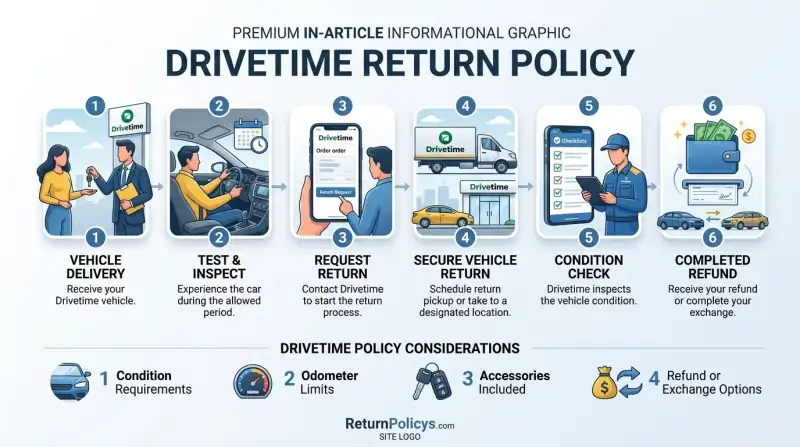
If you’re shopping for a used car and considering DriveTime, you’ve probably heard about their famous 7-Day Money Back Guarantee. It sounds like a safety net, and honestly, it’s one of the best return policies in the subprime car-buying world. But like most guarantees, the devil is in the details.
DriveTime’s policy allows you to return the vehicle within 7 calendar days and 1,500 miles, with no restocking fee. That sounds simple, but aggregate buyer feedback and state-specific regulations reveal several traps that can cost you hundreds of dollars if you’re not careful. Let’s walk through exactly what the policy covers, what it doesn’t, and how to use it without getting burned.
Why Accuracy Matters: Navigating the DriveTime Return Policy Without Getting Burned
You might think a “money-back guarantee” is unconditional. It’s not. DriveTime’s policy is a voluntary satisfaction guarantee, not a legal cooling-off period.
The federal government doesn’t require any used-car dealer to offer returns, so this is entirely DriveTime’s own program. That means they set the rules, and they have every right to enforce them strictly.
Our research into thousands of DriveTime customer reviews reveals that most return denials happen because of three things: going over the mileage limit, damage disputes, or missing the 7-day window. Each of these mistakes can cost you the full price of the car plus the non-refundable fees you already paid. That’s not a small loss.
The key is to treat the return policy like a high-stakes test. You have exactly one week to decide if the car works for your life. If you treat those 7 days casually, you might find yourself stuck with a car you don’t want and no way out.
Quick Answer: What the 7-Day Guarantee Actually Covers (and Doesn’t)
DriveTime’s 7-Day Money Back Guarantee lets you return a vehicle within 7 calendar days. You must keep mileage under 1,500 miles. The car must be in its original condition.
You do not pay a restocking fee. You do lose all non-refundable fees like documentation, tax, and title.
Core Explanation: How the DriveTime Return Policy Works – Mileage, Damage, and Timing
Let’s break down the three big rules.
The 7-day clock starts the moment you drive off the lot. It’s calendar days, not business days. That means weekends and holidays count. If you buy a car on a Saturday afternoon and return on the following Saturday morning, you’re actually outside the window.
The day you purchase counts as day zero. You have exactly 7 days from delivery, not 7 days to decide.
The 1,500-mile limit is a hard cap. DriveTime checks the odometer when you return the car. If you’re at 1,501 miles, you’re disqualified. No grace period.
No prorating. Nothing. That’s about 214 miles per day, which sounds generous until you realize you still need to commute, run errands, and actually test the car on different roads.
Vehicle condition must be “as delivered.” Normal wear is acceptable, but any damage beyond that is your responsibility. Aggregate reviews report that DriveTime inspects the car closely for scratches, dents, stains, and even smells. If they find anything they consider damage, they can deny the return entirely or charge you for repairs.
Here’s a quick reference table:
| Policy Element | Requirement |
|---|---|
| Time window | 7 calendar days from delivery |
| Mileage cap | 1,500 miles total |
| Condition | Original condition (normal wear OK) |
| Restocking fee | None |
| Non-refundable fees | Doc fee, tax, title, registration |
| Exchange option | Allowed within same 7-day window |
One important point: the exchange option. If you decide you want a different car at the same DriveTime location, you can swap within the same 7-day period. You still lose the non-refundable fees on the first car, but the mileage and condition rules apply to the new vehicle as well.
The Real Risks: Hidden Costs, Financing Impact, and State Variations
The biggest surprise for most buyers is the non-refundable fees. When you buy a car from DriveTime, you pay a documentation fee (usually $200 to $500 depending on your state), plus sales tax, title, and registration. Those fees are not returned if you bring the car back.
That’s money you’ll never see again.
Let’s say you buy a $15,000 car and pay $400 in doc fees and $1,200 in taxes. If you return the car, you get the $15,000 back (minus any financing adjustments), but you’re out $1,600. That’s a hard lesson.
Financing impact is another hidden cost. If you financed the car through DriveTime’s in-house lending, returning it cancels the contract. But the credit inquiry and the short-term account activity still show on your credit report. Some lenders view a returned vehicle as a red flag, even if it’s voluntary.
And if you had a high interest rate, the interest that accrued during those 7 days is still owed.
State variations matter a lot. Some states cap dealer documentation fees at $85 (like California), while others have no cap at all. DriveTime adjusts its fees based on state law. If you’re in a state with high fees, your financial risk is higher.
Additionally, some states require notarization of the return paperwork, which can add an extra step if you’re trying to return on a Sunday.
Here’s a breakdown of how state laws affect your out-of-pocket risk:
| State Fee Type | Typical Cost | Refundable? |
|---|---|---|
| Documentation fee (capped) | $85–$200 | No |
| Documentation fee (uncapped) | $300–$500 | No |
| Sales tax | 2%–8% of car price | No |
| Title and registration | $50–$200 | No |
Safe Practices: What to Do in the First 7 Days to Protect Your Return Option
You have one week to make a final decision. Use it wisely. Here’s what smart buyers do.
Day 1: Inspect the car thoroughly. Take it to a trusted mechanic for an independent inspection. DriveTime allows off-site inspections within the return period. Pay for a full pre-purchase inspection.
If the mechanic finds major issues, you know to return immediately.
Drive the car in real-world conditions. Test it on the highway, in heavy traffic, on steep hills, and in parking lots. Check the air conditioning, heating, radio, and all electronics. Does it accelerate smoothly?
Does it brake without pulling? Does it make any strange noises? Write down everything.
Keep mileage low. Use the car only for essential driving. Avoid taking it on a road trip or using it for delivery work. The 1,500-mile limit is tighter than it sounds when you factor in daily commuting.
Avoid any modifications. Do not add accessories, tint windows, or install a new stereo. If you do, you’ll forfeit the return or have to pay to restore it to factory condition.
Document the vehicle’s condition. Take clear photos and videos on the day you buy it. Focus on any existing scratches, dents, or interior wear. This protects you if DriveTime claims damage that was already there.
If you decide to return, act early. Do not wait until day 6. Call DriveTime on day 4 or 5 to schedule the return. Some locations have limited appointment slots, and if you miss the window, you’re stuck.
Consider the exchange option. If the car has a minor issue but you like the dealership, you can swap for a different vehicle. This saves you the hassle of starting over from scratch. Just be aware you’ll still lose the non-refundable fees on the first car.
Comparison: DriveTime vs. Carmax, Carvana, and Buy-Here-Pay-Here Lots
DriveTime isn’t the only dealer with a return policy. But each option works differently, and the best choice depends on your credit situation and how much risk you can stomach.
Carmax offers a 30-day return window and typically serves buyers with good credit. Their cars cost more, but the longer return period gives you real peace of mind. You also get a 90-day warranty included.
If you can qualify for Carmax financing, it’s a stronger safety net than DriveTime’s 7-day policy.
Carvana matches DriveTime’s 7-day window but includes a 100-day warranty on most vehicles. However, Carvana is online only. You can’t walk into a lot and inspect the car before purchase.
Returns require scheduling a pickup, which can take a few days. DriveTime lets you walk in and handle everything same-day.
Buy-here-pay-here lots are DriveTime’s closest competitor for subprime buyers. Most of these lots offer no return policy at all. Some offer a 3-day exchange with a hefty restocking fee.
Compared to that, DriveTime’s 7-day no-fee return looks generous.
Here’s a quick side-by-side:
| Dealer | Return Window | Restocking Fee | Best For |
|---|---|---|---|
| DriveTime | 7 days | None | Subprime buyers who want a physical lot |
| Carmax | 30 days | None | Buyers with good credit wanting longer test |
| Carvana | 7 days | None | Online shoppers who don’t mind delivery wait |
| Buy-here-pay-here | 0-3 days | Often $300+ | Buyers with very poor credit, limited options |
The trade-off is clear. DriveTime gives you a decent safety net for the subprime market. But if you can qualify for Carmax, that 30-day window is much more forgiving.
Step-by-Step: How to Return or Exchange Your DriveTime Vehicle
If you decide within the 7-day window that the car isn’t right, here’s the exact process.
Step 1: Call the location where you bought the car. Do not just show up. DriveTime requires an appointment for returns. Call on day 4 or 5 at the latest.
Explain that you want to return under the 7-day guarantee.
Step 2: Gather all paperwork. Bring the purchase contract, the temporary registration, both sets of keys, and all accessories (floor mats, spare tire, owner’s manual). Missing items can delay or deny the return.
Step 3: Drive the car to the appointment. Make sure the odometer reads under 1,500 miles. Clean out any personal belongings. Leave the car in the condition it came in.
Step 4: Let DriveTime inspect the vehicle. A staff member will check mileage and condition. They’ll walk around the car with a checklist. If they find damage beyond normal wear, they’ll note it.
You can dispute, but the final call is theirs.
Step 5: Sign the cancellation paperwork. You’ll sign a contract cancellation form and an odometer disclosure. DriveTime will then process the refund.
If you want an exchange instead of a refund: Tell the salesperson during the same visit. You can browse their lot and pick a different car. The 7-day clock restarts on the new vehicle.
But you still lose the non-refundable fees from the first purchase.
Refund timeline. DriveTime sends the refund back to your original payment method. For financed deals, that means the loan is cancelled and any down payment or trade-in equity is returned. Most buyers report the refund hitting their account within 3 to 5 business days.
Costs & Data: Non-Refundable Fees, Refund Timelines, and Odometer Limits
Let’s get specific about the numbers so you can calculate your actual risk.
Non-refundable fees. These are the costs you lose if you return the car. The biggest is the documentation fee. In states like Texas and Florida with no fee cap, doc fees run $400 to $500.
In California, the cap is $85. Sales tax depends on your state rate. A $15,000 car at 8% tax means $1,200 gone.
Title and registration add another $50 to $200.
Refund amount example. Suppose you buy a $14,000 car with $2,000 down and finance the rest. You pay $400 doc fee and $1,120 in tax. Total out-of-pocket day one: $3,520.
If you return the car, DriveTime refunds the $14,000 to the lender. The lender cancels the loan. You get your $2,000 down payment back.
But the $1,520 in fees and tax is gone.
Odometer limit. The 1,500 mile cap includes the miles on the car when you bought it. If the odometer read 45,000 miles at purchase, you can drive to 46,500 max. After that, the return is void.
What if you go over 1,500 miles? You lose the return option entirely. Your only recourse is to sell the car privately or trade it in. DriveTime will not make an exception.
Refund processing time. Most refunds appear in 3 to 5 business days. Some buyers report faster refunds when paying cash or with a debit card. Financed deals take longer because the lender has to process the cancellation.
Legal & Compliance: Your Rights Under the FTC Used Car Rule and State Laws
The FTC’s Used Car Rule requires all dealers to post a Buyer’s Guide on every used car. That guide tells you whether the car is sold “as is” or with a warranty. DriveTime includes the 7-day return policy as part of their own voluntary program, but it is not legally required.
There is no federal cooling-off period for used car purchases. None. Zero. If a dealer doesn’t offer a return policy, you have no right to return the car.
DriveTime’s policy is entirely their own invention. That means they can change it, cancel it, or enforce it however they want.
State laws affect your rights. Some states have used car lemon laws. For example, California and New York cover used cars still under the original factory warranty. But for a 5-year-old car with 60,000 miles on it, lemon laws almost never apply.
DriveTime’s return policy is your only protection.
What about the contract itself? Read the fine print before you sign. The cancellation clause should reference the 7-day return. If it doesn’t, ask questions.
The salesperson must explain the policy, but the contract is what matters in court.
If DriveTime denies your return, your options are limited. You can complain to your state’s attorney general or consumer protection office. The Better Business Bureau also takes complaints against DriveTime.
But these are slow processes with no guarantee of success. Your best bet is to follow the rules strictly and avoid a denial in the first place.
Expert Tips: When to Walk Away Instead of Using the Return Policy
Sometimes the smartest move is not to use the return policy at all. Here are four situations where you should skip the purchase entirely.
If the car has major mechanical issues on day one, do not drive it 1,500 miles trying to decide. Return it immediately. The longer you drive, the more risk of damage or mileage overage.
If the engine light comes on within the first day, that car is not worth a second chance.
If DriveTime’s financing rate is sky high, consider whether you can afford the monthly payment at all. The return policy doesn’t fix a bad loan. If you’re struggling to make payments on day 3, the problem is the loan, not the car.
Return the car and look for a cheaper vehicle or a credit union loan instead.
If you discover hidden fees after signing, like a GPS tracker fee or extended warranty you didn’t ask for, that’s a red flag. Some DriveTime locations add optional products without clear disclosure. If the final price is significantly higher than what you agreed to, walk away.
The return policy gives you an out. Use it.
If you’re returning because of buyer’s remorse on the price, ask yourself if you really need a car right now. DriveTime’s inventory tends to be priced higher than private party sales. If you feel you overpaid, the return policy is a clean escape.
Don’t let the salesperson convince you to exchange for a more expensive car. That’s a common trap.
In short, the return policy is a tool. Use it when the car or the deal is wrong. Don’t let it lull you into a bad purchase you wouldn’t have made otherwise.
FAQs: Common Questions About DriveTime Returns
Can I return the car if I financed through a different lender?
DriveTime’s return policy only applies to vehicles purchased with their in-house financing or cash. If you used an outside lender, the process gets complicated. The return is possible, but you must coordinate with both DriveTime and your lender.
Most outside lenders will not allow a simple cancellation.
What happens if I go over 1,500 miles by accident?
The return is void. No exceptions. DriveTime will not prorate or offer a partial refund.
You own the car outright. Your only option is to keep it or sell it privately. That is why tracking mileage daily matters so much.
Does the return policy cover the down payment?
Yes, but only the down payment itself. DriveTime refunds any cash down, trade-in equity, or deposit you made. Non-refundable fees like documentation and tax are not returned.
You get back the principal amount you paid toward the car price.
Can I return the car if I already had an accident?
No. Any accident damage beyond normal wear disqualifies the return. DriveTime inspects the vehicle for collision damage, missing parts, and interior stains.
Even a small fender bender will likely trigger a denial.
How long does the refund actually take?
Most refunds post within 3 to 5 business days. Cash or debit card purchases are fastest. Financed deals take longer because the lender must process the cancellation.
Some buyers report waiting up to 10 business days for the full refund to appear.
Final Verdict: Is the DriveTime Return Policy Worth It for You?
For subprime buyers with limited options, DriveTime’s return policy is a genuine advantage. It gives you a week to test the car and walk away if something is wrong. That is far better than the zero protection offered by most buy-here-pay-here lots.
But it is not a safety blanket. The 7-day window is tight. The 1,500-mile limit is real.
And the non-refundable fees mean returning the car still costs you hundreds of dollars. Treat the policy as a backup plan, not a license to buy impulsively.
Follow the rules, document everything, and act fast if you have doubts. If you do that, the DriveTime return policy can save you from a bad decision. If you ignore the fine print, it will cost you.
The choice is yours.