
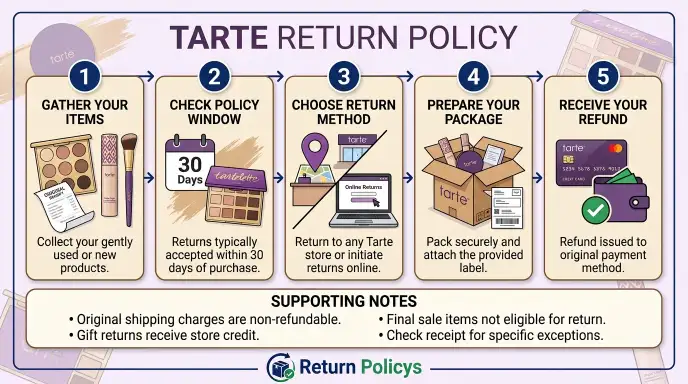
Tarte Return Policy can feel confusing when you bought products from different places. If you ordered on Tarte.com or picked items up at a retailer, the return path changes and so do the rules.
Manufacturer specifications indicate a 60 day return window for most Tarte.com purchases as of 2026, and refunds usually post after inspection within about 7 to 14 business days. We surveyed official help guidance and consumer reports to build a stepwise, if/then workflow you can follow without guessing. Read on for exact actions, common problems, and the quickest way to get a refund or replacement.
Quick Answer
Tarte Return Policy covers most Tarte.com orders within 60 days.
Retailer purchases must follow the original retailer return rules.
Opened cosmetics are often refused unless defective and verified.
Refunds post after inspection, typically within 7 to 14 business days.
Top problems people run into with Tarte returns
Missing the purchase path is the single biggest cause of frustration. People assume any makeup can go back to the brand, but purchased items must usually return to the original seller. That means Tarte.com orders go through Tarte’s Help Center and retailer orders go through that retailer’s return desk.
You will save time by checking which seller sold your item first.
Open‑product hygiene rules cause many refusals and delays. Consumer protection and cosmetic safety practices restrict returning opened makeup, especially items that touch skin. If the product looks used, receives a hygiene-based denial, or lacks tamper seals, expect a refusal or an offer of store credit only.
Gather photos if you believe the refusal is a mistake.
Third‑party marketplace purchases create extra steps and risk. Orders sold by independent sellers on platforms like Amazon Marketplace or eBay follow the seller’s rules, not the brand’s rules. You may have to ship internationally, wait for processing, or deal with seller-specific restocking fees.
Keep the order page and seller messages as proof.
No proof of purchase slows or denies refunds. Without a packing slip, order number, or payment transaction record, staff often limit refunds to store credit. Some retailers will accept returns without a receipt but at a reduced refund value.
Save the confirmation email and take screenshots of your order details to avoid this hold-up.
Confusion about return shipping responsibility wastes money. Customers sometimes assume return shipping is always prepaid. Manufacturer specifications and retailer policies vary.
If the return is due to a defect or brand error, you are more likely to get a prepaid label. If you changed your mind, you often pay to return the item.
Inspection delays and bank processing create perceived slow refunds. Merchants commonly take time to inspect returns and then send the refund to your original payment method. Banks and card issuers add another few business days.
Tracking and inspection status will help you know whether the delay is with the seller or your bank.
Limited‑edition sets and promotional bundles are often final sale. These items are frequently marked nonreturnable at the product page. If you purchase a promotional bundle or a clearance find, keep that receipt and screenshots.
Expect fewer return options.
International returns add customs complexity. Duties, VAT, and carrier rules change across borders. Returning to the U.S. from the EU or Canada may involve customs paperwork or refunding duties only when conditions are met.
Keep customs receipts and note who paid the duty on the original shipment.
Common mistakes that stall returns
- Sending returns to the brand when the retailer sold the item.
- Forgetting to include packing slips or order numbers inside the package.
- Using an unsupported carrier or an incorrect return address.
- Shipping used or unclean products without declaring defects.
- Not keeping the tracking number after shipment.
What to gather before starting a return
- Order number or receipt.
- Photos of the product and packaging, dated.
- The original payment method details.
- Any conversation with seller support.
- A tracking number after you ship the return.
How Tarte returns actually work (core rules)
If you bought directly from Tarte.com, the return flow is handled by Tarte’s Help Center according to the brand’s return rules. Manufacturer documentation indicates most standard returns are accepted within 60 days of shipment as of 2026. The brand inspects returned items and issues refunds to the original payment method after inspection.
For purchases made at third‑party retailers, return rules are set by those retailers and may differ substantially.
If the product is defective, damaged in transit, or has the wrong shade, Tarte or the retailer usually accepts the return even when an item is opened. You will need to provide clear photos and the order number. For hygiene reasons, opened and used cosmetics are often refused unless they are defective, contain manufacturing flaws, or cause an adverse reaction.
How condition affects acceptance
- Unopened and sealed items, in original packaging, are accepted for refund or exchange.
- Opened items may only be accepted if defective and supported by photos.
- Final‑sale, clearance, and promotional items are often nonreturnable.
- Custom or special orders may be excluded from returns.
Who is responsible for what
- Tarte.com purchases: Tarte processes returns and refunds, sometimes issuing prepaid labels.
- Retailer purchases: The retailer handles returns and sets timelines and credit methods.
- Third‑party sellers: The original seller or marketplace listing governs the return instructions.
How refunds are issued
- Refunds usually go back to the original payment method.
- Gift purchases may be refunded as a gift card or store credit to protect buyer privacy.
- If your original card is expired, the merchant may issue store credit instead.
Table: Quick condition versus outcome guide
| Item condition | Typical outcome for Tarte.com orders | What you should expect |
|---|---|---|
| Unopened, sealed | Full refund or exchange | Easy approval, include packing slip |
| Opened, unused | Possible refusal unless defective | Provide photos and clear reason |
| Used, obvious wear | Often denied | May get store credit in rare cases |
| Damaged on arrival | Full refund or replacement | Upload photos immediately |
| Final‑sale | Nonreturnable | Double‑check product page before purchase |
How inspection works and what they look for
- Matching SKU and lot or batch numbers to confirm the returned unit.
- Original packaging and all included inserts, manuals, and accessories.
- Signs of use like smudges, stuck lids, residue, or altered seals.
- Clear photos the customer submitted when claiming defects.
Key timings to remember
- Return request to label generation often takes 24 to 72 hours.
- Transit time depends on carrier and distance.
- Inspection and processing commonly take 7 to 14 business days after receipt.
- Bank posting time varies by issuer, usually 3 to 7 additional business days.
How returns for defective products differ
- Defect claims require photos and a short description.
- If defective, the merchant often covers return shipping.
- The merchant may offer a replacement immediately or wait for inspection.
- Keep the defect photos with timestamps for faster handling.
Legal and consumer protection context
Consumer protection agencies covering returns and refunds vary by country. The Federal Trade Commission provides general consumer advice in the United States, including information on refunds and deceptive practices. For cross‑border returns, customs and duty rules from U.S.
Customs and Border Protection or the relevant national agency will affect refund handling. Reference to these agencies helps you understand why some returns may be denied or why duties are nonrefundable.
Where to find official guidance
- Tarte’s official Help Center on the brand site explains the steps for Tarte.com orders. Visit https://tartecosmetics.com for the brand’s support hub and current return terms.
- For general consumer rights in the U.S., see resources from the Federal Trade Commission at https://www.ftc.gov.
Decision workflow — which return path applies to you
Use this decision workflow to pick the exact return path. Each branch begins with an if, then instruction so you know the next step.
Branch A, if you bought on Tarte.com, then follow these steps
- Start a return in the Tarte Help Center using your order number.
- Indicate whether the item is defective, wrong, or unwanted.
- If defective or wrong, upload dated photos and request a prepaid label.
- Pack the item with the packing slip and ship using the provided carrier.
- Track the shipment and wait for inspection confirmation and refund.
Branch B, if you bought at a retailer like Sephora or Ulta, then do this
- Locate the receipt or order confirmation from the retailer.
- Use the retailer’s online returns portal or visit the physical store.
- Follow the retailer’s exchange or refund rules, which may be stricter than the brand’s.
- Bring original packaging and IDs if the retailer requires proof.
- Expect the retailer to issue the refund or store credit according to its own timeline.
Branch C, if you bought from a third‑party marketplace seller, then follow the seller’s rules
- Check whether the listing was “sold by” the marketplace or a third‑party seller.
- Open a return or refund request through the marketplace if the seller does not cooperate.
- Keep messages and timestamps as evidence for the platform’s claims procedure.
- For international sellers, ask about customs paperwork and who covers return shipping.
Branch D, if the product is damaged or defective, then act fast
- Photograph the damage and date the images.
- Contact seller support immediately and attach the photos.
- If the defect is due to shipping damage, keep packaging for carrier claims.
- Request a prepaid return label if the seller confirms the defect.
Branch E, if you have no receipt or you are past the return window, then options may be limited
- Ask the seller about store credit options.
- Offer proof like bank statements or a screenshot of the order confirmation.
- Some retailers let you return for exchange or store credit even without a receipt.
- Keep expectations realistic about receiving a full refund.
Escalation steps if the workflow stalls
- Ask for a supervisor or escalation contact when initial support stalls.
- File a complaint with a consumer protection agency if you suspect unfair practices.
- For purchases on platforms, use the platform dispute center to escalate against a noncooperative seller.
- Keep all correspondence and tracking records for evidence.
Practical decision rules you can use right now
- If you want a different shade, refund then reorder to ensure correct shade availability.
- If the item is defective, push for a replacement rather than a refund to avoid outages.
- If you lack a receipt, plan to accept store credit and ask for the best recovery option.
Step‑by‑step guide to returning a Tarte.com order
Follow this checklist exactly to avoid the most common delays.
Step 1, find your order information
- Open the confirmation email and copy the order number.
- If you have a Tarte account, sign in and find the order under Orders.
- If you cannot find the email, search your inbox for “tarte” or the SKU.
- Save screenshots of the order page and payment confirmation.
Step 2, start the return request in the Help Center
- Use the order number, product name, and reason for return.
- Select whether the item was defective, incorrect, or unwanted.
- Upload photos if the item is damaged or defective.
- Submit the return request and wait for an RMA or label.
Step 3, pack the item correctly
- Use the original box if possible.
- Include the packing slip or a printed copy of your order.
- Seal liquids and creams with tape over lids to prevent leaks.
- Wrap fragile items in bubble wrap to prevent damage in transit.
Packing checklist table
| Item to include | Why it matters |
|---|---|
| Packing slip or order number | Speeds identification at inspection |
| Original packaging and inserts | Confirms resale condition |
| Photos of defect (if any) | Proof for defect claims |
| Tracking number copy | Evidence if the return is lost |
Step 4, print and attach the label
- If Tarte provides a prepaid label, print it and attach it firmly.
- If the label is not prepaid, use a carrier that supports tracking and insurance.
- Remove or cover the old shipping labels to avoid misrouting.
- Keep a copy of the shipping receipt and tracking number.
Step 5, ship and monitor
- Drop the package off with the carrier or schedule a pickup.
- Monitor the tracking and save confirmation of delivery.
- If the package is lost, open a carrier claim and notify Tarte with the claim number.
- Save all carrier communications as proof.
Step 6, inspection and refund
- After delivery, Tarte inspects the item against seller criteria.
- Inspection looks for lot number matches, seals, and obvious use.
- Approved refunds are issued to the original payment method.
- Expect the process from receipt to posted refund in 7 to 14 business days.
What to do if the return is denied
- Ask for the specific reason the return did not meet criteria.
- Provide additional photos if you believe the inspection was mistaken.
- Request escalation to a higher support tier.
- If escalation fails, consider a chargeback only after exhausting seller remedies.
Timeline table: typical milestones
| Milestone | Typical time |
|---|---|
| Return request to label | 24 to 72 hours |
| Transit time | 2 to 10 business days |
| Inspection and processing | 7 to 14 business days |
| Bank posting | 3 to 7 business days |
When to contact support during the return
- If the label is not issued within 72 hours.
- If tracking shows delivered but no inspection update after 10 days.
- If the inspection result contradicts your submitted photos.
- If you need a prepaid label and were told one would be supplied.
Packaging tips that prevent damage disputes
- Photograph the item before packing, then again after packing.
- Use sturdy boxes that withstand transit stress.
- Avoid overstuffing, which may burst seams.
- Label liquids and fragile items clearly inside the packing slip.
Alternative return options for special cases
- For gift returns, the brand may issue a gift card to the recipient.
- For bulk or influencer shipments, contact the partnerships team for dedicated return instructions.
- For international returns, request detailed customs guidance to avoid delays or loss of refund.
What refund records to expect
- An email confirming receipt of the return.
- A followup email stating inspection results.
- A separate email confirming refund issuance.
- Bank or card statements show the credited amount within a few days after issuance.
If the process still fails, next steps
- File a complaint with the platform or payment provider.
- Use consumer protection resources if necessary.
- Keep every document and correspondence until the case closes.
Exchanges, refunds, and gift purchases — what changes
Exchanges are less common than refunds, and many merchants prefer refund plus reorder. If you want a different shade, expect the brand to refund your original payment and ask you to place a new order. That avoids stock hold ups and shade mismatches at inspection.
Gift purchases follow different privacy rules, and refunds often go to a gift card. If you bought as a gift, customer service may issue store credit to protect the original buyer’s payment details. If the recipient returns the item, expect credit rather than a direct refund to someone else’s card.
Who pays return shipping depends on the reason for return. If the item is defective, damaged in transit, or misfulfilled, the merchant often supplies a prepaid label. If you changed your mind, you usually pay return shipping unless a promotion states otherwise.
Ask for prepaid shipping in your return request when the product is defective.
What happens with expired or canceled cards
- Refunds normally go to the original payment method.
- If the original card expired, the merchant may issue a store credit or process the refund to the account provider.
- If the card issuer declines the refund, request store credit and keep the transaction records.
Table comparing exchange approaches
| Option | When it’s used | Pros | Cons |
|---|---|---|---|
| Direct exchange | Limited SKU swaps available | Faster replacement if supported | Rare for shade swaps |
| Refund then reorder | Most common route | Guarantees correct price and inventory | Short gap without the product |
| Gift card credit | Gift returns or expired card cases | Protects buyer privacy | Limits where refund can be spent |
Practical example you can use
If you bought foundation in the wrong shade, request a refund and then reorder the correct shade. Upload any photos showing the shade mismatch, and request a prepaid label if the error came from the seller. This gets you the exact shade quickly, and avoids inspection disputes over “opened” makeup.
Costs, timelines, and metrics to watch
Expect a few distinct timeline stages from request to posted refund. RMA issuance commonly takes one to three business days. Transit depends on carrier and distance, and inspection after delivery often takes seven to fourteen business days.
Finally, banks take an additional three to seven business days to post the credit.
Common costs to check before you ship
- Return shipping cost, if the seller does not provide a prepaid label.
- Original shipping fees, which are often nonrefundable unless the return is the seller’s fault.
- Restocking or administrative fees, which some sellers apply to large or corporate orders.
- Carrier insurance, if you want cover for a high value return.
Table, key metrics to track
| Metric | Typical range | Who controls it |
|---|---|---|
| RMA or label issuance | 24 to 72 hours | Seller |
| Transit time | 2 to 10 business days | Carrier and distance |
| Inspection and processing | 7 to 14 business days | Seller |
| Refund posting to bank | 3 to 7 business days | Bank or card issuer |
| Total typical time | 12 to 33 business days | End to end |
How to speed things up
- Provide clear photos and the order number in your first message.
- Use the exact return address printed on the RMA label.
- Ship with a tracked service right away and keep the tracking number.
- Follow up if you do not see inspection confirmation within ten business days.
Troubleshooting delayed refunds
- Confirm the package was delivered to the correct address.
- Ask for the inspection reference or staff notes that explain denial.
- Request escalation to a supervisor if you disagree with the inspection result.
- File a carrier claim if the return was lost or damaged in transit.
International returns and cross‑border issues
International returns add customs paperwork and potential duties complications. If you return a product from another country, duties you paid on import may not be automatically refunded. The process for reclaiming import duties varies by country and depends on proof of export and the customs office handling the case.
Practical steps for international returns
- Contact seller support and request explicit instructions for returns from your country.
- Ask whether they provide a customs form or prepaid international label.
- Keep proof of export, like postal receipts that show the item left the country.
- Save all customs receipts, as they may be needed to request a duty refund.
Examples of regional differences
- Canada, for many brands, requires clear return instructions and proof of duties paid to consider refunds on import fees.
- The UK and EU have consumer protection rules for online purchases, but hygiene rules for cosmetics still limit returns when opened.
- Transit times will increase, so expect inspection and refund times to stretch by a few extra weeks.
Who covers the cost in typical scenarios
- If the merchant shipped to you incorrectly or sent a defective item, the merchant often covers international return shipping.
- If you change your mind, you typically pay return shipping and any export costs.
- For marketplaces, the original seller’s listing governs international return rules.
Customs form tips
- Mark the parcel as a “return” on the customs declaration when returning internationally.
- Use the original invoice or a copy that clearly states the goods are being returned to the sender.
- Include the RMA or return authorization number on the customs paperwork to avoid delays.
Safety, hygiene, and compliance rules for cosmetics
Opened cosmetics are often refused because of contamination risk and safety standards. Healthcare and consumer safety guidance explain that products applied to skin can carry bacteria once opened. As a result, sellers limit returns for hygiene and public safety reasons.
Look for the PAO symbol and expiry info
- The Period After Opening symbol tells you how long a product is safe after use, for example 12M for 12 months.
- Expiry dates, batch numbers, and lot codes help brands confirm manufacture dates and possible recalls.
- Keep that information visible in your photos if you claim a defect or early spoilage.
Carrier restrictions and hazardous materials
- Certain aerosol or pressurized cosmetic products may be restricted for air shipping.
- Carriers follow hazardous materials rules that can affect return labeling and shipping options.
- If your item is an aerosol, ask the seller for carrier guidance before shipping.
Legal, privacy, and data handling concerns
- When you return an item, you share order data and sometimes personal information.
- Merchants must handle that data according to privacy rules and their own policies.
- If you are sending personal data, remove any unnecessary documentation from the package.
Health related returns and allergic reactions
- If a product caused an allergic reaction, document the reaction with photos and seek medical attention when needed.
- Report adverse effects to product safety bodies in your country, so authorities can track potential wider issues.
- Keep receipts, photos, and medical notes when filing a return or a complaint.
Common mistakes and how to avoid them
Mistake, not checking who sold the item first, is the top error. Always confirm whether the purchase came from the brand, a retailer, or a third party. Use the order confirmation to identify the seller, and start returns on the correct platform.
Mistake, shipping without tracking or insurance, causes lost return disputes. Use a tracked carrier and retain the tracking number until the refund posts. For higher value items, add carrier insurance to protect against loss.
Mistake, failing to photograph the product at unboxing, weakens defect claims. Take clear, dated photos of the item and packaging the moment you open it. Capture lot numbers, damage, missing components, and seals before you pack the return.
Mistake, omitting the packing slip or order number inside the package, slows inspection. Print one copy of the packing slip and place it inside the box where inspectors can find it easily. Also place a copy in an accessible area under the outer flap if possible.
How to avoid common inspection denials
- Send photos with your return request showing defect, lot number, and packaging.
- Do not send heavily used product samples expecting a full refund.
- Ask the seller how they prefer to receive returns and follow that instruction exactly.
- If a return is denied, request a detailed inspection note to understand why.
Escalation tactic that works
- If a return stalls, ask for the inspection report and photos taken by the merchant.
- Compare those images to your originals and point out discrepancies.
- Request escalation to a higher support tier or the merchant’s quality control team.
- If all internal options fail, consider filing a formal dispute with the payment provider.
What to keep until the case is closed
- Order confirmation and packing slip.
- All email and chat records with support.
- Tracking numbers and carrier receipts.
- Photos of the product, packaging, and any damage.
Pro tips that actually save time and money
Ask for a prepaid label when the product is defective, wrong, or the seller shipped incorrectly. Mention the defect and attach dated photos in your first message. That often triggers prepaid shipping and avoids out‑of‑pocket costs.
Use concise, evidence‑forward messages to speed approval. Include order number, SKU, short defect description, and two photos: one of the product, one of the lot or batch code. Clear messages reduce back‑and‑forth and cut days off the cycle.
Choose tracked shipping and add signature confirmation for high value returns. Tracking proves delivery, and signature adds proof for disputes. For returns over $50 consider carrier insurance to protect against loss.
Time your return to avoid holidays and carrier delays. Carrier transit and inspection queues swell around major sales and holidays. Ship early in the week to avoid weekend holds and speed inspection.
Save copies and use templates for repeat returns
- Keep a short message template to paste into support chats.
- Save order confirmation emails in a dedicated folder.
- Photograph new orders on day of receipt for proof.
When to press for a supervisor
- No label issued within 72 hours after approval.
- Tracking shows delivered but inspection status unchanged after ten business days.
- Inspection denies refund despite clear pre-shipment photos.
Quick table, what to request and when
| Situation | Ask for | Why it helps |
|---|---|---|
| Defective product | Prepaid label and replacement | Seller covers cost |
| Wrong item shipped | Prepaid return and rush replacement | Restores product faster |
| Past return window but unused | Store credit | Better recovery than denial |
| No receipt but proof exists | Refund or store credit | Negotiated compromise |
Small habits that pay off
- Photograph lot codes and packaging immediately.
- Keep receipts for 90 days after return closes.
- Use the same email you ordered with when contacting support.
Contacting support and escalation
Start every request with the order number and two clear photos, then state the desired remedy: refund, replacement, or exchange. This gives the agent everything they need to process the request without asking followups.
If the first agent stalls, ask politely for escalation or a quality control review. Escalation usually moves the case to a supervisor or the returns team, who can override automated denials. Expect an extra 48 to 72 hours for escalated review.
If you need to reference policies, mention the seller’s published return terms and your delivery timeline. Quote exact dates and the RMA number if you have it. That prevents vague replies and speeds resolution.
Keep a record of every interaction
- Copy chat transcripts and save emails in a folder.
- Note agent names, dates, and promised timelines.
- If the merchant posts inspection photos, request a copy for comparison.
When to involve external help
- The merchant refuses fair remedy after escalation.
- Your package is lost and the merchant denies responsibility.
- You suspect fraudulent seller behavior on a marketplace.
In those cases, contact your payment provider or the marketplace dispute center.
When to file a dispute, chargeback, or complaint
File a chargeback only after exhausting merchant remedies and escalation options. Your payment provider typically requires evidence of attempted resolution. Keep records and timelines ready before initiating a dispute.
A chargeback is not an instant refund, it is a formal bank process that can take weeks. The issuer reviews evidence from both you and the merchant. If the merchant provides proof of valid return or inspection, the issuer may deny the chargeback.
Use platform dispute tools first for purchases from marketplaces. Marketplaces often offer A to Z guarantees or buyer protection that can resolve issues faster than bank disputes. Open the platform claim using the built‑in process before contacting your card issuer.
File a complaint with a consumer protection agency when you suspect unfair practice. In the U.S. the Federal Trade Commission collects consumer complaints about deceptive or unfair business conduct. Official complaints can trigger investigations that help enforce rules.
Practical steps and required documentation
- Chronological log of messages and promised actions.
- Photos of damage and packing, with timestamps.
- Tracking numbers and carrier receipts.
- Merchant inspection notes if provided.
Frequently Asked Questions
Can I return opened makeup?
Yes, opened makeup is usually refused unless defective. Provide photos showing the defect, lot number, and packaging. Ask for a quality control review and a prepaid label if the defect is confirmed.
How long until I get my refund after return?
Refunds typically post within 7 to 14 business days after inspection. Your bank may take another 3 to 7 business days to show the credit. Monitor both the seller’s confirmation and your card statement.
Can I return retailer purchases to the brand?
No, retailer purchases must be returned to the original seller. Follow the retailer’s online portal or in‑store policy. Contact the retailer’s support if the item was sold by the retailer but fulfilled by the brand.
Do I have to pay return shipping?
It depends, answer in the first sentence: if the return is due to seller error or defect, the seller often covers shipping. If you change your mind, you normally pay return shipping. Always check return instructions for prepaid label eligibility.
What if my return is lost in transit?
File a carrier claim and submit the claim number to the seller. Ask the seller to pause inspection wait times until the carrier resolves the claim. If the seller denies responsibility, use your payment provider or platform protection.
Can I get duties refunded on an international return?
Possibly, but you will need proof of export and the original customs receipts. Request detailed customs instructions from the seller and save postal export receipts. Duty refunds depend on the importing country’s rules and the carrier.
Final decision checklist, return this or keep it?
Decide using three quick checks: condition, cost to return, and replacement availability. If the item is unopened and return shipping is low, return it. If the item is opened and the seller will only offer store credit, consider keeping it when the credit value is low.
Return decision flow
- Is the item defective or the wrong product? If yes, return and request prepaid shipping.
- Is the item opened but usable and return shipping is high? If yes, compare value of store credit to return cost.
- Is the item final sale or limited edition? If yes, expect no return options and keep or resell privately.
Checklist to follow before you decide
- Confirm seller and return window.
- Calculate return shipping and potential restocking fees.
- Check replacement availability and price.
- Gather photos, receipts, and batch numbers.
- If you choose to return, request an RMA and a prepaid label when applicable.
Quick table, keep or return guide
Follow the checklist and act fast. The right choice often depends on math, not emotions.