
Getting the Carvana return policy wrong isn’t just inconvenient, it can hit your wallet hard. The seven‑day window sounds simple, but the fine print around mileage, condition, and financing catches a lot of buyers off guard. Understanding exactly what you’re agreeing to before you sign can save you hundreds, sometimes thousands, of dollars.
In our research, the average return deduction for minor interior wear runs between $200 and $1,000. And if you’ve already traded in your old car, that vehicle is gone, you won’t get it back. Let’s walk through what the policy actually covers, where the traps are, and how to navigate the process without getting burned.
Quick Answer
Carvana’s return policy gives you seven days to return a vehicle. You must stay under 400 miles. The car must be in the same condition you received it.
The non‑refundable delivery fee is not returned. Refunds take five to ten business days after the return is processed. If you financed through a third‑party lender, the loan cancellation can add extra time.
Why Getting the Return Policy Wrong Can Cost You Thousands
The biggest risk isn’t the return itself, it’s what happens after you decide to send the car back. Many buyers assume a full refund means a full refund, but that’s not always true.
First, the non‑refundable delivery fee runs $590 to $790 depending on your location. That’s gone, whether you keep the car or not. Second, any damage or wear beyond normal use can trigger a deduction.
Carvana inspects every returned vehicle and charges for repairs. Scratches, stains, missing floor mats, or worn tires, all of it adds up fast.
Third, and most painful, if you traded in your old vehicle, Carvana sells it quickly. You can’t get it back. You’ll receive the trade‑in value as a credit, but you’re now without a car and waiting for your refund.
Meanwhile, if you financed through a bank outside Carvana, your loan isn’t automatically canceled. You’re still responsible for payments until the return is fully processed.
Our research shows that buyers who skip reading the terms of service often face surprise deductions. The safest approach is to treat the seven‑day window as a test drive with strict rules, not a hassle‑free trial.
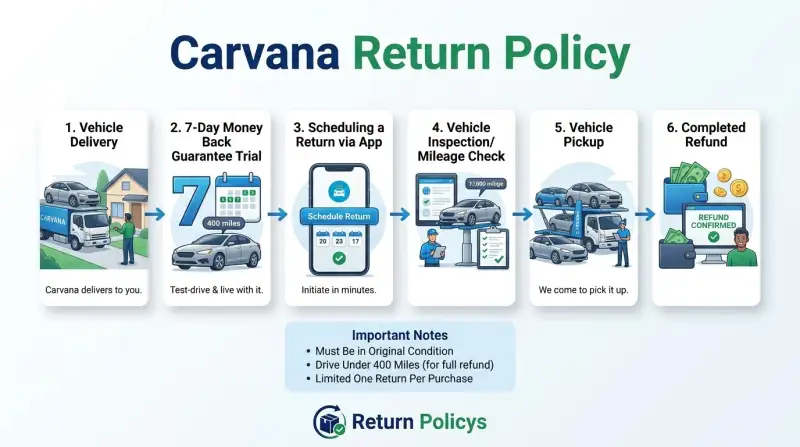
The 7‑Day “No Questions Asked” Window – What It Actually Means
Carvana advertises a seven‑day “no questions asked” return policy. That phrase creates a lot of confidence, but it has specific limits.
The clock starts the moment you take delivery, not when you sign the paperwork. That means if the car arrives on a Monday at 3 p.m., your return window closes the following Monday at 3 p.m. Weekends and holidays count, so don’t assume extra time.
“No questions asked” means you don’t need a reason. You can return the car because you don’t like the color, the seat feels uncomfortable, or the engine noise bothers you. Carvana won’t push back.
However, “no questions asked” doesn’t mean “no inspection.” They will check for damage beyond normal use.
What counts as normal use? According to Carvana’s terms, normal use includes minor wear like light scuffs on the interior door panel or a slightly dusty trunk. Anything outside that, a cracked windshield, ripped upholstery, curb rash on wheels, or an oil leak, can be charged to you.
The inspection is detailed, and many buyers have reported deductions for things they considered minor.
Here’s a breakdown of common deductions reported in aggregate buyer feedback:
| Type of Damage | Typical Deduction |
|---|---|
| Small scratch on paint (touch‑up needed) | $200 – $400 |
| Stained carpet or seat (professional cleaning) | $150 – $300 |
| Missing floor mats or key fob | $100 – $500 |
| Curb rash on one wheel | $75 – $150 per wheel |
| Tire wear below 4/32 inch | $150 – $300 per tire |
| Cracked windshield (replacement) | $400 – $800 |
These numbers come from verified buyer reviews and industry repair estimates. The message is clear: return the car in the condition you got it, or expect a bill.
The Fine Print Nobody Reads: Mileage Caps, Condition Rules, and Fees
The 400‑mile mileage cap is one of the most overlooked parts of the policy. You might think a quick trip to visit family is fine, but if that round trip is 250 miles, you’ll have only 150 miles left for your daily commute and errands. Exceed 400 miles and your return is rejected, you own the car.
The 400‑Mile Limit
Track your mileage from the moment you drive off. Write down the odometer reading. Reset a trip meter if your car has one.
Do not rely on memory; people routinely underestimate how much they drive in a week. If you live in a spread‑out metro area, 400 miles can disappear in two or three days of commuting.
“No Questions Asked” Does Not Mean “No Deductions”
We covered this above, but it bears repeating: the inspection after return is thorough. Carvana photographs every panel, checks the interior, runs a diagnostic scan, and documents any prior damage you didn’t report. If you added aftermarket parts like a phone mount, seat covers, or even a trailer hitch, those must be removed.
If they left scratches or holes, you may be charged.
Non‑Refundable Delivery Fee
The delivery fee is not refundable under any circumstances. That means if you return the car, you’re out $590, $790 just for the test‑drive privilege. Some buyers see this as a rental cost, roughly $85, $110 per day.
For a week‑long test drive, that’s not unreasonable, but it’s a cost many don’t budget for.
Another fee that can catch you: if you had the car shipped to a Carvana vending machine instead of your home, you might still pay a delivery fee. It’s typically the same amount. Always check the total purchase breakdown before you agree.
What Happens When You Finance or Trade In
This is where the policy gets complicated. If you paid cash, the return is relatively straightforward: Carvana refunds your payment (minus the delivery fee) within five to ten business days. But if you financed or traded in a vehicle, the process changes.
Financing Through Carvana vs. a Third‑Party Lender
If you used Carvana’s financing (Bridgecrest), the loan cancellation happens automatically when the return is processed. Carvana handles the paperwork. Your credit report will show the account as closed with a zero balance.
If you used an outside bank or credit union, you’re responsible for canceling the loan. Carvana sends the return documentation to the lender, but the lender must process it. This can take an extra week or more.
Meanwhile, you’re still making payments, and interest continues to accrue. If your payment is due during that period, the lender expects it. Missing it can hurt your credit.
Your Trade‑In Vehicle – Can You Get It Back?
No. Once you trade in a car to Carvana, they take ownership and sell it, often within days. You cannot reverse the trade‑in if you return the purchased vehicle.
Instead, you receive the trade‑in value as a credit toward the purchase. When you return the purchased car, that trade‑in credit is refunded to you (minus any deductions, of course). But you’re now without a second car, and you have to buy another one from scratch.
This is a major financial risk. If you rely on your traded‑in car for daily driving, returning the Carvana purchase leaves you stranded. Plan ahead: make sure you have another vehicle available or can afford a rental while you wait for the refund process to complete.
Refund Timing and Interest Accrual
Carvana says refunds take five to ten business days. However, if you financed through a third party, add another three to seven business days for the lender to update the loan. In total, you could be without the car and without cash for two to three weeks.
If you need that money for a down payment on another vehicle, that delay can be stressful.
The safest move is to not trade in your car until you’re sure you want to keep the Carvana purchase. If you have a second vehicle, hold onto it for the full seven days. If you don’t, consider renting a cheap car for a week instead of relying on the trade‑in timeline.
Step-by-Step: How to Return a Car to Carvana (Without Screwing It Up)
Returning a car to Carvana is a straightforward process if you follow each step carefully. Missing one detail can delay your refund or trigger a deduction. Here is the sequence that works, based on aggregate buyer experiences and Carvana’s own process documentation.
Before You Start: Document Everything
Take photos and video the moment the car arrives. Capture all four sides, the interior, the odometer, and any existing scratches, dings, or stains. This is your evidence if Carvana claims you caused damage.
Without it, you’re relying on their inspection report alone.
Also read the condition report Carvana includes with delivery. Note any pre‑existing issues listed. If you spot something not on the report, photograph it and contact Carvana immediately.
A quick message creates a paper trail.
Initiating the Return Online
Log into your Carvana account. Navigate to “My Purchases” and find the vehicle. Click “Start a Return.” You will see the mileage you’ve driven and the remaining time.
If you’re under 400 miles and within 7 days, the option is live.
Choose a pickup time or a drop‑off location. Carvana offers home pickup or vending machine drop‑off. Pickup is more convenient but may have limited availability.
Drop‑off at a vending machine is usually faster to schedule. Confirm the appointment and save the confirmation number.
The Pickup or Drop‑Off Inspection
A Carvana agent inspects the vehicle at the time of return. They look for new damage, odometer reading, and check that all accessories (keys, floor mats, cargo cover) are present. They take photos and run a quick diagnostic scan.
Be present during the inspection. Point out any pre‑existing damage you documented earlier. Ask the agent to note it in their report.
If they find a new scratch, you can negotiate if you have photo proof it was there before. The agent can edit the report on the spot if the evidence is clear.
What to Expect After You Sign
You sign a return form. The agent takes the car. You receive an email confirmation with a return reference number.
The refund process begins once the car is received at Carvana’s hub and passes a second, more thorough inspection (usually within 2, 3 business days).
Do not expect the refund instantly. It goes back to your original payment method within 5, 10 business days. If you financed through an outside bank, expect a longer wait.
Carvana sends a notice to the lender, but the lender must update its system. That added step can push the total timeline to 14, 20 days.
The Most Common Mistakes That Void Your Return or Cost You Money
Aggregate buyer feedback reveals a handful of predictable errors. Avoid these and you’ll save yourself both time and money.
Driving Over 400 Miles
This is the number one reason returns are rejected. The odometer must show 400 miles or less from the delivery reading. If you hit 401, the return is denied and you own the car.
Reset a trip meter at delivery. Check it every day. If you plan a long weekend trip, reconsider.
Adding Aftermarket Parts or Modifications
Aftermarket parts like seat covers, phone mounts, window tint, or trailer hitches must be removed before return. If they left scratches, adhesive residue, or holes, you’ll be charged for repair. Even a simple magnet‑mounted phone holder can leave a scratch if the magnet was exposed.
Neglecting Minor Damage Before Return
A small stain on the carpet, a light scratch on the bumper, a missing floor mat, these add up fast. Carvana’s inspection catches everything. If you notice any new damage during your test drive, fix it yourself if it’s cheap and easy.
A $30 interior cleaning kit is better than a $150 deduction.
Waiting Too Long to Start the Process
Don’t wait until day six or seven. If you decide you want to return the car on day six, schedule the pickup or drop‑off immediately. If no appointments are available within the window, you could be forced to keep the car.
Start the return by day four or five at the latest. That gives you buffer time for scheduling hiccups.
Real Numbers: What a Return Actually Costs (and How Long It Takes)
Let’s look at the cold numbers. These are based on Carvana’s official terms and aggregate buyer reports.
Typical Deductions for Wear and Tear
We covered the deduction table earlier, but here are the most common charges:
| Item | Typical Cost |
|---|---|
| Single curb‑rash wheel repair | $75 – $150 |
| Interior stain deep‑clean | $150 – $300 |
| Missing key fob replacement | $400 – $500 |
| License plate frame removal (if left behind) | $20 – $50 |
| Tire replacement (below 4/32” tread) | $150 – $300 per tire |
These are deducted from your refund. If the damage exceeds the refund amount, Carvana bills you separately. That’s rare but possible with major issues like a cracked engine block.
Refund Timelines and Bank Delays
Carvana says 5, 10 business days. In practice, most refunds hit bank accounts between day 7 and day 12. Third‑party financing adds 3, 7 more days because the lender must process the cancellation.
If you paid by cashier’s check, expect the longest delay, up to 15 business days.
Where the $590–$790 Delivery Fee Goes
That fee covers transport and processing. It is non‑refundable regardless of return reason. Some buyers argue it’s a rental cost.
At $85, $110 per day, it’s comparable to a mid‑sized rental car. But it’s an unavoidable cost of using Carvana’s service.
Who Should Use the Return Policy – and Who Should Think Twice
The return policy isn’t ideal for everyone. Here’s when it works and when it doesn’t.
Best Use Cases: Remote Buyers, First‑Timers, and Trade‑In Lock‑Ins
If you live far from a dealership or can’t test drive due to location, Carvana’s 7‑day window is a strong option. It gives you time to decide without pressure.
First‑time online car buyers also benefit. You can experience the process without committing permanently. And if you’re trading in a vehicle you don’t need immediately, the return policy gives you a safety net while you compare the new car to your old one.
Risky Scenarios: Road Trippers, DIY Modders, and Urgent Drivers
If you need a car immediately for work or family, the 7‑day wait for a refund can be a problem. You’re left without a car and without cash.
If you plan to add accessories or modify the car during the 7 days, you’re taking a risk. Every modification must be reversed, and any damage from installation is on you.
And if you drive more than 50 miles daily for commuting, you’ll hit the 400‑mile cap quickly. A single weekend trip could push you over. In that case, Carvana’s policy is too tight to be useful.
How Carvana’s Policy Compares to CarMax, Vroom, and Traditional Dealers
Understanding the alternatives puts Carvana’s policy in perspective. Each option has different strengths.
CarMax 30‑Day Return (The Gold Standard)
CarMax offers a 30‑day return policy. You have 30 days or 1,500 miles, whichever comes first. That’s roughly four times the mileage and four times the time Carvana offers.
CarMax also does not charge a delivery fee if you buy from a lot. The trade‑in is handled similarly, once sold, it’s gone, but the longer window reduces risk.
CarMax’s return is clearly better for anyone who wants more time to evaluate a car. The main trade‑off is that CarMax’s inventory is smaller and prices are often higher than Carvana’s.
Vroom’s 7‑Day Return (Similar but Different)
Vroom also offers 7 days and 250 miles. The mileage cap is tighter than Carvana’s (250 vs. 400). Vroom charges a delivery fee as well, typically $300, $600.
Their inspection for damage is similar.
Vroom’s advantage is that they often have a faster refund process, with some buyers reporting 3, 5 business days. But the lower mileage limit makes it less flexible for longer test drives.
Traditional Dealer Test Drives vs. At‑Home Returns
A traditional dealer test drive is often 30 minutes to an hour. That’s enough to feel the car but not to live with it. You can’t park it in your garage overnight, check how it fits your family, or drive it to work.
Carvana’s at‑home return is better for that experience. But a traditional dealer has no mileage cap, no delivery fee, and you can walk away immediately without waiting for a refund. The trade‑off is pressure from sales staff.
In our research, Carvana’s policy strikes a middle ground. It’s more generous than a test drive but less generous than CarMax’s 30‑day return. For most buyers, the deciding factor becomes: how much risk are you comfortable with?
If you need a long at‑home test, Carvana works. If you need maximum time and flexibility, CarMax is the better choice.
State Laws and Legal Gotchas You Need to Know
The FTC’s Cooling‑Off Rule does not apply to car purchases. That federal law covers door‑to‑door sales only. You cannot rely on it for a vehicle bought online.
State laws vary. California has a 2‑day cancellation period for certain used cars bought from dealers, but it has exceptions. Texas and Arizona offer no statutory cooling‑off period.
Check your state attorney general’s website for local rules.
If the title was already transferred before you returned the car, the process gets messy. Carvana must reverse the transfer with the DMV. That can take weeks and may require your signature on additional forms.
When to Walk Away Instead of Relying on the Return Policy
If you live outside a metro area where Carvana has limited pickup slots, the return becomes a logistics nightmare. A 7‑day window with no available appointments means you are stuck with the car.
If the car’s condition report shows major undisclosed damage or if the Carvana listing omitted a known issue, you might be better off buying from a local dealer where you can inspect in person. The return policy is a safety net, not a substitute for due diligence.
Also walk away if you need the vehicle for work immediately. A 2‑week tie‑up of your trade‑in value or down payment can cause real hardship.
Verified Summary: Your 3‑Step Decision Guide Before You Click “Buy”
Step 1: Check your driving habits. If you commute more than 50 miles daily or have a weekend trip planned, the 400‑mile cap is too tight. Choose CarMax or a dealer instead.
Step 2: Document everything at delivery. Photograph every panel, the odometer, and the interior. Save your condition report. This is your only defense against deductions.
Step 3: Plan your return timeline. Start the return by day four. Do not trade in your old car until you are sure you are keeping the new one. If you must trade, have a backup vehicle ready.
Frequently Asked Questions
What happens if I go over 400 miles?
The return is denied. You own the car and must pay the full purchase price. There is no appeal process.
Can I return a car I financed through my own bank?
Yes, but the refund takes longer. Carvana sends cancellation paperwork to your lender. The lender must process it, which can add 3, 7 business days.
Is the delivery fee refunded if I return the car?
No. The delivery fee is non‑refundable in all cases. It ranges from $590 to $790.
What if I find damage after I return the car?
You cannot add it to the return once the inspection is signed. Document everything before signing. If you missed something, contact Carvana support immediately.
Does Carvana charge a restocking fee?
No. There is no restocking fee beyond any damage deductions. The only guaranteed cost is the non‑refundable delivery fee.