
You bought a car from AutoNation. A day or two later, that new-car feeling fades. Maybe you found a better deal.
Maybe the financing terms sting. Or maybe the car just doesn’t fit your life the way you hoped. You heard about the AutoNation Return Policy.
The question is: does it really let you walk away with a full refund?
The answer is yes, but only under a very specific set of conditions. As of 2026, AutoNation offers a 7‑day / 1,000‑mile return window on most new and used vehicles at participating dealerships. But that guarantee comes with strings attached: state laws, mileage limits, condition checks, and a potential restocking fee.
In our research, the policy works best when you know exactly what those strings are before you try to pull the return lever. Let’s walk through how it actually works.
Quick Answer
AutoNation does let you return most vehicles within 7 calendar days and 1,000 miles. You must return the car in good condition. You may owe a restocking fee.
The policy does not apply in all states. Financing refunds can take up to two weeks. Trade‑ins may not be returned to you if they have already been sold.
How the AutoNation Return Policy Actually Works
AutoNation calls it their “7‑Day Return / 1,000‑Mile Return” program. It’s a voluntary corporate policy, not a legal requirement. Here’s what it covers:
| What | Details |
|---|---|
| Time window | 7 calendar days from purchase date |
| Mileage limit | 1,000 miles from odometer reading at delivery |
| Eligible vehicles | Most new and used vehicles, including certified pre‑owned |
| Excluded vehicles | Some luxury models, high‑mileage used cars, and commercial vehicles |
| Condition requirement | No excessive wear, damage, or missing parts |
| Restocking fee | Typically $250–$500 (varies by state and dealer) |
| Financing refund | Prorated and processed within 3–10 business days |
| Trade‑in reversal | Only possible if your trade‑in has not been sold |
The policy is applied consistently across AutoNation’s corporate‑owned dealerships. But franchise dealers operating under the AutoNation brand may have different rules. Always check with the specific store.
Key Variables That Affect Your Return
Three big factors control whether your return goes smoothly: where you live, how much you’ve driven, and the car’s physical condition. Here’s a deeper look at each one.
Your State’s Laws
No federal law gives you a right to return a car. Your state may, or it may not. AutoNation’s return program is offered in about 40 states.
It’s not available in Alaska, Hawaii, and a few others. Even within participating states, local laws can override parts of the policy. For example:
- California has a 2‑day cooling‑off period for used cars under $40,000. AutoNation’s 7‑day policy runs concurrently.
- New York has no general auto return law. AutoNation’s policy applies as offered.
- Florida requires a buyer’s remorse notice on certain used cars. Again, the corporate policy supplements state law.
Check your state’s consumer protection website for any mandatory cooling‑off periods. Your sales contract should also state whether the return policy applies.
Time Since Purchase
The clock starts ticking the moment you drive off the lot. It runs for 7 calendar days, not business days. If you buy on a Friday afternoon, your return window closes the following Thursday at the same time.
Weekends and holidays count.
Do not rely on a verbal extension. Some dealerships may grant an extra day or two for inspection delays, but get it in writing. The corporate policy is strict: returns after day 7 are generally not accepted.
Mileage on the Odometer
You can drive up to 1,000 miles after delivery. The odometer reading at the moment you sign the contract is the baseline. Every mile over 1,000 is a problem.
The dealer may still accept the return, but they will likely deduct a per‑mile fee (typically $0.20 to $0.50 per mile) from your refund. In some cases, they may refuse the return entirely if you exceed 1,200 or 1,500 miles.
Plan your return before you hit 800 miles. That gives you buffer in case the inspection or paperwork takes an extra day.
Vehicle Condition & Damage
The car must be returned in “good condition.” That means:
- No new dents, scratches, or interior stains beyond normal wear.
- All original keys, remotes, floor mats, and accessories must be present.
- No modifications (aftermarket tires, stereo, tint) unless the dealer approves them.
- Tires must have reasonable tread depth (usually 4/32″ or more).
The dealer will perform a walk‑around inspection. If they find damage, they will charge you for repairs. Minor scuffs and light dirt are usually ignored.
Cigarette burns, torn seats, or a cracked windshield? Expect a deduction.
Financing vs. Cash Purchase
The refund process differs depending on how you paid:
- Cash or bank check: Refund is issued as a check from the dealership, typically within 7 business days.
- AutoNation financing: The refund goes back to the lending institution first. Any equity (your down payment plus principal payments) is returned to you after the loan is cancelled. This takes longer, 10 to 14 business days is common.
- Third‑party financing: Your lender must agree to unwind the contract. Most will, but it adds paperwork. Allow up to 15 business days.
Trade‑In Reversal
If you traded in a vehicle, getting it back is not guaranteed. The dealer will try to locate your trade‑in. If it’s still on the lot and unsold, they will return it.
If it has been sent to auction or sold, you will receive the agreed‑upon trade‑in value as a cash refund. That amount is deducted from the purchase price of the returned vehicle.
Important: The trade‑in value you received during the original deal may have included a dealer markup or a “convenience fee.” You will not get that extra amount back. You only receive the wholesale value the dealer actually received for the car. This is a common point of frustration.
Decision Branch 1: Are You Eligible?
Use this checklist before you ask for a return.
Eligibility Checklist
- You are in a participating state (ask the dealer or check AutoNation’s website).
- Your purchase date is within the last 7 calendar days.
- Your odometer shows fewer than 1,000 miles since delivery.
- The car has no new damage beyond normal light wear.
- All original keys, remotes, mats, and accessories are in the car.
- You have the original purchase contract and temporary registration.
- You have not already returned a vehicle under this policy (one return per purchase).
- The car is not a commercial vehicle, luxury model, or high‑mileage unit listed as excluded.
If you meet all eight, you are eligible. If you fail one or two, call the dealership anyway. Some stores have discretion to work with you.
Excluded Vehicles & Situations
Not every car qualifies. Common exclusions include:
- Luxury brands: Certain high‑end models from Mercedes, BMW, Lexus, etc., may be excluded. Check with the sales manager.
- High‑mileage used cars: Vehicles with over 70,000 or 80,000 miles are often not covered.
- Commercial vehicles: Trucks registered for business use, vans, and fleet vehicles are typically excluded.
- Motorcycles, RVs, and boats: Not covered under the standard return policy.
- Vehicles sold “as‑is” with a signed waiver: If you signed an “as‑is” acknowledgment, the return policy may be void.
Decision Branch 2: What Will It Cost You?
Even if you’re eligible, you may owe money. Here’s the typical cost breakdown.
Restocking Fees
Most AutoNation locations charge a restocking fee. The amount varies:
| State | Typical fee |
|---|---|
| California | $250 |
| Florida | $350 |
| Texas | $500 |
| Others | $250–$500 |
Some states cap the fee by law. For example, California limits it to $250 for used cars. The fee is deducted from your refund.
If you paid $30,000 and the fee is $500, you get $29,500 back.
Damage Charges
The dealer will inspect the car. If they find damage they consider excessive, they will charge you the repair cost. Common charges:
- Stone chips on the hood: $75, $150
- Cigarette burn on seat: $200, $400
- Scuffed alloy wheel: $100, $200
- Missing floor mats: $50, $100 per mat
You have the right to get a written estimate before they proceed. Ask for it.
Non‑Refundable Add‑Ons
Some products you bought with the car are not refundable, even if you return the vehicle:
- Extended warranty (already active): Prorated refund possible, but check terms.
- Gap insurance (if already paid out to a third party): No refund.
- Tire and wheel protection: Usually non‑refundable after 30 days.
- Vin etching, theft deterrent devices: Typically non‑refundable.
Ask your salesperson which add‑ons are refundable before you sign the return paperwork. Better yet, ask before you buy.
Step‑by‑Step Return Process: From Start to Refund
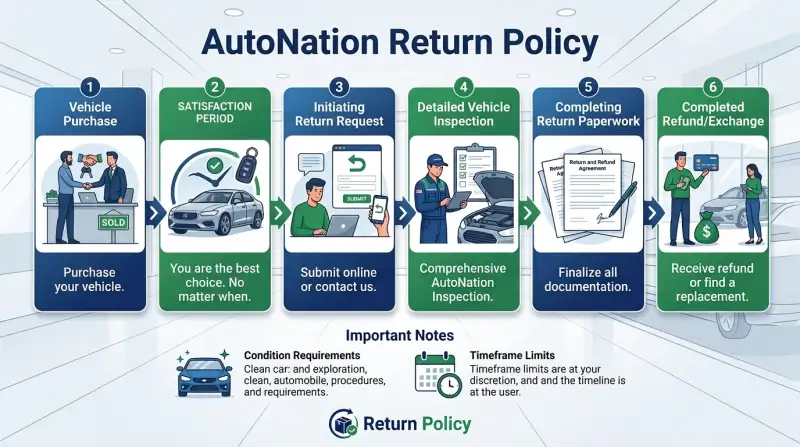
- Call the dealership. Explain you want to return the vehicle. They will schedule an appointment for inspection.
- Drive the car to the dealership within the 7‑day window. Do not exceed 1,000 miles.
- Bring all paperwork: the purchase contract, temporary registration, keys, remotes, floor mats, and any accessories.
- Participate in the walk‑around inspection. The dealer will note any damage. You can take photos on your phone for your records.
- Sign the return paperwork. This includes a cancellation of contract, a mileage verification form, and a damage waiver if applicable.
- Pay any fees. The restocking fee and damage charges are deducted from your refund. You may pay with a credit card if you prefer, but cash is simpler.
- Receive your refund. For cash purchases, expect a check within 3, 7 business days. For financed purchases, allow up to 14 business days.
- Wait for the trade‑in retrieval. If applicable, the dealer will contact you to pick up your old car or send you the cash value.
Mistakes to Avoid When Returning a Car to AutoNation
- Waiting until day 7. Delays happen. Inspections can take hours. If you wait until the last day, you risk missing the window. Return by day 5 or 6.
- Assuming the policy applies everywhere. Not all AutoNation stores are corporate‑owned. Franchised locations may have a different policy. Confirm before you buy.
- Forgetting the mileage limit. A weekend road trip can eat up 400 miles fast. Keep an eye on the odometer.
- Leaving personal items in the car. Remove everything: phone chargers, sunglasses, kids’ toys. The dealer is not responsible for lost items.
- Not getting a damage estimate in writing. If the dealer says “we’ll charge you $500 for a scratch,” ask for a written quote. They may reduce it if you push back.
- Signing a waiver without reading it. Some return forms include a release of liability. Read the fine print.
What If You Miss the Return Window? Your Alternatives
If you are past 7 days or over 1,000 miles, you cannot use the corporate return policy. You have other options:
- Negotiate a trade‑in: Bring the car back to AutoNation and trade it for a different vehicle. The dealer may give you a fair trade‑in value, but you will lose the “new car” premium you paid.
- Sell it privately: You may get close to your purchase price if the car is still current model year and low mileage.
- Return to a third‑party dealer: Some competitors offer longer return windows (up to 30 days), but you will take a loss on the sale.
- Contact AutoNation customer relations: If you have a valid complaint (e.g., undisclosed damage), they may offer a goodwill adjustment. Do not count on this.
Real Scenarios: How the Policy Plays Out
The Smooth Return
Maria bought a 2024 Honda Civic. After three days, she realized the back seat was too small for her two car seats. She returned the car on day 4 with 280 miles.
The inspection found light dirt on the floor mats, which was wiped off. She paid a $250 restocking fee. Her financing refund arrived in 9 business days.
No drama.
The Surprise Fee
James bought a used Ford F‑150. On day 6, he returned it with 860 miles. The dealer noticed a 3‑inch scratch on the tailgate.
James argued it was there when he bought it. He did not have photos. The dealer charged $275 for a touch‑up repair.
James paid the restocking fee ($350) plus the damage charge. He got $625 less than he expected.
The Trade‑In Headache
Linda traded her 2018 Toyota Camry for a 2026 SUV. Two days later, she wanted to return the SUV. The Camry had already been sent to auction.
The dealer offered her the wholesale value of the Camry, which was $3,000 less than the trade‑in allowance she received. Linda lost $3,000 on the trade‑in, plus the restocking fee. She learned a tough lesson: you cannot rely on getting your old car back.
Frequently Asked Questions
Can I return a car to AutoNation after 10 days?
No. The policy only allows returns within 7 calendar days. After day 7, your only option is to trade the car in or sell it elsewhere.
Do I need a reason to return the car?
No. AutoNation does not require you to give a reason. You can return the car for any reason or no reason at all, as long as you meet the time, mileage, and condition requirements.
How long does the refund take?
For cash purchases, 3 to 7 business days. For financed purchases, 7 to 14 business days. The refund goes back to your original payment method if possible.
What if I damaged the car after buying it?
You can still return it, but the dealer will charge you for repair costs. Minor scuffs and light dirt are usually overlooked. Significant damage like broken glass or torn upholstery will reduce your refund.
Does the return policy apply to online purchases?
Yes, but the 7‑day window starts when the vehicle is delivered to your home or when you take possession at the dealership. Check the delivery paperwork for the exact start date.
Can I return a car if I financed through a credit union?
Yes, but it takes longer. Your lender must agree to unwind the loan. They will typically cooperate, but processing can take up to 15 business days.
Final Decision Guide: Should You Return or Keep the Car?
Ask yourself these three questions:
- Am I within the 7‑day / 1,000‑mile limit? If no, stop. You cannot return it under policy.
- Is the car in good condition with no new damage? If no, expect a deduction. Decide whether the deduction is worth the hassle.
- Do I have a better alternative? If you can sell the car privately for close to what you paid, that may be faster and cheaper than a return with fees.
If you answer yes to all three, the return is likely a good move. If you are on the fence, give the car a few more days. The first week is often just buyer’s remorse, not a real problem.
But if the car genuinely does not work for you, the AutoNation return policy is one of the more generous in the industry, just make sure you use it before the clock runs out.
State-by-State Policy Variations
Return policies vary more than most buyers realize. In California, the restocking fee is capped at $250 for used cars. In Texas, fees can reach $500.
Florida requires a specific “buyer’s remorse” disclosure on certain used vehicles.
Check your state’s consumer protection website before you drive to the dealer. If your state has a mandatory cooling‑off period, AutoNation’s policy runs alongside it. You get whichever window gives you more time, but the mileage limit still applies.
How to Dispute a Return Decision
If the dealer denies your return or charges an unexpected fee, ask for the corporate customer relations line. AutoNation’s headquarters can sometimes override a local decision.
Document everything. Take photos of the car before and during inspection. Save copies of the contract, the return paperwork, and any damage estimates.
If you believe the dealer acted unfairly, file a complaint with the Better Business Bureau or your state attorney general’s office.
Tips for a Hassle-Free Return
Clean the car before you bring it back. A deep interior vacuum and a quick exterior wash prevent the dealer from claiming wear that was already there.
Bring all documents, keys, and accessories. Missing a single key fob can trigger a $200 deduction. Remove every personal item, even from the glove box and trunk.
Schedule the return appointment early in the day. Late afternoon returns often face rushed inspections and less patient staff.
Long-Term Implications of Returning a Car
Returning a car does not hurt your credit score directly. The loan is unwound, and the trade‑in reversal is recorded as a simple transaction.
However, if you returned a vehicle after driving it 800 miles, the dealer may note it in their internal system. Future buyers with multiple returns may face stricter verification. One return is normal.
Two or more in a short period can flag you in the dealer’s database.
When It Makes Sense to Keep the Car
Deciding to keep a car you wanted to return is sometimes the smarter move. If the only issue is mild buyer’s remorse and the car runs well, give it two weeks. Many initial doubts fade after the first fill‑up and a few commutes.
If the financial penalty for returning exceeds $1,000 and you can afford the payments, keeping the car avoids a net loss. Compare the restocking fee, damage charges, and trade‑in loss against the cost of selling the car privately. Often, a private sale in the first month recovers nearly the same amount with less hassle.
Step-by-Step Return Process: From Start to Refund
Call the dealership within the first 5 days. Schedule an appointment for an inspection and bring the car, keys, paperwork, and any accessories.
The dealer will inspect the vehicle and note any damage. You sign a cancellation form and pay any restocking or damage fees. Your refund arrives by check (cash buyers) within 7 business days, or by lender refund (financed buyers) within 14 days.
Mistakes to Avoid When Returning a Car to AutoNation
Waiting until day 7 invites delays. Schedule the return by day 5 or 6. Do not assume the policy applies everywhere.
Some franchise locations have different rules.
Forget to remove personal items, and they may be lost. Skip getting a damage estimate in writing, and you may overpay. Read every waiver before signing.
Small print can release the dealer from obligations you thought were covered.
What If You Miss the Return Window? Your Alternatives
If you are past 7 days or over 1,000 miles, the corporate policy no longer applies. You can trade the car in at the same dealership, but you will take a loss on the value difference.
Selling the car privately is often a better option. You can recover closer to what you paid if the car is low mileage and clean. Another alternative is contacting AutoNation customer relations for a goodwill adjustment.
This rarely works for simple buyer’s remorse.
Real Scenarios: How the Policy Plays Out
One buyer returned a 2024 Honda Civic on day 4 with 280 miles. She paid a $250 restocking fee and received her refund in 9 days. No surprises.
Another buyer returned a used Ford F‑150 on day 6 with 860 miles. The dealer charged a $350 restocking fee plus $275 for a scratch he claimed was preexisting. The buyer had no photos.
He lost $625 more than expected. A third buyer traded in her Camry, then tried to return the SUV. Her Camry had already been sold at auction.
She received $3,000 less than her trade‑in allowance.
Frequently Asked Questions
Can I return a car to AutoNation after 10 days?
No. The 7‑day window is firm. After that, only a trade‑in or private sale is possible.
Do I need a reason to return the car?
No. You can return it for any reason as long as you meet the time, mileage, and condition requirements.
How long does the refund take?
For cash purchases, 3 to 7 business days. For financed purchases, 7 to 14 business days. The refund goes to your original payment method.
What if I damaged the car after buying it?
You can still return it, but the dealer will charge for repair costs. Minor scuffs are usually overlooked. Significant damage reduces your refund.