
You walk into Batteries Plus holding a dead car battery or the wrong phone charger. You wonder if you can still get your money back. The Batteries Plus return policy isn’t one-size-fits-all.
The answer depends on what you bought, whether you have the receipt, and how long ago you made the purchase.
The standard return window is 30 days for most items. But there are important exceptions and hidden costs that catch shoppers off guard. As of 2026, the rules split by product type, purchase channel, and condition.
Let’s walk through the exact conditions so you know what to expect before you head to the store.
The Problem: Can You Return a Battery to Batteries Plus?
The short answer is yes. You can return most items. But not all batteries are treated the same.
If you bought a standard alkaline pack and it’s unopened, you’re in good shape. If you bought a lithium-ion power tool battery that’s been used, the rules change. If you’re returning a car battery, there’s a core charge to worry about.
The confusion comes from how Batteries Plus classifies inventory. They sell everything from disposable coin cells to AGM marine batteries to smartphones and tablets. Each category has its own return conditions, time limits, and possible fees.
The store’s policy isn’t hidden, but it’s not posted in big letters at the register either.
Here’s what we cover in this guide: the exact return window for each product type, what happens if you lost the receipt, how in-store and online returns differ, and the fees you might face.
Quick Answer: The Core Policy in One Take
Most items can be returned within 30 days. You need the original receipt or your phone number. Opened batteries are accepted unless they show wear.
Defective items get a full refund or exchange. Online orders can be returned in store. Restocking fees apply to electronics and special orders.
| Battery Type | Return Window | Receipt Required | Restocking Fee | Core Charge |
|---|---|---|---|---|
| Standard alkaline/coin cell | 30 days | Yes | No | No |
| Rechargeable (lithium-ion, NiMH) | 30 days | Yes | No | No |
| Car/boat battery (lead-acid, AGM) | 30 days | Yes | No | Yes |
| Phone/tablet | 30 days | Yes | 20% | No |
| Accessories (chargers, cases) | 30 days | Yes | No | No |
It Depends on What You Bought: Product Type Breakdown
The single biggest factor is the item category. Batteries Plus splits its inventory into five main groups. Each group has its own rules and gotchas.
Standard Batteries (Alkaline, Coin Cell, Flashlight)
These are your everyday AA, AAA, C, D, 9V, and button cells. They’re the easiest to return. If the package is unopened and within 30 days, you get a full refund to your original payment method.
If you opened the package but didn’t use the batteries, most stores accept them as long as they look new. A few stores may test them with a voltmeter. That’s rare.
The key gotcha involves multi-packs. If you bought a 12-pack and used two batteries, you might only get store credit for the remaining ten. The policy doesn’t officially detail partial returns.
Store managers have discretion. Customer reports indicate that returns of opened but unused packs are often accepted.
Rechargeable & Power Tool Batteries (Lithium-Ion, NiMH)
This is where things get trickier. Lithium-ion batteries are classified as hazardous materials. They can’t be shipped back through standard mail.
Online orders of these batteries MUST be returned in store. You can’t just slap a label on the box and hand it to UPS.
If you bought a power tool battery and it’s defective, bring it in within 30 days. The store will test it on the spot. If it works fine but you changed your mind, opened batteries are accepted as long as they show no physical damage.
Scratches or dents might lead to a rejection.
Some lithium-polymer phone charger packs are treated the same way. Always check the label before you try to mail one back.
Car & Marine Batteries (Lead-Acid, AGM, Core Charges)
This category trips up the most people. When you buy a new car battery, you pay a core charge upfront. That’s typically $10 to $30 depending on battery size and your state’s regulations.
That charge is fully refundable when you bring back your old battery. If you don’t bring the old one back, you forfeit that money.
Returning a new car battery that you never installed is straightforward. You get a full refund within the 30-day window. The core charge is also refunded because you didn’t trade in anything.
If you installed it and then decided it’s the wrong size, things get messy. Used car batteries are not accepted for return. The store will test it for defects.
If it’s truly dead or underperforming, they’ll exchange it under warranty. If it’s just the wrong fit, you’re stuck.
Marine and deep-cycle batteries follow the same core-charge logic. Keep the original purchase receipt. You’ll need it to prove you paid the core charge.
Phones, Tablets & Smart Devices
Batteries Plus sells unlocked phones, tablets, and some smart home devices. These are treated like electronics, not batteries. You have 30 days to return them.
There’s a 20% restocking fee if the device is not defective.
The device must be fully wiped of personal data. The original box and all accessories must be included. It must not show signs of physical damage.
If the device is defective, the restocking fee is waived. You’ll still need to prove the defect. The store may test it.
Be prepared to show the receipt or your purchase history via phone number.
One important detail: phones activated on a carrier cannot be returned if the activation was completed. Always ask the associate before you activate. Test the phone on Wi-Fi first if you think there’s a chance you’ll return it.
Accessories (Chargers, Cases, Cables)
Chargers, wall adapters, cables, screen protectors, and cases are among the easiest returns. Unopened items within 30 days get a full refund. Opened items are accepted as long as they’re in resalable condition.
No frayed cables. No broken packaging.
Screen protectors that have been applied cannot be returned. They can’t be reused.
Special-order accessories are different. Items not stocked at the store and ordered just for you are non-returnable unless defective. Ask the associate whether the item is a stock item or a special order before you pay.
Your Receipt Changes Everything: With, Without, or Lost
Your receipt is your golden ticket. With it, you get a full refund to your original payment method within the 30-day window. Without it, you’re looking at store credit at the item’s lowest selling price in the past 90 days.
That could be significantly less than what you paid.
If you lost the physical receipt but used a credit or debit card, the store can often look up the transaction. They use your card number or the phone number you provided at checkout. This works best if you bought the item within the past few months.
Older purchases may not be in the system.
If you paid with cash and lost the receipt, you’re in a tougher spot. The store may still offer store credit. They’ll ask for a valid photo ID and record the return to prevent fraud.
They can also check your loyalty account if you provided a phone number at the time of purchase.
Pro tip: always give your phone number during checkout. It ties the purchase to your account. That makes receipt-less returns much smoother.
Keep the receipt in your glove compartment if it’s a car battery. The core charge refund often requires it.
In-Store vs. Online Returns: What’s Different
Most customers return items in store. That’s where the vast majority of Batteries Plus transactions happen. But what if you bought online and had it shipped to your door?
The process is similar with a few important differences.
If you ordered on the Batteries Plus website for home delivery, you have two options.
Return in store. This is usually the easiest. Bring the item, the packing slip or your order confirmation email, and your ID. The store will process the return like any other purchase.
No shipping costs. No hassle.
Return by mail. You can request a return authorization through the website. They’ll send you a prepaid return label. But remember: hazardous batteries cannot be shipped by consumer mail.
You’ll be directed to return those in store. Non-hazardous items like phone cases and chargers can be mailed back.
If you return by mail, the refund takes longer. Expect 5 to 10 business days after the item arrives at the warehouse. Include all original packaging and accessories.
Missing something could delay the refund.
One more nuance: online orders sometimes qualify for a 60-day return window. That applies if you’re a loyalty program member. Check your account to see if you have extended time.
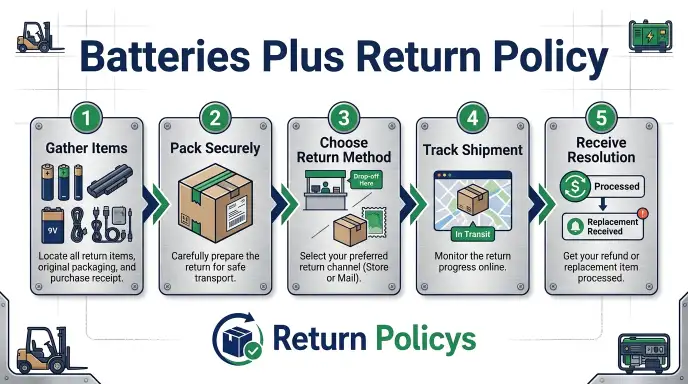
Step-by-Step: How to Return (Process Flow by Channel)
The actual return process is simpler than the policy makes it sound. Here’s exactly what you need to do.
Returning In-Store
Walk in with the item and your receipt. If you don’t have the paper receipt, give the associate your phone number. They’ll look up the purchase in the system.
That works for about 90% of transactions within the first few months.
The associate will inspect the item condition. For batteries, they may check for swelling, corrosion, or physical damage. For electronics, they’ll look for cracked screens, missing accessories, or water damage signs.
If everything passes, they process the refund.
You’ll get the money back to your original payment method. Cash purchases get cash. Credit card purchases go back to the same card.
Debit card purchases can take 3 to 5 business days to show up in your account.
The whole thing takes about 5 to 10 minutes. Faster if the store is quiet. Slower if they need to test a battery.
Returning an Online Order In-Store
Bring the item plus the packing slip or order confirmation email. The store can scan the barcode on the packing slip to pull up your order. If you don’t have the packing slip, they can look it up by your name and email address.
The refund is processed the same way as an in-store purchase. You don’t pay return shipping. You don’t pay a restocking fee for standard items.
Online-only specials follow the same 30-day rule.
One warning: if you used a gift card or store credit for the online purchase, the refund goes back to that same gift card or store credit. You can’t get cash back from those payment methods.
Returning an Online Order By Mail
This is the least common route. Most people prefer in-store returns. But if you live far from a location, here’s how it works.
Go to the Batteries Plus website. Navigate to the returns section. Enter your order number and email address.
They’ll generate a prepaid return label if the item is eligible.
Print the label. Pack the item securely in its original packaging if possible. Include all accessories, manuals, and inserts.
Tape the label to the box. Drop it at a UPS or FedEx location.
The refund processes after the warehouse receives and inspects the item. That typically takes 5 to 10 business days. You’ll get an email confirmation when the refund is issued.
Remember: hazardous batteries cannot be mailed back. The system will block the return label generation for lithium-ion or lead-acid batteries. You’ll be directed to take those to a store.
Returning a Defective Item
Defective returns follow a slightly different path. You still need the receipt or purchase lookup. But the store will test the item to confirm the defect.
For a car battery, they’ll put it on a load tester. If it fails, you get a replacement on the spot. No refund for defective items.
You get an exchange. If they don’t have the exact same battery in stock, they may offer a comparable model or a store credit.
For a phone or tablet, they’ll check for software issues and physical damage. A defective device that shows signs of drops or liquid damage will be rejected. The restocking fee is waived only if the defect is genuine and not caused by you.
The Hidden Costs: Restocking Fees, Core Charges & Timelines
This is where the policy catches most people off guard. You assume you’ll get your full money back. Then the associate mentions a fee.
Let’s break down every hidden cost you might face.
Restocking Fees
Batteries Plus charges a 20% restocking fee on phones, tablets, and smart devices. That’s it. Everything else has no restocking fee.
The 20% applies if the device is not defective. If you buy a $200 phone and decide you don’t want it, you get back $160. If the phone is defective, the fee is waived.
Some special-order items also carry a restocking fee. These are items the store ordered specifically for you. They can’t put them back on the shelf.
Ask the associate before you pay. If they say special order, ask about the return policy for that specific item.
Core Charges Explained
The core charge is not a fee. Think of it as a deposit. When you buy a new car or marine battery, you pay an extra amount on top of the purchase price.
That amount is refundable when you bring back your old battery.
The core charge exists because batteries contain lead and acid. The manufacturer wants the old battery back for recycling. The charge incentivizes you to return it instead of throwing it in the trash.
As of 2026, typical core charges at Batteries Plus range from $10 to $30. The exact amount varies by battery size and state regulations. Some states like California and New York have mandatory core charges set by law.
Here’s the key: if you return the new battery but don’t have the old battery to return, you lose the core charge. If you return the new battery and also bring the old battery, you get the core charge back plus the purchase price.
If you keep the new battery and eventually bring in your old battery, the core charge is refunded at that point. There’s no time limit on core charge returns. You can bring in an old battery a year later and get the deposit back.
Time Limits
The standard return window is 30 days from the date of purchase. That’s printed on the receipt and posted on the website. No exceptions for most items.
If you’re a Batteries Plus Rewards member, you may get an extended 60-day return window on some purchases. Check your account or ask an associate. The extended window typically applies to accessories and standard batteries.
It does not apply to phones or car batteries.
After 30 days, your only option is warranty service. Batteries Plus offers a limited warranty on most batteries. That’s typically 1 to 3 years depending on the brand and type.
The warranty covers defects, not wear and tear. A battery that dies after 13 months is covered. One that slowly loses capacity over time is not.
How Long Does the Refund Take?
In-store returns are instant. The money is back on your card or in your hand the same day. The one exception is debit card refunds.
Those can take 2 to 3 business days to appear in your bank account.
Online returns by mail take longer. The clock starts when the warehouse receives the package. Not when you drop it off.
Count on 5 to 10 business days after delivery. Sometimes faster. Sometimes slower during holiday seasons.
Store credit from a receipt-less return is issued immediately. You can use it right away.
Tax and Fees
Sales tax is fully refunded on returned items. If you paid $10 in tax on a $150 battery, you get the $10 back.
Some states have battery disposal fees added at purchase. These fees are not refundable. They go to the state, not the store.
If you’re in California, Connecticut, or Minnesota, expect a small non-refundable fee on lead-acid batteries.
When you buy a battery, there’s typically your state’s sales tax plus any applicable environmental fee. Only the sales tax gets refunded. The environmental fee is a pass-through to the state.
The environmental fees vary. In California, it’s around $2 per battery. In Connecticut, it’s about $1.50.
In Minnesota, it’s roughly $1. These fees help fund battery recycling programs. You pay them at purchase.
They stay paid even if you return the battery.
Common Mistakes That Get Returns Rejected
You’d be surprised how many people walk out empty-handed. The associate said no. The customer didn’t understand why.
Here are the most common reasons returns get rejected.
No Receipt or Purchase Record
This is the number one reason. Without a receipt, the store can still look up your purchase by phone number or credit card. But if you paid cash and didn’t give your phone number, you have no record.
The store may still offer store credit. But they’re not obligated to. Many locations refuse cash-only returns without any record.
The fix: always give your phone number at checkout. Even if you don’t want emails. It ties the purchase to your profile.
Returning Used Car Batteries
If you installed the battery and decided it’s the wrong size, you’re out of luck. Used car batteries cannot be returned. The store will only exchange them if they’re defective.
Wrong fit is not a defect.
The fix: check the battery group size before you buy. Look at your old battery. The group size is printed on the label.
If you’re not sure, ask the associate to verify the correct size for your vehicle.
Missing Original Packaging
Batteries Plus reserves the right to refuse returns on items without original packaging. This is more common with electronics than batteries. A phone without the box, charging cable, and earbuds will likely be rejected.
The fix: keep the box and accessories until you’re sure you’re keeping the item. For batteries, keep the packaging until you’ve tested the fit.
Physical Damage
Dents, cracks, scratches, corrosion, or swelling are all red flags. Any sign of damage leads to rejection. A swollen lithium-ion battery is a fire risk.
The store won’t take it back. They’ll direct you to a hazardous waste disposal site.
The fix: handle batteries carefully. Don’t drop them. Don’t expose them to extreme heat.
If a battery is swollen, don’t try to return it. Dispose of it properly through a certified facility.
Returning Hazardous Batteries By Mail
You can’t ship lithium-ion or lead-acid batteries through the mail. The system won’t generate a return label. If you try to pack them up and send them anyway, the carrier will reject the package.
The fix: take them to a store. It’s the only option.
Returning Past the 30-Day Window
After 30 days, the system may not allow the return. The associate can’t override it in most cases. You’ll be directed to the manufacturer for warranty claims.
The fix: set a reminder on your phone for day 25 after any significant purchase.
Wiped Devices
If you’re returning a phone or tablet and didn’t factory reset it, the store may refuse the return. They need the device to be wiped to protect your privacy and prepare it for resale.
The fix: back up your data and factory reset the device before you walk in.
Activating a Phone
Once a phone is activated on a carrier plan, it cannot be returned. This is a hard rule. Even if you activate it and decide within an hour, the answer is no.
The fix: don’t activate the phone until you’re sure you want to keep it. Use it on Wi-Fi first to test it out.
Your Rights & Safety: Hazardous Materials, State Laws & Credit Card Protections
You have more rights in a return situation than most people realize. State and federal laws provide protections that go beyond the store’s written policy. Your credit card company may offer backup coverage if the store refuses.
Hazardous Materials Regulations
Lithium-ion batteries are classified as Class 9 hazardous materials under U.S. Department of Transportation regulations. Lead-acid batteries are regulated under different rules.
These laws affect how batteries can be transported, stored, and disposed of.
For returns, this means Batteries Plus cannot accept damaged or leaking batteries in some states. They are required by law to handle hazardous waste through certified channels. If a battery is leaking or swollen, the store will refuse the return.
They’ll direct you to a local hazardous waste facility.
The EPA’s official guidelines on battery disposal state that damaged batteries should not be transported without proper packaging. If you have a swollen battery, contact your local waste management authority for disposal instructions.
State Consumer Protection Laws
Some states give you more rights than the store’s posted policy. Here are key examples.
California. The Song-Beverly Consumer Warranty Act gives you the right to a refund or replacement for defective products within a reasonable time. The store’s 30-day policy is not the final word if a product fails prematurely.
New York. The state’s implied warranty laws cover defects for up to four years on some products. Batteries Plus’ limited warranty may not be the only protection you have.
Texas. The Deceptive Trade Practices Act allows you to sue for damages if a retailer misrepresents the return policy or sells a defective product.
These laws don’t override the store’s policy for non-defective returns. But they provide additional recourse if a product fails or the store misleads you.
Credit Card Purchase Protection
Your credit card issuer may offer return protection as a benefit. This covers items the store won’t take back. Typical coverage includes accidental damage, theft, or store refusal within 90 or 120 days.
Check your card’s benefits guide. Visa Signature, Mastercard World Elite, and American Express cards often include this. Coverage is typically capped at $250 to $500 per claim.
You’ll need to file a claim with the card issuer and provide documentation.
For Batteries Plus returns, this is useful if you’re outside the 30-day window. Or if the store refused the return for a non-defective reason. The card issuer may reimburse you.
The FTC and Return Policies
The Federal Trade Commission requires retailers to honor their posted return policies. If a store tells you one thing and their policy says another, you can file a complaint with the FTC.
Batteries Plus generally follows its posted policy. Most disputes come from customers who didn’t read the fine print. The real value of FTC protection is for situations where the store misapplies its own rules.
Your Right to a Receipt
By law, you have the right to a receipt for any purchase. If you lost yours, the store is not required to accept a return. But many states have laws that require retailers to offer refunds or store credit for defective items regardless of receipt status.
In practice, Batteries Plus uses a common-sense approach. If you can prove the purchase through your phone number or credit card, they’ll process the return. If you can’t prove it, they may offer store credit as a goodwill gesture.
Store managers have discretion on this.
Real Scenarios: What Happens When It Actually Goes Wrong
Theory is useful. But real stories show how the policy works in practice. Here are four common scenarios from customer feedback.
Scenario 1: The Wrong Car Battery
You bought a battery for your 2018 Honda Civic. You checked the group size at the store. But when you got home, it didn’t fit.
The terminals were on the wrong side.
What happens. You can’t return a used car battery. If you installed it and drove with it, the store will reject the return. If you only test-fitted it and didn’t drive, you might get lucky.
Some stores accept returns on batteries that show no signs of use. But the policy says no.
The better approach. Check the fitment before you buy. Ask the associate to verify the battery group size against your vehicle. If you’re replacing a battery yourself, take a photo of the old battery’s label.
Compare the group size before you leave the store.
Scenario 2: The Dead Power Tool Battery
You bought a lithium-ion battery for your drill. You charged it fully. Then it died after five minutes of use.
You think it’s defective.
What happens. Within 30 days, the store will test the battery. If it fails the test, you get an exchange. No refund, but a replacement.
If it passes the test, the store will suggest you try charging it again. Some batteries need a full charge cycle before they work correctly.
The better approach. Charge the battery fully before you assume it’s defective. Lithium-ion batteries sometimes ship with a partial charge. That’s not enough for heavy use.
If it still fails, bring it in before day 30.
Scenario 3: The Phone You Regret Buying
You bought an unlocked phone from Batteries Plus. You opened it, turned it on, and set it up. Then you realized the screen is too small for your needs.
What happens. You can return it within 30 days. But you’ll pay a 20% restocking fee. The phone must be factory reset and in perfect condition with all accessories.
If you dropped it or scratched the screen, the return is rejected.
The better approach. Don’t activate the phone on a carrier. Test it on Wi-Fi first. If you’re not sure about the size, compare it to your current phone before you buy.
The restocking fee is $40 on a $200 phone. That’s a costly lesson.
Scenario 4: The Lost Receipt
You bought a pack of AA batteries three weeks ago. You paid cash and didn’t give your phone number. The batteries are unopened but you don’t need them anymore.
What happens. Without a receipt or purchase record, the store may refuse the return. Some locations will offer store credit at the lowest selling price. Others will turn you away.
It depends on the store manager.
The better approach. Always provide your phone number at checkout. Even for small purchases. It creates a record that lasts for years.
If you lose the receipt, the store can pull up the purchase in seconds. Without that record, you’re gambling on the manager’s goodwill.
FAQs: The Top Questions Customers Ask
Can I return a battery without the original packaging?
Yes, for most standard batteries. If the battery is loose but unused, the store will usually accept it. The associate may test it with a voltmeter first.
For electronics and phones, you need the original box and all accessories. Those returns are almost always rejected without the packaging.
How do I get my core charge refunded without buying a new battery?
Bring your old battery to any Batteries Plus location. You don’t need a receipt. You don’t need to buy anything new.
The store will take the old battery and give you cash for the core charge amount. That amount varies by state and battery type. Typically $10 to $30.
What if the store rejects my return?
First, ask the manager to explain the specific reason. If it’s a policy issue, ask if there’s a workaround. If the item is defective and within warranty, request an exchange instead of a refund.
If you believe the store violated its own policy, contact customer service through the Batteries Plus website. You can also file a complaint with the Better Business Bureau or your state attorney general’s office.
Can I return a gift without a receipt?
Yes, but only for store credit. You’ll get the lowest selling price of that item in the past 90 days. The person who gave you the gift may have provided their phone number at checkout.
If so, the store can look it up and process a full refund back to their card. That requires their permission.
Do I have to return online orders to a store?
No, but it’s faster. You can request a prepaid return label through the website for non-hazardous items. The refund takes 5 to 10 business days after the warehouse receives the package.
For hazardous batteries like lithium-ion or lead-acid, you must return them in store. The system won’t generate a label for those.
What happens if my battery is recalled?
If a battery manufacturer issues a recall, Batteries Plus will follow the manufacturer’s instructions. You typically get a full refund or replacement regardless of the return window. Bring the battery and proof of purchase.
The store may direct you to the manufacturer’s recall website instead of handling it in store.
Final Decision Guide: Should You Return, Exchange, or Walk Away?
You’re standing in the store with a product in hand. The associate is waiting. Here’s how to decide your next move.
You Have the Receipt and It’s Within 30 Days
Return it. No question. You get a full refund to your original payment method.
There’s no reason to accept store credit or an exchange unless you want a different product. If the item is defective, ask for an exchange instead of a refund. You’ll get a working replacement immediately.
You Have the Receipt but It’s Past 30 Days
Walk away from a return. The store won’t process it. Instead, check the warranty.
Most batteries have a 1 to 3 year manufacturer warranty. Contact the battery brand directly. For car batteries, Batteries Plus may offer a pro-rated warranty credit toward a new battery.
Ask the associate about warranty options.
You Don’t Have the Receipt
If you provided your phone number at checkout, ask the associate to look up the purchase. If you used a credit card, they can look it up that way. If neither works, you’re looking at store credit at the lowest selling price.
Decide if that’s worth it. If the item is worth less than $10, it may not be worth the hassle.
The Item Is Defective
Exchange, don’t return. You want a working product, not your money back. The exchange is free within 30 days.
After 30 days, use the manufacturer warranty. Batteries Plus will handle the warranty process for you on most items. They’ll ship the defective unit to the manufacturer and give you a replacement.
You Bought the Wrong Car Battery
If you haven’t installed it, return it for a full refund. Buy the correct group size. If you already installed it, you’re stuck.
Used car batteries cannot be returned. Your only option is to sell it privately or use it in another vehicle. Always verify the group size before you leave the store.
The Core Charge Is Confusing You
Bring your old battery in at the same time you buy the new one. You’ll pay the core charge upfront. But the store will immediately refund it when you hand over the old battery.
That way you don’t have to make a second trip. If you forgot the old battery, bring it back later. There’s no time limit on core charge refunds.
You’re Outside the Return Window and the Item Is Fine
Walk away. You have no leverage. The store won’t bend the policy for non-defective items.
Consider selling the item on a marketplace. You’ll likely get more than store credit anyway.
Quick Decision Table
| Your Situation | Best Action | Time Required | Money Back? |
|---|---|---|---|
| Receipt, within 30 days | Full refund | 5-10 minutes | 100% |
| Receipt, defective | Exchange | 10-15 minutes | Replacement value |
| No receipt, phone on file | Full refund or store credit | 5 minutes | 100% or lowest price |
| No receipt, no record | Store credit only | 5 minutes | Lowest price |
| Past 30 days, defective | Warranty claim | Varies | Replacement |
| Past 30 days, non-defective | Walk away | 0 minutes | $0 |
| Wrong car battery, installed | Sell privately | Days or weeks | Varies |
The bottom line is simple. Keep your receipt. Give your phone number at checkout.
Return within 30 days. That’s the trifecta for a hassle-free experience at Batteries Plus. Miss any one of those three, and you’re at the mercy of store policy and manager discretion.