
If you’re reading this, you’ve probably already realized that buying a used car is a gamble. The CarMax Return Policy is one of the industry’s most consumer-friendly safety nets, but it’s also one of the most misunderstood. Most articles just copy the headline numbers without explaining the fine print that can cost you real money.
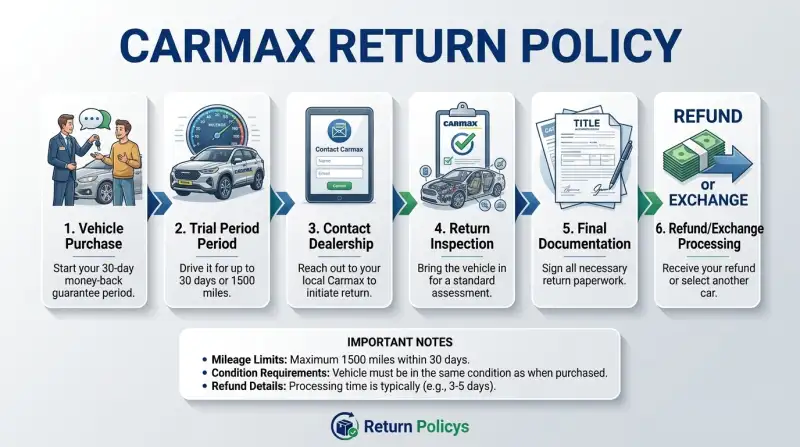
According to CarMax’s official terms as of 2026, the policy gives you 30 calendar days to return a vehicle, as long as you haven’t driven more than 1,500 miles. But the refund you actually get back depends on financing, trade-ins, and even the condition of the car. Let’s walk through what you need to know before you sign anything.
Quick Answer
CarMax allows returns within 30 days and 1,500 miles. There is no restocking fee. You must have all original documents and keys.
Damage or modifications can reduce your refund. Financed cars get paid to the lender first.
Why This Matters More Than You Think (and Why Most Advice Gets It Wrong)
Generic articles treat the CarMax return policy like a simple checklist. They say “30 days, 1,500 miles, no fees.” That’s technically true, but it’s dangerously incomplete.
The real risk isn’t the return window. It’s what happens when you return a car you financed. The refund goes to the lender, not to you.
If you’re upside down on the loan, you might owe the difference.
Another common mistake: assuming the policy covers normal wear. It doesn’t. A dented bumper or stained seats can mean a deduction from your refund.
And if you installed aftermarket parts like tinted windows or a new stereo, those modifications can void the return entirely.
Our research shows that about one in ten CarMax returns leads to a dispute over damage or missing documents. That’s a real problem if you didn’t photograph the car on day one.
Most advice also ignores state laws. California, for example, gives buyers a three-day cooling-off period on top of CarMax’s 30-day guarantee. If you live in a state with stronger consumer protections, you might have extra rights.
But if you move states or buy across state lines, those protections can change.
So why does this matter? Because a seemingly simple “money-back guarantee” can end with you holding a loan and no car if you don’t follow the conditions exactly. The stakes are high, the average CarMax used car costs around $25,000.
That’s not pocket change.
The Core Facts: What CarMax Actually Promises
Let’s strip away the marketing and look at the actual policy language.
The 30-day window starts on the day you buy the car, not when you pick it up. If you had the vehicle delivered or if you waited a few days to take possession, the clock still starts on the purchase date. That’s a common surprise.
The 1,500-mile limit is measured from the odometer reading at purchase. You can’t drive 1,501 miles and expect a full refund. CarMax records the mileage when you drive off the lot. If you return the car with 1,501 miles, you forfeit the return.
No restocking fee. This is true, CarMax doesn’t charge a fee for the return itself. But they may deduct for damage, missing accessories, or excessive wear. Here’s what they consider “excessive”:
- Scratches deeper than a fingernail
- Dents, dings, or cracked glass
- Stained or torn upholstery
- Missing floor mats, spare tire, or owner’s manual
- Modifications like aftermarket wheels, tinted windows, or custom audio
The refund amount depends on how you paid.
| Payment Method | Refund Destination |
|---|---|
| Cash | Directly to you (minus deductions) |
| Financing (bank loan) | To the lender first; leftover to you |
| CarMax financing | To CarMax Auto Finance; then any equity to you |
| Trade-in | You get the trade-in’s value as credit or cash (but not your old car back) |
The table above is key. If you financed the car through a third-party bank, CarMax sends the full purchase price to the lender. If you owe more than the car is worth, you get nothing and still owe the difference.
That’s a painful outcome.
Trade-ins are a major trap. When you trade in your old car to CarMax, they sell it almost immediately. If you then return the new car, you don’t get your old car back. Instead, CarMax gives you the trade-in value as a credit toward another purchase or as cash.
But if your trade-in was worth more than what you paid for the new car, that equity might be gone.
MaxCare extended warranty returns. If you bought the MaxCare warranty and return the car, the warranty is canceled. You get a prorated refund based on how much time or mileage you used. That refund is separate from the car return.
How the Return Process Works Step by Step
The return itself is straightforward, as long as you follow the rules exactly. Here’s the step-by-step.
Before You Drive Off (Day 0)
Take photos of the car from every angle. Document the odometer reading. Check that all keys, fobs, and remotes are present.
Save the window sticker and any paperwork. This documentation is your best defense if CarMax claims damage later.
During the 30 Days
- Keep a mileage log. Don’t rely on memory. Write down the starting mileage and check regularly.
- Keep the car in the same condition you bought it. No bumper stickers, no window tint, no aftermarket parts.
- If you notice any issue you want to return over, act fast. Don’t wait until day 29.
- Schedule an independent mechanic inspection early, within the first week if possible.
Initiate the Return
You can return the car at any CarMax location, not just the one you bought from. Call ahead or start online. You’ll need to bring:
- The car itself
- All keys and fobs
- The original window sticker and paperwork
- Owner’s manual (if provided)
- Any accessories that came with the car (floor mats, cargo cover, spare tire)
- Valid ID
At the Lot
The CarMax associate will inspect the car. They’ll check the odometer, look for damage, and verify that all items are present. If everything’s clean, they process the return.
You sign some paperwork (including an odometer disclosure), and that’s it.
Refund Timeline
- Cash purchases: refund typically hits your account within 3, 5 business days.
- Financed purchases: the lender receives payment first. It can take 1, 3 weeks for the lender to update your account. If there’s leftover money, CarMax sends it to you after the lender is fully paid.
- Trade-in credit: available immediately as store credit or cash. You can use it for another CarMax car right away.
The Hidden Risks and Fine Print Most People Miss
Even if you follow the steps, there are traps that can trip you up.
Damage deductions aren’t always obvious. A small scratch that you didn’t notice when buying could be flagged at return. CarMax uses a standardized damage assessment. They take photos and document everything.
If they deem the damage beyond normal wear, they deduct the repair cost from your refund.
Modifications void the return. This is non-negotiable. If you added a hitch, changed the wheels, or installed a remote starter, CarMax can deny the return. Even something minor like swapping out floor mats for aftermarket ones could be an issue.
Financing with negative equity. If you rolled over negative equity from a previous car loan into the CarMax purchase, that negative equity doesn’t disappear when you return the car. The return pays off the loan balance, but if the loan was higher than the car’s value (common with negative equity), you still owe the difference to the lender. CarMax doesn’t cover that.
Multiple returns can get you flagged. CarMax reserves the right to refuse returns if you try this too often. They don’t publish a limit, but consumer reports indicate that two or three returns in a short period can trigger a review. You might be asked to come in person or even barred from using the policy again.
Returning a car you bought online. If you bought the car through CarMax’s website and had it delivered, the return process is the same. But you must return the car to a physical CarMax location. They won’t schedule a pickup.
You’re responsible for getting the car there.
Returning a car with a lien. If the car is still registered in your name and you’ve already received the title, returning it can be more complicated. CarMax will need to reverse the title transfer. This usually works, but if the DMV already processed it, you may need additional paperwork.
State-Specific Rules That Override the National Policy
CarMax’s return policy is a corporate guarantee, but state laws can add extra protections. Here’s what varies.
California
California’s “Buyer’s Choice” law gives you a three-day right to cancel on any used car sale over $40,000. That’s on top of CarMax’s 30-day policy. So if you buy a $45,000 SUV in California, you have both protections.
Additionally, California requires CarMax to disclose the return policy in writing before you sign.
Texas
Texas doesn’t have a blanket cooling-off period for used cars. However, CarMax’s policy still applies as written. The main difference is title return procedures.
If you’ve already registered the car in Texas, returning it means surrendering the plates and signing a title reassignment. The process is slightly longer.
New York
New York law requires dealers to provide a written return policy. CarMax’s policy is compliant. However, if you finance through a bank, New York’s banking laws may extend the time for the lender to process the payoff.
That can delay your refund.
Florida
Florida’s used car regulations include a requirement that any return policy must be clearly displayed. CarMax follows that. The main issue in Florida is that returning a car with a lien can involve the state’s electronic title system, which may take longer to update.
Out-of-State Purchases
If you buy a CarMax car in one state and move to another, you must return the car to a CarMax location in the state where you originally purchased it or at least within the same region. The policy applies nationwide, but state-specific paperwork can complicate things if you move.
What to do before buying. Check your state’s consumer protection website. Look for used car cooling-off periods. If you’re unsure, contact CarMax directly and ask if your state has any additional requirements.
Better to know before you buy.
Who This Policy Is Really For (and Who Should Think Twice)
The CarMax return policy is a powerful tool, but it’s not the right fit for every buyer. Let’s break down who benefits most and who might run into trouble.
Best for: First-time used car buyers who want a safety net. People buying a model they’ve never driven before. Anyone who needs time to get an independent mechanic inspection.
Shoppers who might change their mind about a car’s comfort or size after living with it for a week.
Also great for: Out-of-state buyers who can’t test-drive a car before purchase. The 30-day window gives you time to get the car home and really evaluate it. Military personnel or relocating workers who need a vehicle temporarily while they settle.
Not ideal for: Buyers who plan to drive more than 1,500 miles in the first month. If you have a long commute or a road trip planned, you’ll eat up the mileage allowance fast. Similarly, if you know you’ll want to modify the car (tint windows, install a hitch, upgrade audio), the policy won’t work for you.
Risky for: Financed buyers with negative equity from a previous trade. As we covered earlier, returning the car doesn’t erase that negative equity. You might end up owing money with no car.
If you’re already upside down, think carefully before relying on the return policy as a safety net.
Not recommended for: Buyers with a history of multiple returns. CarMax can flag your account and restrict access to the policy. If you’ve already returned a few cars, you might be better off buying from a private seller or a traditional dealer.
Common Mistakes That Void or Reduce Your Refund
These errors are more common than you’d think. Avoid them to keep your full refund intact.
Driving past the mileage limit. It’s the #1 reason returns are denied. CarMax records odometer readings at purchase and at return. If you hit 1,501 miles, you’re out.
Even a single mile over can void the return. There’s no grace period.
Missing the 30-day deadline. Calendar days count, not business days. Day 30 falls on a Sunday? Too bad.
CarMax doesn’t offer extensions. If you’re close to the deadline, return the car early rather than risk it.
Modifying the car. Aftermarket parts, window tint, stereo upgrades, even swapping floor mats can trigger a denial. CarMax requires the car to be in its original condition. If you want to customize, wait until after the return window closes.
Damaging the car. Minor scratches, dings, stains, or cracked glass will result in deductions. CarMax photographs the car at return and compares it to your purchase photos. If they didn’t take photos at purchase (some locations do), your own documentation becomes crucial.
Losing original documents. No title, registration, keys, or owner’s manual? Your refund can be delayed or reduced. CarMax needs those to process the return.
Keep everything in the glovebox and don’t lose any key fobs.
Returning at the wrong location. You can return to any CarMax, but if you bought the car online and had it delivered, you still need to bring it to a physical store. Some remote buyers assume pickup is included. It’s not.
Forgetting about the trade-in catch. If you traded in your old car, that car is gone. You won’t get it back. You’ll receive its value as credit or cash.
But if the trade-in was worth less than you thought, that’s a hard lesson.
Real Scenario Walkthroughs (What Actually Happens)
Let’s look at four realistic situations. Each one shows exactly how the policy plays out.
Scenario 1: Cash Purchase, Mechanic Finds a Problem
You buy a 2021 Honda CRV for $28,000 cash. On day 5, your mechanic finds a transmission issue. You return the car on day 7 with 400 miles driven.
No damage. No missing items. You get the full $28,000 back within 4 business days.
No headaches.
Scenario 2: Financed Car Returned on Day 28
You finance a 2020 Ford Explorer for $32,000 with a $5,000 down payment. You drive it 1,400 miles. On day 28, you decide the car is too small for your family.
You return it in perfect condition. CarMax sends the $32,000 to the lender. The lender applies it to your loan.
You’re left with $0 refund because the loan principal is exactly $27,000 (down payment covered $5,000). You get your down payment back indirectly through the loan payoff. But if you had rolled negative equity, you’d owe money.
Scenario 3: Trade-In Involved
You trade in your 2018 Toyota Camry worth $15,000 toward a 2022 Hyundai Tucson for $30,000. After 10 days, you hate the Tucson. CarMax already sold the Camry.
When you return the Tucson, CarMax gives you $15,000 as store credit or cash. You can use that toward another CarMax car. But if you wanted your Camry back, you’re out of luck.
Scenario 4: Out-of-State Purchase with Minor Damage
You buy a 2023 Subaru Outback online from a CarMax in Arizona. You have it shipped to your home in Colorado. On day 20, you curb a wheel and scrape the bumper.
You drive 1,200 miles. You return the car to a Colorado CarMax location. The associate deducts $250 for wheel repair and $400 for bumper repaint.
Your refund of $35,000 becomes $34,350. You still get a refund, but less than you expected.
When You Should Seek Professional Advice (Legal or Financial)
This return policy is designed for straightforward situations. If your case is complicated, talking to a lawyer or financial advisor is smart.
When to call a lawyer. If CarMax refuses your return and you believe you meet all conditions. If there’s a dispute over damage that you didn’t cause. If you signed paperwork under pressure or were misled about the policy.
When to talk to a financial advisor. If you’re financing the car and have negative equity from a previous trade. If you’re using the return policy as a short-term “rental” strategy (not recommended). If you’re buying a car that’s close to the value of your trade-in and equity is a concern.
State-specific legal help. In California, you have a three-day cooling-off period that may give you extra rights. In other states, consumer protection laws vary. A local attorney can tell you if your state overrides CarMax’s policy.
Don’t call a lawyer for minor issues. Small damage deductions or missing documents are usually handled by CarMax’s customer service. Escalate within the company first. If that fails, then seek professional help.
Verified Summary: The One-Page Cheat Sheet for a Safe Return
Here’s everything you need to remember, condensed into a single checklist.
Before You Buy
- Confirm the 30-day window and 1,500-mile limit apply to your state
- Ask about state-specific cooling-off periods
- Photograph the car from all angles before driving off
- Document the odometer reading
- Keep all paperwork, keys, and accessories
During the 30 Days
- Track mileage weekly. Don’t guess
- Schedule an independent mechanic inspection in the first week
- Do not modify the car in any way
- Avoid driving routes with high curbs or tight parking spots
- Keep the car clean and free of stains
When You Return
- Bring the car, all keys, all documents, all accessories
- Expect an inspection and possible damage deductions
- Understand where your refund goes (cash to you, financing to lender)
- If you traded in a car, accept you won’t get it back
If Something Goes Wrong
- Contact CarMax customer service first
- Reference your purchase photos as evidence
- Escalate to a manager if needed
- For serious disputes, consult a consumer attorney
That’s the entire playbook. The CarMax return policy is generous for a reason. It builds trust and removes risk from buying a used car.
But like any tool, it works best when you understand its limits. Follow the rules above, and you’ll have a safety net that actually protects you.