
Returning tires isn’t like sending back a pair of shoes. Tire Rack Return Policy has a few important forks in the road that determine whether you get a full refund, pay a restocking fee, or end up stuck with a set you don’t want. The key difference comes down to one thing: have the tires touched the road yet?
As of 2026, the policy splits into clear paths depending on mounting and mileage, and knowing where you stand before you start saves time and money.
In our research, we found that most return issues happen because people assume an unused tire is the same as an unmounted tire. Tire Rack treats them differently. For example, a tire that has been mounted but never driven is still eligible for return, but it falls into a different category than one still in the box.
The 45-day window applies to both, but the restocking fee structure changes. That’s where the decision tree starts to branch.
Quick Answer
Tire Rack accepts returns within 45 days. Unmounted tires get a full refund. Mounted tires may face a restocking fee.
Used tires are only returnable if defective. Always get an RMA number first.
The First Fork: Unmounted vs. Mounted Tires
The single biggest factor in your return is whether the tire has been mounted on a wheel. It doesn’t matter if it’s still shiny and clean. The moment a tire gets stretched onto a rim, it enters a different return category.
Unmounted – The Clean Return
If your tires are still in their original packaging, never touched by a mounting machine, you’re in the best position. Here’s what that looks like:
- Full refund of the purchase price
- No restocking fee
- Free return shipping (Tire Rack provides a prepaid label)
- You just need the original boxes and the RMA number
This is the easiest return you’ll ever do. As long as you’re within the 45-day window and the tires aren’t damaged, you’re basically guaranteed a hassle-free refund.
Mounted – Where It Gets Tricky
Once a tire has been mounted, the rules shift. Even if you never drove on it. Even if it sat in your garage.
The mounting process itself can stretch the bead and introduce tiny marks. Tire Rack considers these tires “used” for policy purposes, even if the tread is pristine.
Here’s the difference:
| Condition | Restocking Fee | Return Shipping | Window |
|---|---|---|---|
| Unmounted | 0% | Free | 45 days |
| Mounted, zero miles | 10% – 15% | Free | 30 days |
| Mounted, driven | Not eligible (unless defective) | N/A | N/A |
If your tires are mounted but never driven, you still have options. Expect a restocking fee, typically 10 to 15 percent of the tire price. You’ll also need to return them within 30 days, not 45.
The shipping label is still free, but the fee cuts into your refund.
Why the Difference Matters
Tire Rack can’t resell a mounted tire as new. Even if it looks perfect, the rubber has been seated on a rim. That changes the fit and risks subtle damage.
The restocking fee covers the cost of inspection, potential remanufacturing, or disposal if needed. It’s not arbitrary, it’s standard across most online tire retailers.
The Second Fork: Has It Been Driven On?
This is the point where most returns die. If your tires have touched asphalt, even for a mile, the policy changes dramatically.
Zero Miles – Still Eligible
You already know this from the mounted category above. Zero miles means zero road contact. Even if the tire is on a rim, as long as it hasn’t rolled under load, you can still start a return.
You’ll lose the restocking fee, but you won’t be out the whole cost.
Even 5 Miles – Now It’s “Used”
Once a tire has been driven, Tire Rack considers it used. Used tires are not returnable for buyer’s remorse, wrong size, or changed mind. The only exception is a manufacturing defect.
If you have a defective tire that’s been driven, you need to file a warranty claim, not a return.
Here’s the logic: road use introduces invisible wear. Micro-cracking, heat cycling, and tread wear start the moment the tire rolls. Tire Rack cannot resell a used tire as new, and they don’t have a used tire outlet like some local shops.
So the policy is simple: driven = final sale.
How to Prove It
If you’re claiming zero miles, Tire Rack may ask for proof. Take photos of the tread depth (should be full, original depth). Take photos of the sidewall and bead area.
If the tire still has the factory stickers on the tread, that’s gold. Those stickers tear off after a few revolutions.
The Third Fork: Why Are You Returning It?
The reason you’re returning matters almost as much as the tire’s condition. Different reasons lead to different outcomes.
Defect or Wrong Item
This is the best-case scenario for a return. If the tire has a manufacturing defect, separation, bulge, sidewall bubble, or if Tire Rack shipped the wrong size or model, you’re covered fully. No restocking fee.
Free return shipping. Full refund. You just need to contact customer service within the warranty period (usually 30 days for defects, but tire warranties vary by manufacturer).
Tire Rack’s own terms state that defects are handled at their discretion. In our research, customers who provided clear photos of the defect (bulge, crack, uneven tread) got rapid approvals. The key is to report it immediately, don’t drive on a defective tire longer than necessary.
Buyer’s Remorse / Changed Mind
This is your fault, and the policy reflects that. If you simply decided you don’t want the tire, you’re limited to the unmounted or mounted-but-unused categories. As soon as the tire is driven, you’re out of luck.
Expect the restocking fee if mounted.
Road Hazard Damage (Not a Return)
Pothole damage. Nail punctures. Sidewall cuts.
These are road hazard issues, not manufacturing defects. Tire Rack does not cover road hazard under their return policy. You need a separate road hazard warranty (often sold at checkout) or your tire manufacturer’s warranty.
If you don’t have either, you’re buying a new tire.
This is a common pain point. People hit a pothole and expect a refund. But Tire Rack explicitly excludes road hazard from returns.
The only way to get compensation is through a road hazard warranty or a credit card purchase protection benefit.
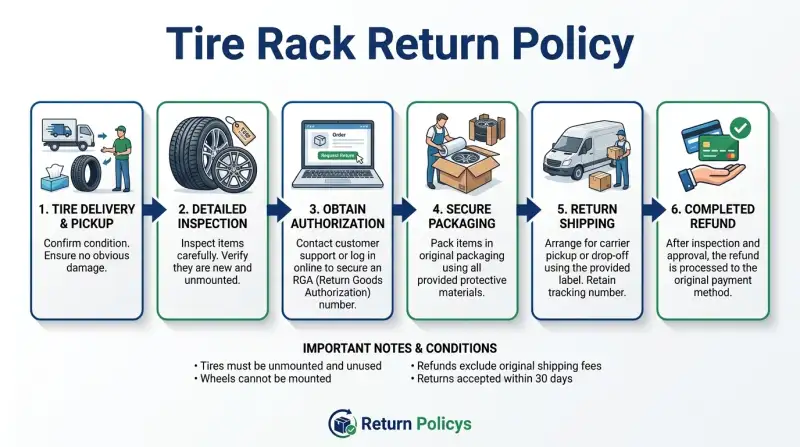
Step-by-Step: How to Actually Return a Tire
Now that you know which fork you’re on, let’s walk through the actual process. It’s straightforward if you follow the steps in order.
Getting Your RMA Number
- Log into your Tire Rack account.
- Go to “Order History” and find the order.
- Click “Return Item” or “Request Return.”
- Select the reason from the dropdown.
- Choose the condition (unmounted, mounted not driven, defective).
- Submit the request.
Within one business day, you’ll receive an email with your RMA number and a prepaid return label. Don’t ship anything without an RMA. Tire Rack will refuse the package if they don’t see an RMA on the box.
Packing and Shipping
Tire Rack requires the tires to be in their original boxes or similar sturdy packaging. Loose tires bouncing in a freight truck get damaged, and that damage voids your return. If you don’t have the boxes, use heavy-duty cardboard and tape to protect the sidewalls and bead area.
Place the RMA number on the outside of each box. Include a copy of the packing slip or the RMA confirmation inside. Use the prepaid label.
Schedule a pickup with the carrier (usually FedEx or UPS) or drop it off at a location.
What Happens After Tire Rack Receives It
Tire Rack inspects every returned tire. They check for:
- Tread depth
- Sidewall damage
- Bead deformation
- Signs of mounting
- Road wear or foreign objects
If the tire matches the condition you declared, the refund is processed in 5 to 7 business days. If they find damage you didn’t disclose (e.g., you said unmounted but they see mounting marks), they may deny the return and send the tires back, or charge a higher restocking fee.
Pro Tip: Document Everything
Take photos of the tires before you ship. Show the tread depth with a gauge. Show the sidewall.
Show the bead area if possible. If there’s any dispute later, you have evidence. This is especially important for defect claims.
What It Costs: Restocking Fees, Shipping, and Timelines
Let’s talk money. The costs tied to a Tire Rack return depend entirely on which fork you’re on.
Unmounted tires returned within 45 days cost you nothing. Full refund. Free shipping. No restocking fee.
That’s the cleanest outcome.
Mounted but undriven tires hit your wallet with a restocking fee. Expect 10 to 15 percent of the tire price. On a set of four tires at $150 each, that’s $60 to $90 lost. The shipping label is still free, but the fee stings.
Driven tires are non-returnable unless defective. If you have a defect, shipping is free and no fee applies. If you don’t, you’re keeping the tires.
What about special orders? If Tire Rack ordered a tire specifically for you (rare sizes, non-stock items), the restocking fee can jump to 20 percent or more. Check your order confirmation, it will say “special order” if applicable.
Timeline for refunds: After Tire Rack receives and inspects your return, refunds process in 5 to 7 business days. Credit card refunds may take an additional billing cycle to appear. Debit card refunds are faster, usually within 3 to 5 business days after processing.
Shipping costs if you’re outside the free window: If you missed the 45-day mark but Tire Rack approves a late return (rare but possible), you pay return shipping. Expect $20 to $50 per tire depending on weight and distance.
Mistakes That Kill Your Return (And How to Avoid Them)
We see the same errors over and over in buyer feedback and forum threads. Avoid these and you’ll keep your return alive.
Skipping the RMA number. No RMA on the box means the warehouse rejects the shipment. You pay for shipping both ways.
Returning mounted tires without disclosing they were mounted. Tire Rack inspects every return. If they find mounting marks and you claimed unmounted, they deny the return entirely.
Waiting past the window. The 45-day clock starts from the delivery date, not the order date. Mark your calendar. Day 46 is a dead end for most returns.
Not keeping original packaging. Tires shipped loose get damaged. Damaged tires during transit are your problem, not Tire Rack’s. They can refuse the return if the tire arrives scratched or bent.
Confusing a defect with road hazard. A nail hole is road hazard. A sidewall bubble is a defect. Mix them up and you’ll get denied.
Inspect the tire carefully before filing.
Forgetting to check the tire manufacturer’s warranty. Sometimes the manufacturer offers a separate warranty that covers different issues. Tire Rack’s return policy and the manufacturer’s warranty are separate systems.
Real-World Scenarios: What Worked and What Didn’t
Let’s look at three common situations based on aggregate buyer experiences.
Scenario 1: Unmounted, returned within 30 days. A buyer ordered the wrong size summer tires. Realized the mistake before mounting. Requested an RMA online, received a label, shipped the tires back in the original boxes.
Full refund in 8 days. No fees. No hassle.
Scenario 2: Mounted, zero miles, returned at day 35. The tires were mounted by a shop but the car never left the garage (wrong offset). The buyer called customer service, explained, and got approval with a 12 percent restocking fee. Free shipping.
Refund minus $72 on a $600 set. Total turnaround: 12 days.
Scenario 3: Driven 10 miles, returned for “don’t like the ride.” Denied. The buyer didn’t realize driven tires are final. No exception was made.
The buyer ended up selling the tires locally at a loss.
What worked in the successful cases: Honesty about condition. Quick action within the window. Proper packing.
Clear communication with customer service.
What killed the third case: Driving on the tires. The policy is clear. Driven tires are only eligible for defect claims.
Expert Tips: How to Get an Exception When You’re Past the Window
Exceptions are rare, but they exist. Here’s what we’ve found from our research.
Call, don’t email. Phone representatives have more authority to approve exceptions. Explain your situation clearly. Be polite.
Be specific about why you missed the window. “I was out of town for three weeks and couldn’t inspect the tires until today” works better than “I forgot.”
If the tire hasn’t been mounted, mention that. Unmounted tires are the strongest case for an exception. Tire Rack can still sell them as new.
Offer to pay the restocking fee plus return shipping. Even if you’re past the window, offering to cover costs can persuade a supervisor.
If you have a road hazard claim but no warranty, ask about goodwill. Tire Rack sometimes offers a partial credit on a replacement tire for loyal customers. No guarantees, but it’s worth asking.
Document everything. If you get a verbal approval, ask for an email confirmation before shipping. Verbal promises can be lost in the system.
Frequently Asked Questions
Can I return mounted tires that have never been driven?
Yes, within 30 days of delivery. You’ll pay a 10 to 15 percent restocking fee. Shipping is free.
How long does it take to get a refund from Tire Rack?
After they receive and inspect your return, refunds process in 5 to 7 business days. Credit cards may take one extra billing cycle.
Does Tire Rack charge a restocking fee on all returns?
No. Unmounted tires returned within 45 days have no fee. Mounted tires and special orders may have fees.
Can I return tires that have been driven on?
Only if they have a manufacturing defect. Buyer’s remorse returns are not accepted for driven tires.
What if I lost the original boxes?
You need sturdy packaging that protects the tire during shipping. Tire Rack recommends heavy-duty cardboard and tape. Write the RMA number on the box.
How do I know if my tire is defective or just damaged from road hazard?
A defect is a manufacturing issue: sidewall bulge, tread separation, or abnormal wear patterns. Road hazard is external: nails, cuts, pothole damage. If you’re unsure, take clear photos and call Tire Rack customer service.
Decision Guide: Should You Return It or Keep It?
Here’s a quick checklist to decide your next move.
| Your Situation | Recommended Action |
|---|---|
| Unmounted, within 45 days, changed mind | Return. Full refund, no fee. |
| Mounted, zero miles, within 30 days, changed mind | Return. Expect restocking fee, but better than keeping wrong tires. |
| Mounted, zero miles, past 30 days | Call and explain. Exception possible if unmounted? (No, but worth asking.) |
| Driven under 10 miles, defect suspected | File defect claim with Tire Rack. Photos required. |
| Driven over 10 miles, defect suspected | Contact tire manufacturer for warranty. Tire Rack may refuse return. |
| Driven, road hazard damage, no warranty | Keep the tire. Buy a replacement. Consider road hazard warranty next time. |
| Past 45 days, unmounted | Call. Offer to pay restocking fee. Low odds but possible. |
Bottom line: If your tires are unmounted and within the window, return without hesitation. If they’re mounted but unused, weigh the restocking fee against the cost of keeping the wrong tires. If they’ve been driven, your only hope is a defect.
Policy is policy. But Tire Rack customer service has a reputation for reasonable exceptions when you’re honest and concise. Make your case clearly, provide evidence, and you might get a break.
Warranty vs. Return Policy: Know the Difference
A return refunds your money. A warranty covers defects after the sale. Tire Rack handles returns, while tire manufacturers handle most warranty claims.
If your tire has a manufacturing defect, you can file a claim with either Tire Rack or the brand itself. Tire Rack often acts as the intermediary, but some manufacturers require direct contact.
Warranty claims follow a different timeline. They can take weeks, especially if the manufacturer needs to inspect the tire. Returns are faster, usually resolved within 10 days.
Returning Wheels vs. Tires
Wheels have their own return rules. They are not covered by the same policy as tires. Wheels must be unmounted, unblemished, and in original packaging within 30 days.
A 15 percent restocking fee applies to most wheel returns. Scratches or mounting marks void the return entirely. Lug nuts and TPMS sensors are final sale.
If you bought a wheel and tire package, each component follows its own policy. You can return the unmounted tires separately, but the wheels stay bound by their 30-day window.
International and Military Address Returns
Returns from APO, FPO, and international addresses have different rules. Tire Rack generally does not pay return shipping from these locations.
For APO addresses, you must coordinate with the shipping carrier directly. Tire Rack provides the RMA but not the prepaid label. Expect higher shipping costs and longer timelines.
Canadian customers use Tire Rack Canada’s separate policy. The return window is 30 days, and restocking fees may be higher due to cross-border logistics.
How to Appeal a Denied Return
If Tire Rack denies your return, you have options. Start by calling customer service and asking for a supervisor. Be polite and explain your situation clearly.
Provide photo evidence. If the denial was based on condition, show that the tire was indeed unmounted or undamaged. Sometimes a supervisor will override the initial decision.
If that fails, check your credit card’s purchase protection. Some cards cover returns or damage within 90 days. A chargeback is a last resort only if the policy was clearly violated.
The Bottom Line on Tire Rack Returns
The policy is straightforward but unforgiving on details. Unmounted tires within 45 days are easy. Mounted tires cost you a fee.
Driven tires are final.
Know which fork you’re on before you start. Get your RMA number. Pack carefully.
Document everything. That’s the formula for a smooth return.