
Bellami Return Policy can feel confusing when you need to return extensions, a wig, or a styling tool. In our research, common questions are about time windows, hygiene rules, and whether a purchase from a marketplace is eligible for a refund.
Manufacturer specifications indicate many hair accessory returns are only accepted if unopened, and warranty claims vary by tool type, as of 2026. Read on for clear, step by step guidance so you know exactly what to do next.
Quick Answer
Bellami Return Policy varies by purchase source and item condition.
Direct purchases, often, must be returned within a set return window.
Opened or used hair items are commonly non returnable for hygiene.
Defective tools may go through warranty claims instead of refunds.
Bellami Return Policy 2026
What causes the most return headaches with Bellami products
The biggest frustration is not knowing who to contact, the seller or Bellami. Customers who bought from Amazon, Ulta, or another retailer often need to use the seller’s return channel. That is different from Bellami.com returns.
Hygiene rules cause many rejections for hair goods. Opened extension packs, unsealed lingerie, and used wigs are frequently refused. Return staff will check seals and packaging.
They also compare the item to photos you supplied when you opened a claim.
Missing proof of purchase is another common problem. Without an order number or packing slip, Bellami or a retailer may offer only store credit. Aggregate buyer reports show that having a receipt speeds approvals and avoids reduced refunds.
International returns create extra cost and paperwork. Customs fees, duties, and cross border transit slow refunds. Many international buyers assume the refund will include duties.
It usually does not automatically include duties unless the seller states otherwise.
Counterfeit or tampered goods complicate returns further. If an item is not genuine, Bellami will refuse service and recommend reporting the marketplace listing. Verified buyer feedback shows disputes that involve counterfeit claims can extend resolution time beyond 30 days.
Other trouble hotspots include restocking fees, final sale items, and unclear warranty boundaries. Clearance items marked final sale are often non returnable. Electronics and heated tools may be covered by a separate warranty period, not by the standard return window.
Simple mistakes create delays that feel like policy failures. People ship items without tracking, or they tape over original tags. Those details matter at the inspection step.
Preparing the right evidence avoids a reject and speeds your refund.
How Bellami’s returns, exchanges, and warranty process works
Start with where you bought the item. If you purchased at Bellami.com, you will use Bellami’s returns process. If you purchased from a third party, their return system applies.
That distinction decides the first set of steps.
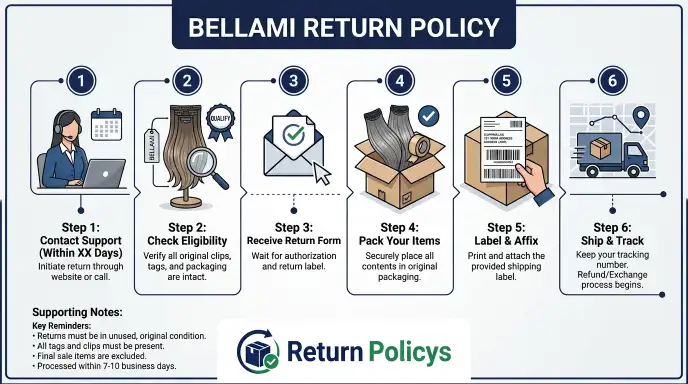
General workflow for direct Bellami purchases, as found on manufacturer guidance, looks like this. First, open a returns ticket through Bellami customer support or the returns portal. Next, get an RMA or return authorization.
Then, pack the item with its original packaging and ship it with tracking. Finally, Bellami inspects the item and issues a refund or exchange.
Inspection is a key checkpoint. Returns centers verify the condition, packaging, and any included serial numbers for tools. Inspections usually check for seals on extension packs and the presence of tags on tools.
Expect this step to take business days to complete after the carrier delivers your package.
Refunds are normally issued to the original payment method. If the original method is not available, Bellami may offer store credit. Exchange orders replace the original item with a newly shipped item instead of issuing a refund.
If an item is out of stock, you may get credit or a refund.
Warranty claims follow a different path than standard returns. For heated styling tools and electronics, locate the serial number and proof of purchase. Manufacturer warranty requests may ask for photos of the defect and a description of the issue.
Warranties may cover repair or replacement rather than refunds.
If you need a faster official reference, visit Bellami’s support pages at the brand site. For consumer protection context, the Federal Trade Commission provides guidance on returns and refunds in the United States. Those resources help clarify your rights when a seller refuses a valid return.
Common timing ranges you should expect are the following. Authorization and RMA issuance often occurs within 24 to 72 hours. Shipping to a returns center depends on carrier choice and location.
Inspection and refund issuance commonly take 7 to 14 business days after the item is received, though some claims resolve faster.
Keep documentation at every stage. Save your original shipping receipt and carrier tracking. Take dated photos of the packaged item and any damage.
That evidence is the primary lever if a return is disputed or a refund is delayed.
Which Bellami items are returnable, non‑returnable, and final‑sale
Below is a concise reference table that maps product types to common return rules and practical notes. Use it to decide the right approach for your item.
| Product category | Returnable by Bellami.com | Common conditions and notes |
|---|---|---|
| Clip‑in extensions, sealed packs | Yes, if unopened | Must be sealed, original packaging, proof of purchase |
| Tape‑in or bonded extensions, opened | Usually no | Hygiene rule, no returns once adhesive is used |
| Wigs, human‑hair pieces | Yes if unopened | Open wigs often non returnable, check seller policy |
| Heated styling tools | Yes if defective | Standard returns may accept unused tools, warranties cover defects |
| Brushes and combs | Yes if unused | Must be in original packaging and show no wear |
| Accessories (clips, cases) | Yes, typically | Non faulty accessories usually returnable when unused |
| Clearance, final sale items | No | Marked final sale items are final, no refunds |
| Gift cards | No | Electronic gift cards are non refundable |
| Custom orders, color matched products | No | Custom and personalized orders are not returnable |
Returnability depends on two variables: condition and seller. Condition means sealed and unused for hygiene items. Seller means Bellami.com versus a third party marketplace.
Those two variables decide eligibility in nearly every case.
Open packages that show signs of use are the most frequent non returnable scenario. Extensions with cut wefts, worn clips, or evidence of chemical treatment get refused. Bellami inspects both cosmetic and functional aspects.
The inspector is checking that the product can be resold in new condition.
Final sale labels are binding when the product is explicitly marketed as final sale. Clearance items often fall into this bucket. Manufacturers and retailers can mark items final sale for regulatory reasons or inventory control.
Always check the product page and your order confirmation for that flag.
Warranty coverage is separate, and often longer than the return window for tools. For example, a heater element failure may be covered under a one year warranty, while returns for non defective tools must occur within the standard return period. Trust the warranty language on the product listing or warranty page.
If you are unsure whether your item qualifies, gather evidence before you reach out for a return. Take clear photos of seals and tags. Keep the original shipping box and packing slip.
These simple steps make it easier to get approval and to resolve disputes if the return is denied.
Decision workflow: Refund versus exchange versus warranty, pick the right route
If you want a direct starting point, answer three questions. Who sold the item, what is the item condition, and what outcome do you want. The answers map to a clear branch in the decision tree.
Step 1, who sold the item. If you bought direct from Bellami.com, open a return ticket with Bellami support. If you bought from a third party retailer or marketplace, start the return through that retailer.
Marketplace returns are handled by the seller on that platform.
Step 2, check item condition. If the package is unopened and in original packaging, request a refund or exchange. If the package is opened but unused and the product is not a hygiene item, explain that clearly and ask for guidance.
If the product is clearly used or altered, expect a refusal or a partial credit.
Step 3, determine whether the issue is a defect. If the item does not function correctly, lodge a defect claim. For electronics and heated tools, attach photos and a video that reproduces the failure if possible.
For hair pieces, show the defect in photos and include the order number.
If your objective is a refund, and you are within the return window with an unopened item, select refund. If you want a different color or length, ask for an exchange and confirm stock availability. If you have a defective tool covered by warranty, start a warranty claim and expect a repair or replacement instead of a refund.
Use the following quick scenario guide to choose the right path.
- You bought from Bellami.com, item unopened, within return window, want money back, choose refund.
- You bought from Bellami.com, item unopened, want a different size, choose exchange.
- You bought elsewhere, check that seller’s policy first, follow their return portal.
- Item is defective, follow warranty process, expect repair or replacement.
Documentation you will need varies by branch. Refunds for standard returns need order ID and proof of condition. Exchanges need the same plus a target SKU to exchange into.
Warranty claims need serial numbers, detailed photos, and a defect description. Keep all communications in writing.
If a return is refused, escalate calmly. Ask for the inspector’s notes and the specific policy clause used for denial. If the item was purchased through a marketplace and the seller is unresponsive, you can open a dispute with the marketplace.
If that fails, contact your payment provider to explore chargeback options. Use the FTC resources for consumer rights guidance if the seller refuses to abide by advertised returns.
Step‑by‑step: How to return a Bellami order (actionable checklist)
Follow these steps if the seller is the brand or its authorized site.
If you bought from a marketplace, use their return flow instead.
- Gather your documents.
, Order number, packing slip, and payment method.
, Clear photos of the item and any damage, dated.
- Open the right channel.
, For direct purchases contact Bellami support via the official site.
, For third‑party purchases open a return through that seller or platform.
- Request authorization.
, Ask for an RMA or return authorization number.
, Write the RMA on the packing slip and the outside of the box.
- Pack the item correctly.
, Return the item in its original packaging if possible.
, Keep seals and tags visible, do not cover serial numbers.
- Ship with tracking and insurance.
, Use a carrier that provides a tracking number and delivery record.
, Keep the shipment receipt and tracking ID until the refund posts.
- Notify support with tracking.
, Send the tracking number to your support ticket.
, Ask for an estimated inspection and refund date.
- Track inspection and refund.
, The returns center inspects for condition and completeness.
, Expect an email when refund or exchange is processed.
How do I prepare photos and evidence
Answer, take dated photos that show seals, tags, and any defect.
Take a clear photo of the outer box with the shipping label visible.
Photograph the product in natural light, front and back.
If there is a defect, capture a short video showing the failure.
Attach images to the support ticket and keep originals until resolved.
What packaging works best
Answer, original box with padding and visible tags is best.
Wrap items with bubble wrap and place in a sturdy box.
Avoid taping directly over manufacturer labels.
Place the packing slip and a copy of the RMA inside the box.
Costs, timelines, and metrics to expect (refund speed, shipping, fees)
Expect these typical timelines for direct returns.
Authorization often takes 1 to 3 business days.
Transit time depends on carrier and distance, usually 1 to 7 days domestically.
Inspection and refund processing commonly take 7 to 14 business days after delivery.
| Action | Typical time | Who usually pays shipping |
|---|---|---|
| RMA authorization | 1 to 3 business days | N/A |
| Customer return transit | 1 to 7 business days (domestic) | Usually customer, unless prepaid label provided |
| Returns inspection | 3 to 10 business days | N/A |
| Refund posting | 5 to 14 business days after inspection | Refund issued to original method |
Shipping cost rules vary. Sellers sometimes provide prepaid labels for defective or incorrect orders. Most routine returns require the customer to pay return postage.
Restocking fees are possible for certain categories, especially large items or items returned without original packaging. Check the product page and the order confirmation for any fee notes.
Refunds are sent to the original payment method when possible. Bank or card processing may add 3 to 10 business days before you see the credit. Store credit is an alternative some retailers provide when original payment methods cannot be used.
International returns add complexity. Duties and import taxes are often non refundable unless the seller agrees to reimburse them. Transit times expand because of customs clearance.
For consumer rights in the United States, see the Federal Trade Commission guidance on refunds and merchant obligations at FTC.
Common mistakes that get returns rejected (and how to avoid them)
Not including a packing slip or order ID often triggers a refusal. Attach the packing slip inside the box and write the order ID on the outside near the RMA. Keep a screenshot of the confirmation email as backup.
Returning opened hygiene items is the single most common rejection reason. If the product is a sealed extension pack, wig, or adhesive tape, do not open the seal if you think you may return it. If you have opened it, photograph the seal and tags immediately to document condition.
Shipping without tracking or proof of postage creates disputes. Always use traceable shipping and keep the receipt until the refund posts. If a carrier loses the package you have the tracking record for a carrier claim and dispute support documentation.
Altering or washing hair pieces voids return eligibility. Do not cut wefts, trim tags, or remove adhesive labels before getting return authorization. These actions change the item’s resale condition and often result in partial or no refund.
Sending the return to the wrong address causes long delays. Confirm the returns address provided with the RMA. If the platform sends its own label, use that label and don’t readdress the package.
Keep the tracking number handy and confirm delivery.
Alternatives when a return is declined (resell, repair, warranty path)
If a direct refund is refused, option one is resale. Resell outlets include secondhand marketplaces and local consignment shops. Price items honestly and disclose condition, including any opened packaging.
Option two is warranty or repair. For functional failures on tools, a warranty claim may offer repair or replacement. Gather serial numbers and photos and submit a warranty request through the manufacturer support page.
Most warranties require proof of purchase and a defect description.
Option three is payment dispute. If the seller misapplies their return terms, you can open a dispute with your card issuer or PayPal. Provide copies of order confirmations, support ticket history, and photos.
Note, banks have timelines for chargebacks, so act promptly.
Option four is escalation to the marketplace. If you bought from a reseller, report the listing or open a platform dispute. Many marketplaces hold funds until the dispute resolves.
Keep messages polite and factual, and include the evidence you collected.
Option five is accept partial credit. Sometimes the seller offers reduced refund or store credit. Evaluate the cost to resell versus accepting a partial refund.
Choose the route that minimizes your loss and time spent.
Expert tips to speed approval and secure a full refund
Start clean, and document everything clearly. Time stamped photos and a clear packing slip make the inspector’s job easy. That reduces back and forth and accelerates the refund.
Label your box with the RMA and cover only non essential areas of manufacturer labels. If the return requires an RMA, write it on the packing list, put it inside, and mark the outside of the box. This prevents processing delays at the returns desk.
Ship with signature required for high value items. Signature on delivery provides proof of receipt at the returns facility. It also deters packages from being misplaced or marked delivered inaccurately.
If you suspect a defective tool, record a short video that shows the failure. A video speeds the warranty team’s diagnosis and can cut inspection time. Attach the video to your support ticket or upload it to a cloud link noted in the ticket.
Keep polite, concise ticket messages. Ask specific questions and request confirmation of the repair, refund, or exchange timeline. Escalate only if needed, and keep escalation messages factual and time stamped.
When shipping internationally, request the seller provide a returns customs form to avoid duty disputes. If duties were paid at purchase, ask for a statement on whether duties are refundable upon return. Document all communication in writing.
Safety, hygiene, and legal notes for hair products and heated tools
Heated tools often carry an electrical safety listing, such as UL or ETL, and you should check the product label. Manufacturer specifications indicate safety markings and maximum rated voltages, as of 2026. If a tool lacks a recognized safety mark, do not use it, and document that omission when filing a return or warranty claim.
Hygiene rules apply strongly to hair extensions, wigs, and adhesive tapes. Opened packs that touch skin or hair are commonly non returnable. Retailers treat these items like medical hygiene goods, because used hair products may carry biological contamination risks.
For cross border returns, customs and duties matter. Duties paid on the original import are typically not automatically refunded by carriers when you return the item. Keep receipts for duties and request a written duty refund policy from the seller if you expect reimbursement.
Consumer law varies by country and region. In the United States, the Federal Trade Commission covers unfair merchant practices, and the FTC explains general refund rules on its site. In the EU, consumer cancellation rights may give you a 14 day window for online purchases, but hygiene exceptions can apply.
Check local consumer protection guidance if you need escalation.
If a product presents a safety issue, stop using it immediately and preserve evidence. Take dated photos and videos, tag the serial number, and file a safety complaint with the seller and with a relevant authority if needed. For electrical hazards, you can consult the U.S.
Consumer Product Safety Commission for recall and reporting information.
Use cases, who benefits most, and when to choose each path
Choose a refund if you received the wrong item, it is unopened, and you want your money back. This path is fastest when you are within the seller’s stated return window and have the order ID.
Choose an exchange if you want a different color, length, or model, and the replacement is in stock. Exchanges keep you from reordering and reduce the chance of paying new shipping charges.
Choose a warranty claim if the item is defective or fails to operate. Warranties often cover repair or replacement, and they are the correct path for heater element failures or electrical faults.
Choose a third party return route when you bought from a marketplace or retailer other than the brand. That seller’s policy governs timelines, refunds, and shipping responsibility.
Choose resale or repair when returns are denied for cosmetic reasons or when the item is open and non returnable for hygiene. Selling used items with clear condition notes reduces your loss.
Maintenance and long‑term handling to preserve return eligibility
Keep original packaging and tags for at least the return and warranty period. Packaging is often the deciding factor for a return, and original materials increase the chance of a full refund.
Avoid altering the product before you confirm return eligibility. Do not cut, wash, dye, or otherwise change extensions or wigs if you may return them. These alterations make the item non resalable and usually void the return.
For heated tools, store them clean and dry, and retain the box and the instruction manual. Preserve the serial number label. The warranty department often requires a serial number for verification and a description of how the item failed.
Record purchase documentation and communications in one place. Save order confirmations, RMA numbers, support emails, photos, and shipping receipts. A simple folder or cloud drive with dated files shortens dispute resolution.
If you plan to resell an item, preserve condition and take high quality photos that match the item’s real state. Buyers expect accurate condition descriptions and will penalize the seller for undisclosed wear.
Frequently Asked Questions
What is the usual return window for purchases made on Bellami.com?
Typical return windows vary by seller, and many brands use 14 to 30 day windows for standard returns. Check the order confirmation for the exact date range. If you are outside that window, ask support about exchanges or warranty options.
Can I return opened hair extensions or wigs?
Most sellers refuse returns for opened hair extension or wig packs because of hygiene rules. If an item was opened accidentally, document the condition with dated photos and contact support immediately. They may offer limited options, but full refunds are unlikely.
Who pays return shipping for Bellami returns?
Return shipping responsibility depends on the reason for return and the seller policy. If the item was defective or the wrong shipment, the seller sometimes provides a prepaid label. For change of mind returns, customers usually pay postage.
Confirm on your order page.
How long does a refund take after the return is received?
After the returns center inspects the item, refunds usually post within 5 to 14 business days to the original payment method. Card processors may require an additional 3 to 10 business days before you see the credit. Request written confirmation of the refund date.
What if a return is denied due to inspection findings?
If a return is denied, request the inspector’s notes and photos. If you disagree, escalate through the seller’s formal appeal channel or the marketplace dispute system. Keep all documentation and consider a payment provider dispute if the seller refuses reasonable resolution.
Are customs duties refundable on international returns?
Customs duties are not automatically refunded when you return an item, and policies vary by seller. Ask the seller if they reimburse duties and obtain any necessary customs paperwork for re export. Keep receipts for duties and shipping for a possible claim.
Decision checklist, exactly what to do next based on your situation
If you bought direct, unopened, and want money back: gather order ID, open a support ticket, request an RMA, ship with tracking, and keep receipts. Expect inspection and a refund to the original method.
If you bought direct, opened, and want an exchange: confirm exchange eligibility with support, identify the replacement SKU, request stock confirmation, and ship per instructions. Be ready for possible restocking or sanitation fees.
If you bought from a third party: start with that seller’s return portal, follow their step by step instructions, and retain all messaging. If the seller refuses, open a marketplace dispute or contact your payment provider.
If the item is defective: collect serial numbers, dated photos, and a short video showing the fault, then submit a warranty claim. Ask whether repair, replacement, or refund applies and get an estimated timeline in writing.
If you have no receipt or lost order ID: assemble any alternative proof, such as bank statements, screenshots, or email confirmations. Expect a store credit offer in many cases. If you paid by card, your issuer can sometimes provide transaction IDs to assist the seller.
If you’re international: calculate return shipping and duty costs before sending the item back. Request written confirmation from the seller about duty reimbursement policy if you think you qualify. Use tracked shipping and retain customs paperwork.
If a return stalls: escalate politely, request inspection notes, and use marketplace or payment disputes when reasonable. Keep communications factual, include evidence, and set clear expectations for response times when you escalate.