
You sit across the desk, keys in hand, and a knot in your stomach. The car you just bought doesn’t fit your life the way you thought it would. Maybe the payments are too high.
Maybe you found a better deal somewhere else. Or maybe you just changed your mind. You ask the finance manager: “Can I return this?” Their answer is almost always no.
That’s because a Toyota Return Policy doesn’t exist the way most people expect.
It sounds like a simple question, but the answer is loaded with traps. In our research across dealer agreements, state laws, and buyer experiences, we found one hard fact: Toyota Motor Corporation does not offer a manufacturer-level return policy. As of 2026, every single new Toyota sale is handled by independent dealerships, and their default stance is final sale.
No cooling‑off window. No 30‑day guarantee. No easy walk‑away.
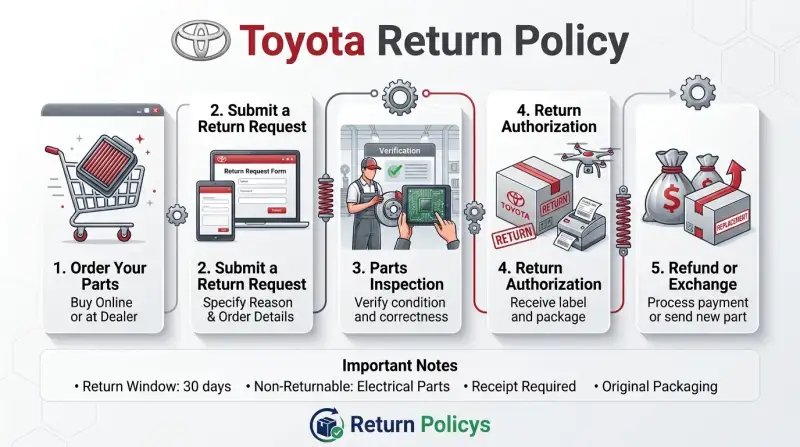
Quick Answer
Toyota has no manufacturer return policy. All new car sales are final. Your only options are dealer goodwill, lemon law, or a trade-in.
You cannot return a Toyota after driving off the lot. There is no federal cooling-off period for dealerships.
Why This Matters More Than You Think
A new Toyota is a major life purchase. The average transaction price of a new vehicle in the U.S. now hovers around $48,000. That’s not pocket change.
An emotional decision or a missed detail can turn into years of regret and thousands in negative equity.
Buyers who assume they can “just return it” often walk into a financial trap. You don’t find out the truth until you try. And by then, the paperwork is signed, the loan is funded, and the value of your car has already dropped by 10% to 20% the moment you pulled out of the dealer lot.
Knowing this before you sign changes everything. It shifts your focus from “I can always return it” to “I need to be absolutely sure this is the right car for me.”
The Hard Truth: Toyota Does Not Have a Manufacturer Return Policy
Let’s be blunt. Toyota the manufacturer does not operate a return program. There is no central 800 number you can call to request a return.
No online return portal. No standard form.
Every Toyota dealership is independently owned and operated. They set their own sales policies. And the vast majority of them treat a new car sale as final the second you take delivery.
A small number of dealers may offer a short-term exchange or “satisfaction guarantee,” but those are exceptions, not the rule. You cannot count on one unless you get it in writing before you sign.
Toyota Financial Services, the company that handles most Toyota loans and leases, also has no return mechanism. If you finance with them, you owe the full balance. Cancelling a lease early triggers termination fees and penalties.
There is no “buyer’s remorse” clause anywhere in the contract.
What Most People Get Wrong — The Cooling-Off Myth & “30-Day Return” Lies
The most common myth we hear is that you have a three-day cooling-off period after buying a car. That rule comes from the Federal Trade Commission’s Cooling-Off Rule. But here’s the catch: it only applies to sales made at your home, workplace, or a temporary location like a fair or hotel.
It does not apply to purchases made at a car dealership.
You might also have heard rumors about a 30-day return policy. Those stories often come from other manufacturers that briefly experimented with return programs, or from used-car superstores like those that offer a short return window. Toyota has never adopted such a policy for new vehicles.
Here are the biggest misconceptions we see:
- “I can return it within three days.” No. That rule does not apply to dealership sales.
- “Toyota has a 30-day return policy.” False. There is no such program.
- “I can cancel my loan.” Not unless you refinanced and the lender allows a rescission period. That’s rare for auto loans.
- “The dealer will take it back if I complain enough.” Some dealers have done goodwill exchanges, but they are not obligated to. It’s a favor, not a right.
The truth is simpler and harsher: once you sign and drive away, your only way out is through one of the options below.
Your Real Options When You Want to “Return” a Toyota
You can’t return a Toyota like a shirt that doesn’t fit. But you do have a few paths. They all come with costs, paperwork, and no guarantees.
Let’s walk through each one.
Dealer Goodwill Exchanges: Rare, Conditional, and Worth Asking
If you call the dealer within the first day or two and explain your situation professionally, they might agree to an exchange. Some dealers will let you swap for a different model or trim, especially if you are willing to pay a small restocking fee or absorb the difference in price.
This is not a return. It is a voluntary exchange that only works if:
- You contact them immediately (ideally within 24 hours).
- The car has very low miles (under 100).
- The car has no damage or customization.
- You are willing to pay any difference in value or fees.
Practical tip: ask the dealer to put any exchange policy in writing before you buy. If they refuse, assume the answer is no.
Lemon Law Buybacks: The Legal Forced Return
If your Toyota has a serious defect that the dealer cannot fix after a reasonable number of attempts, you may qualify for a lemon law buyback. This is not a voluntary return. It is a legal remedy that forces the manufacturer to repurchase the vehicle.
Every state has its own lemon law. In California, for example, a vehicle is presumed a lemon after two repair attempts for a serious safety defect, or four attempts for any other defect, or if the car is out of service for 30 or more days. You must follow the state’s specific process, including notifying Toyota and using an approved dispute resolution program.
If you win a lemon law claim, Toyota buys back the car at the original purchase price, minus a small usage fee for the miles you drove. This is your strongest option if the car has a genuine problem. But it’s not available for simple buyer’s remorse.
Trade-In or Private Sale: The Costly Exit
If you have no defect and no goodwill exchange, your only option may be to sell the car. You can trade it in at another dealership or sell it privately. Either way, you will lose money.
The trade-in value will be below wholesale because the dealer needs to make a profit on resale. A private party sale will typically get you a better price, but it takes time, effort, and a buyer willing to pay fair market value.
Example: you buy a Toyota Camry for $30,000. Drive it off the lot. Two weeks later, private party value is roughly $26,000 to $27,000.
Trade-in value is around $24,000 to $25,000. You are out $3,000 to $6,000 instantly.
Financing & Lease Cancellation: What You’re Actually Signing
If you financed the car, you cannot simply cancel the loan. You must pay off the full balance. If the car is worth less than what you owe, you have negative equity.
That difference must be paid in cash or rolled into a new loan, which is almost always a bad financial move.
If you leased, early termination is possible but expensive. You will pay the remaining lease payments, a disposition fee, and any early termination penalties. Some lessors will let you transfer the lease to another person through a lease swap website.
That can be a cleaner exit.
How Depreciation Kills Your Leverage (The Numbers You Need to Know)
Depreciation is the silent enemy of every exit strategy. A new car loses value the second it leaves the lot. Understanding this helps you see why returning or exchanging a car is so hard.
Here is a typical new Toyota depreciation curve:
| Time Since Purchase | Estimated Value as % of MSRP | Real‑World Example ($30,000 MSRP) |
|---|---|---|
| At signing | 100% | $30,000 |
| After 1 day | 80%–90% | $24,000–$27,000 |
| After 1 month | 75%–85% | $22,500–$25,500 |
| After 1 year | 65%–75% | $19,500–$22,500 |
| After 3 years | 50%–60% | $15,000–$18,000 |
These numbers vary by model, market conditions, and mileage. A Toyota Tacoma holds value better than a Toyota Corolla. But the pattern is universal: the steepest drop happens in the first year, and especially in the first month.
Why does this matter for a return? Because if the dealer took the car back, they would have to sell it as a used vehicle. They would need to absorb that depreciation or pass it to you.
Since they can’t sell a new car as new once it’s titled, they have no incentive to take it back. Your leverage shrinks as the miles go up.
This is also why a lemon law buyback uses a usage fee. The law recognizes that you used the car, so you pay a small amount per mile. It’s fair, but it still stings.
Knowing these numbers before you sign helps you avoid a mistake. If the car doesn’t feel right during the test drive, do not gamble. Walk away.
It’s cheaper than trying to “return” a car you already own.
Red Flags and Risk Factors Every Buyer Should Know
A lot of the pain tied to a Toyota return policy comes from what happens before you drive off the lot. If you spot these red flags early, you can avoid needing a return at all.
Pressure to sign same day. A dealer who says “this price is good only today” is using a classic tactic. Walk away. A real deal will still be there tomorrow.
No chance to have a third party inspect. If the dealer won’t let you take the car to an independent mechanic, that’s a warning. Even new cars can have hidden issues.
Unusual or verbal promises. If the salesperson tells you “if you don’t love it, bring it back” but won’t put it in writing, assume it’s not true. A return or exchange promise is only real when it’s typed into the contract or a separate signed agreement.
Rushed paperwork. The finance office will try to move fast. Slow down. Read every line.
Look for arbitration clauses, no-cancellation language, and any fees tied to early payoff.
Buying a car that stretches your budget. If the payment makes you uncomfortable at signing, it will feel worse a month later. That financial stress often leads to buyer’s remorse, and there is no easy exit.
Step-by-Step: What to Do Immediately After Buyer’s Remorse
You just drove home and realize you made a mistake. Time is your enemy. Every minute that passes reduces your options.
Step 1: Stop driving. Park the car. Do not add more miles. Keep the interior clean.
Do not smoke in it or eat in it. A car with 50 miles and a fresh smell is easier to negotiate on than one with 500 miles and stained seats.
Step 2: Call the dealer within 24 hours. Ask for the sales manager. Be polite and direct. Say you made a mistake and would like to discuss an exchange or return.
Do not threaten or demand. Ask what they are willing to do.
Step 3: Review your paperwork. Look for any return or exchange language. Check the finance contract for cancellation terms. Read the arbitration clause.
If you physically signed a “Buyer’s Guide” on a used car, the FTC allows some protections, but they are limited.
Step 4: Document everything. Take photos of the odometer, the condition of the car, and any issues. Save all emails and texts. Write down the names and titles of everyone you talk to.
If you end up in a lemon law or legal situation, this record is gold.
Step 5: Contact Toyota Customer Experience. The manufacturer’s number is 1-800-331-4331. Explain your situation. They cannot force a dealer to take a car back, but they may be able to mediate or offer goodwill assistance.
Step 6: Explore the options we covered earlier. Dealer goodwill, lemon law (if there’s a defect), or trade-in. Each path has a time limit. Act fast.
When to Seek Legal Help or File a Consumer Complaint
Most buyer’s remorse situations do not need a lawyer. But some do. You should consider legal help if:
- The dealer misrepresented the vehicle’s condition, history, or price.
- You bought a car with a serious defect and the dealer refuses to repair it.
- The dealer refused to honor a written exchange or return policy.
- You believe the dealer violated your state’s consumer protection laws.
Where to go first. Start with your state’s Attorney General consumer protection office. Many of them offer free mediation. If that fails, you can file a complaint with the Better Business Bureau’s AUTOCAP program.
AUTOCAP is a dispute resolution service used by many car dealers.
When to hire a lawyer. If you have a legitimate lemon law claim, a lawyer who specializes in lemon law can handle the process on a contingency basis. That means they take a portion of the settlement and you pay nothing upfront. Look for a lawyer who handles cases against Toyota directly.
Filing a complaint with the FTC. The Federal Trade Commission accepts complaints about deceptive practices. They do not resolve individual cases, but they use the data to go after bad dealers. You can file at reportfraud.ftc.gov.
Documentation is everything. Without paper proof, a he-said-she-said scenario rarely ends in your favor. Keep every receipt, every contract, every communication.
State-by-State Differences (California vs. the Rest)
Your ability to force a return depends heavily on where you live. California has the strongest consumer protections. Other states are weaker.
| State | Lemon Law Trigger | Cooling‑Off Period | Dealer Return Mandate |
|---|---|---|---|
| California | 2 attempts for safety defect, 4 for others, or 30 days out of service | None (FTC rule only for home sales) | No mandate |
| Texas | 4 attempts or 30 days out of service | None | No mandate |
| Florida | 3 attempts or 30 days out of service | None | No mandate |
| New York | 4 attempts or 30 days out of service | None | No mandate |
| Illinois | 4 attempts or 30 days out of service | None | No mandate |
No state has a law that lets you return a perfectly good car just because you changed your mind. The only difference is how easy it is to win a lemon law claim. California is the friendliest because it uses a lower threshold.
The other states are more restrictive.
Out-of-state buyers. If you bought a Toyota in a state where you do not live, you may have to pursue a claim in the dealer’s state. That complicates things. Ask the dealer for their return policy in writing before you travel to pick up the car.
Your local state’s lemon law. Look up your state’s statute. Search for “[your state] lemon law” on an official .gov website. The National Highway Traffic Safety Administration (NHTSA) also has a lemon law summary page for each state.
Frequently Asked Questions
Can I return a Toyota within 30 days?
No. Toyota and its dealers do not offer a standard 30-day return policy. Any exception is rare and voluntary.
Always ask in writing before you buy.
What if I bought a used Toyota? Is there a return policy?
Used car sales are also final at most dealers. Some dealers may offer a short-term exchange or a limited warranty. Ask before signing.
The FTC’s Used Car Rule requires a Buyer’s Guide to show whether the sale is “as is” or “with warranty.”
Does Toyota have a satisfaction guarantee program?
Toyota occasionally runs a “Satisfaction Guarantee” promotion, but it applies to lease returns or specific dealer programs. It is not a blanket return policy. You must confirm with your dealer whether they participate.
Can I get my down payment back if I return the car?
Only if you successfully negotiate a return with the dealer. Even then, they may deduct fees or depreciation. You rarely get the full down payment back.
How long do I have to file a lemon law claim in California?
In California, you must file within the warranty period (typically 3 years/36,000 miles). But the repair attempts must happen within that window. Act quickly once you notice a recurring problem.
Does Toyota Financial Services allow loan cancellation?
Your loan agreement is a binding contract. You cannot cancel it after signing. You must pay off the balance.
There is no grace period.
Verified Summary and Final Advice
Here is the bottom line. Toyota has no return policy. Your only exit paths are goodwill, lemon law, or selling the car.
Each one costs you money or time.
Act fast if you regret your purchase. Contact the dealer within 24 hours. Document everything. Do not add miles.
If the car has a defect, start the lemon law process immediately.
Sign nothing under pressure. Read every contract line. Ask for return or exchange policies in writing. If a dealer refuses to put a promise on paper, assume it is false.
Know your state’s protections. California gives you the strongest lemon law. Everywhere else, you have fewer rights. Research your state’s consumer protection office before you buy.
The safest strategy is prevention. Take a test drive. Sleep on the decision. Bring a trusted mechanic.
A few extra hours of caution can save you thousands in regret.