
So, you bought tires from Discount Tire. Perhaps the size is wrong, or maybe the ride feels harsher than you expected. Additionally, you might have found a better deal elsewhere.
Whatever the reason, the Discount Tire Return Policy determines whether you get your money back and how much. Our research shows most return requests fall into one of seven scenarios. Furthermore, the outcome depends on three key factors: when you bought them, whether they’ve been mounted, and their current condition. Let’s explore this step by step.
Quick Answer
Discount Tire accepts returns within 30 days of purchase. Unused, unmounted tires generally receive a full refund. Conversely, used tires may qualify for a prorated refund or exchange.
A receipt is preferred; however, they can often look up your purchase. Online orders from Discount Tire Direct typically have slightly different rules. It is important to note that road hazard damage is covered under a separate warranty, not the standard return policy.
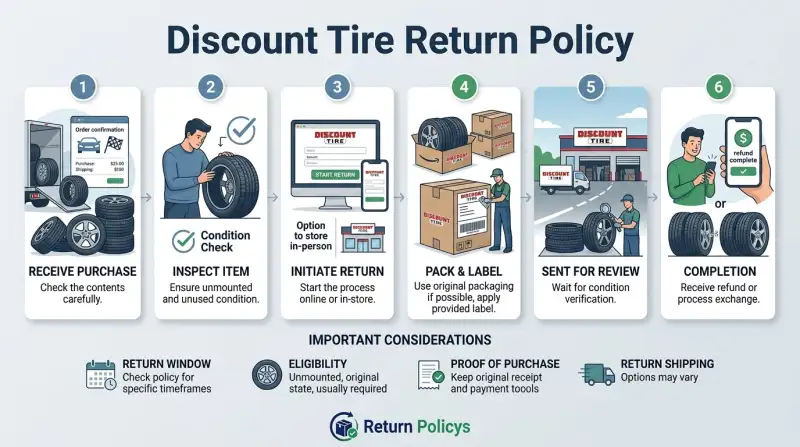
The Problem: You Need to Return Tires — But Will Discount Tire Take Them?
You’re standing in your garage, observing a set of tires that simply don’t fit. Perhaps the bolt pattern is off, or maybe you ordered the wrong sidewall height. Alternatively, you might just dislike how they handle wet roads.
The first thing to understand is that Discount Tire aims for a customer-friendly return process. However, this process has clear boundaries. By understanding these boundaries, you can avoid frustration and wasted time.
A common mistake people make is assuming all tire returns operate identically. They do not. The policy branches into several categories based on your specific situation. Therefore, a decision-tree approach is most effective for determining your outcome.
The Core Decision Tree: 7 Questions That Determine Your Outcome
Answer every question in order. Your path through this tree will reveal precisely what you can expect.
Question 1: Do You Have Your Receipt (or Can They Look It Up)?
If you possess the paper or digital receipt, that’s excellent. If not, Discount Tire can often locate the purchase by scanning your license plate or looking up your credit card number. They maintain purchase records for a reasonable period. For instance, if you bought the tires with a card, they will likely find the transaction. However, if you paid cash and lost the receipt, you might receive store credit instead.
Question 2: Are the Tires Still Unmounted?
Unmounted tires that have not been driven on represent the simplest case. Discount Tire treats them as new merchandise. You will receive a full refund, without questions, provided they are in their original condition, free of scuffs, dirt, and with all stickers intact.
Question 3: How Much Have You Driven on Them?
If the tires are mounted and you have accumulated miles on them, the refund amount changes. Tires with less than 2/32” of tread wear are still considered “like new” for proration purposes. Once they exceed that limit, the refund is based on the remaining tread depth.
Discount Tire utilizes a straightforward formula: they measure the tread, calculate the percentage of life remaining, and refund that portion. Consequently, you won’t receive the full price back, but you will get some reimbursement.
| Tread condition | Refund type | Typical refund percentage |
|---|---|---|
| Unmounted, unused | Full refund | 100% |
| Mounted, < 2/32” wear | Prorated refund | 85–95% |
| Mounted, > 2/32” wear | Prorated refund | 50–80% depending on mileage |
Question 4: Is It a Defect, Road Hazard Damage, or Just Buyer’s Remorse?
This is where confusion often arises. Please note that road hazard damage (such as a nail puncture or sidewall cut) is not covered by the return policy. Instead, it is covered by the free road hazard warranty included with every Discount Tire purchase.
Therefore, if you hit a pothole and the tire is damaged, you should file a warranty claim rather than attempting to return it. Defects (e.g., a bulge, vibration, or premature wear) are handled by the manufacturer’s warranty, not the store’s return policy. Discount Tire will assist you in processing that claim. Conversely, buyer’s remorse (wrong size, dissatisfaction with the ride) qualifies for the regular return process.
Question 5: Are You Returning the Full Set or Just One Tire?
Discount Tire generally requires the return of the full set of tires purchased together. If you bought four tires and wish to return only one, they will often permit an exchange for a different brand or model. However, a partial refund for a single tire is less common. Therefore, always inquire at the store, as they are often flexible on this matter.
Question 6: Was This an In-Store Purchase or an Online Order?
In-store returns are processed immediately. You enter the store, they inspect the tires, and you receive a refund then and there. Nevertheless, online orders from Discount Tire Direct follow a different procedure.
You need to contact their customer service to initiate a return. They will provide a shipping label; however, you are responsible for return shipping costs unless the error was theirs. Furthermore, you must return the tires in their original packaging, including any stickers or labels.
Question 7: Is It Still Within the 30-Day Window?
The standard return window is 30 days from the purchase date. After this period, Discount Tire may still accept a return at their discretion, but it is not guaranteed. If you are beyond the 30-day limit, it is advisable to call ahead and explain your situation. In many cases, they make exceptions if the tires are clearly unused.
Refund vs. Exchange vs. Store Credit: What You Actually Get
Once you know which branch of the decision tree you’re on, the next consideration is the form of reimbursement you will receive.
- Full Refund: This applies to unmounted, unused tires returned within the designated window. The money is returned to your original payment method.
- Prorated Refund: This applies to used tires with measurable tread wear. The refund amount is calculated based on the remaining tread life. Typically, this is credited back to your card.
- Exchange: With an exchange, you swap the returned tires for a different set. You will pay the difference if the new tires cost more, or conversely, you will receive a refund for the difference if they cost less.
- Store Credit: If you lack a receipt and they cannot locate your purchase, you will receive store credit for the tires’ current value. This credit can be used for any future purchase in the store.
Here’s a quick comparison table:
| Scenario | Refund type | Payment method |
|---|---|---|
| Unused, with receipt | Full refund | Original payment |
| Unused, no receipt | Store credit | In‑store credit |
| Used, within 30 days | Prorated refund | Original payment |
| Used, past 30 days | Possibly store credit | Discretionary |
| Exchange | New tires plus price difference | As negotiated |
Missing Your Receipt? Here’s What Happens (and How to Still Win)
Losing a receipt happens frequently. However, there’s no need to panic. Discount Tire possesses a lookup system that links purchases to your vehicle’s license plate number. When you initially purchase tires, they request your plate information. This record remains stored in their system.
If you paid with a credit card, they can also trace the transaction using the card number. Provide them with the last four digits and the transaction date; they will likely find it. Nevertheless, if you paid cash and have no plate on file, you will probably receive store credit. This credit is usable for any future purchase, including tires, rotations, or repairs. While not an ideal outcome, it does tie you to Discount Tire for your subsequent needs.
Pro Tip: Take a photo of your receipt immediately after purchasing. Email it to yourself. This simple action effectively solves the problem of a lost receipt forever.