
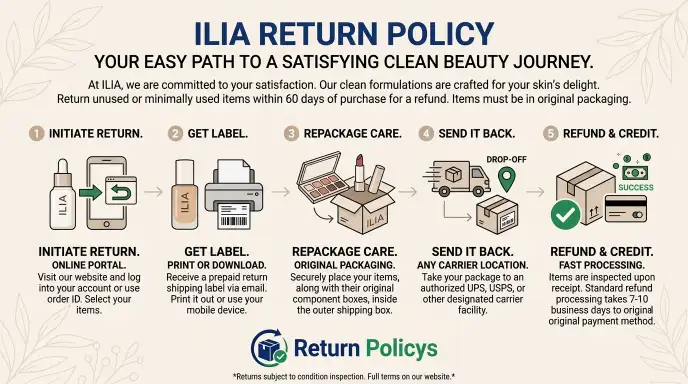
If you need a refund or exchange, the ILIA Return Policy tells you which steps to follow and who pays what. The policy differs for purchases made on ilia.com versus purchases made at third party retailers, so the correct path depends on where you bought the item.
Manufacturer specifications indicate a typical 30 day return window for direct purchases, as of 2026. Our research shows receipts, photos, and tracking speed approvals. Read on to pick the exact path that fits your order.
Quick Answer
ILIA Return Policy varies by point of purchase and product condition.
Direct purchases at ilia.com usually have a 30 day return window.
Retailers like department stores follow their own return rules.
Damaged items often qualify for prepaid return shipping and replacement.
Problem / common pain points with ILIA returns (lost receipts, opened cosmetics, international duties)
Customers often mix up brand rules with seller rules, which delays refunds. Returns for ilia.com orders follow ILIA processes. Returns for retailer purchases follow the seller’s policy.
Missing proof of purchase reduces refund options. Without order numbers or receipts, many sellers offer credit instead of cash refunds. Keep packing slips and confirmation emails.
Opened or heavily used cosmetics raise hygiene concerns and may be rejected. Brands inspect returned makeup for resaleability. Photograph condition before you ship.
International returns involve customs and duties that are often non refundable. That can leave you with a product refund but still out of pocket for import taxes. Check the seller’s international return instructions.
Shipping without tracking creates disputes if a parcel disappears. Tracked returns prove delivery and speed resolution. Always save carrier receipts and tracking numbers.
Timing errors are common: waiting until the seller window closes wastes options. Start returns within the stated window on your order confirmation. If you bought during a holiday promotion, check for extended windows.
Core explanation — how ILIA handles returns and what differs by seller (ilia.com, Sephora/Nordstrom/Credo/independent stockists)
There are two return routes: direct to the brand, and return to the seller. Direct purchases through ilia.com use ILIA’s portal. Third party purchases follow the retailer’s return policy.
Eligibility typically requires the product to be unused or gently used, in original packaging, and returned within the stated window. Heavily used items can be refused or receive partial credit.
Refunds for direct returns post to the original payment method. Retailer refunds go through the seller’s system and timelines can vary. Shipping fees are usually refunded only for seller error or defects.
Batch codes and lot numbers are used to track defects and recalls. Including these codes in your claim helps the brand verify production issues quickly. Photos of lot codes reduce back-and-forth.
Exchanges are often handled as refunds plus a new order. That avoids inventory holds and timing problems. If you need a different shade, expect to return then reorder.
For official guidance, check ILIA’s support at https://www.ilia.com and general consumer rules at the Federal Trade Commission, https://www.ftc.gov.
Decision flow — which path fits your situation (direct purchase, retailer, damaged, gift, international)
If you bought on ilia.com, start the brand portal. If you bought from a retailer, follow the seller’s return process. If the item is damaged, photograph it and contact the seller immediately.
If the purchase was a gift, try to locate the giver’s order number. If you are outside the seller’s country, expect customs paperwork and possible non refundable duties. If the seller provided a prepaid label, use it.
If the seller refuses a valid defect claim, escalate with evidence and consider contacting your payment provider. Card disputes require documented attempts to resolve with the seller first.
If you lack the receipt, search your email and payment history, or ask the seller to look up the order by payment card or loyalty account. If those fail, store credit is a common fallback.
Step-by-step: Returning an item to ilia.com
Start the return request in your ilia.com account. Locate the order, choose Return, and enter the reason and order number. Attach photos if the item is damaged or defective.
Wait for ILIA to confirm eligibility and issue instructions. You may receive a prepaid label, or a return address and authorization number. Save any emails and the return number.
Pack the item in the original packaging when possible. Include the packing slip or a printed order confirmation. Wrap liquids and fragile compacts to avoid transit damage.
Ship with tracking and keep the tracking number until your refund posts. If ILIA supplied a prepaid label, use it and keep the carrier receipt. If you pay postage, insure high value items.
ILIA inspects returned items for seals, lot codes, and condition. Approved returns are refunded to the original payment method within about 5 to 10 business days after inspection. Bank posting times can add extra days.
If ILIA requests more photos or information, respond promptly to avoid delays. If a return is denied, request the reason in writing and gather documentation before escalating to your card issuer.
Step-by-step: Returning ILIA purchased from a third‑party retailer
Confirm the seller on your order confirmation or bank statement. Returns go to the seller that processed payment. Start with that retailer’s portal or the in-store desk.
In-store returns are often fastest when you have the original receipt. Bring the product, packaging, and proof of purchase. Ask for a printed return confirmation before you leave the store.
If you need to mail the return, use the retailer’s online portal to request a label or instructions. Follow their packing and shipping rules and attach any required return paperwork.
If the retailer issues a prepaid label, use it and save the carrier receipt. If the retailer requires in-store proof but you only have a digital receipt, show the order email or a screenshot and the payment card used.
If the retailer refuses a return for a damaged item, escalate with photos, order details, and communications. Then contact the brand with your evidence for additional verification or support.
| Return type | Where to start | Proof required | Shipping responsibility |
|---|---|---|---|
| In-store return | Store desk | Receipt or order email | Retailer covers for defects |
| Online retailer return | Retailer portal | Order number, photos if damaged | Prepaid label or customer pays |
| Marketplace return | Marketplace system | Marketplace order ID | Marketplace or seller policy applies |
Damaged, defective, or wrong item workflow
Yes, document damage immediately. Photograph the outer box, inner product, and any visible lot codes. Preserve the original packaging.
Send photos and order details to the seller first, and to the brand if requested. Include the order number, purchase date, and a short description of the defect.
If approved for defect return, use the supplied prepaid label and keep the carrier receipt. If no label is provided, ship with tracking and save the proof of postage.
For suspected contamination or safety issues, stop using the product and store it sealed. Brands and regulators take contamination reports seriously and may ask for additional information.
If replacements arrive damaged, repeat the documentation process and ask for escalation. If the seller refuses to help, use the payment provider dispute process with a clear evidence packet.
Exchanges vs refunds vs store credit — how ILIA typically handles swaps
Exchanges are usually processed as a refund then a separate purchase. Brands prefer this method for inventory accuracy. Expect to receive money back, then place a new order.
Retailers may offer immediate in-store exchanges if they have the desired item in stock. That option works best when you need a quick swap. Confirm in-store availability before you return.
Store credit is common when no proof of purchase exists or for some final sale items. Credit policies vary, so ask about expiry, online usability, and in-store acceptance before you accept credit.
| Option | Best when | Downsides |
|---|---|---|
| Refund | You want cash back to original payment | Refund posting can take several business days |
| Exchange | Store has the desired replacement in stock | Requires store inventory to match request |
| Store credit | No receipt or seller policy limits cash refunds | Credit may have expiry or restrictions |
If a promotion affected your price, refunds reflect the amount you actually paid. Return full bundles to avoid misapplied partial refunds.
International returns and customs (duties, VAT, non‑refundable taxes, return shipping responsibility)
International returns usually require customs paperwork and can incur fees. Duties and VAT paid on import are often non refundable through customs. That can leave you with a refund minus import taxes.
Confirm with the seller whether they cover duties for defective returns. Some brands reimburse duties for seller error, but most do not for change of mind returns. Check the return notes in your order portal.
When shipping a return internationally, label the parcel as returned goods and include the original invoice and a clear reason for return. Incorrect declarations cause customs delays or fees.
Expect longer transit and inspection times for international returns. Customs clearance can add several business days to delivery and processing. Use a carrier with customs brokerage support and clear tracking.
Keep all postage and customs receipts if you plan to request reimbursement. Some sellers will consider partial reimbursement for duties and fees for proven defects, but policies vary by seller and country.
Mistakes to avoid that block your refund (no tracking, heavy use, missing original packaging, wrong return address)
Not using tracked shipping is the top mistake. Tracking proves delivery. Ship with a carrier that provides end-to-end tracking and save the receipt.
Sending heavily used items often leads to reduced refunds or refusals. Light testing is acceptable, heavy use is not. Photograph condition before shipping and describe testing in your return notes.
Omitting the packing slip or order confirmation slows processing. Include a printed order confirmation if you no longer have the packing slip. Clear documentation helps the inspector match the return to your order.
Using the wrong return address wastes time. Verify the return address in the portal or on the label before you seal the box. If you must change carriers, confirm the correct address first.
Discarding outer shipping boxes removes evidence of transit damage. Keep both inner and outer packaging until the return completes. Photos of the original packaging help support damage claims.
Waiting until the last day of the return window risks carrier delays. Start returns early and allow time for shipping and inspection. If you need an extension, request it in writing.
Data & timelines: return windows, inspection periods, refund posting, carrier tracking hold times
Return windows depend on seller and SKU. Direct purchases commonly allow about 30 days from delivery. Retailers vary between 14 and 30 days, with holiday extensions sometimes applied.
Inspection periods usually take 3 to 7 business days after the seller receives the package. Peak seasons can extend inspection to 10 to 14 business days. Expect longer times during holidays.
Refund posting typically occurs within 5 to 10 business days after approval. Your bank or card issuer may add several more days before the credit appears. Check your card’s posting rules.
Carrier tracking scans provide evidence of delivery. If a package shows delivered, start a carrier inquiry within 7 days to preserve claims. Keep the tracking number and the carrier receipt for any disputes.
| Step | Typical business days | Notes |
|---|---|---|
| Start return request | 0 to 2 | Begin immediately when you decide to return |
| Seller inspection | 3 to 14 | Seasonal peaks can extend this |
| Refund issued by seller | 1 to 3 after inspection | Seller posts refund to payment method |
| Bank posting time | 3 to 10 | Depends on card issuer or payment method |
| Carrier transit for return | 2 to 10 domestic, 7 to 30 international | Use tracking to confirm delivery |
Safety, legal & compliance notes (hygiene rules for cosmetics, EU/UK distance‑selling rights, customs rules)
Hygiene drives many cosmetic return rules. Opened products are subject to inspection for contamination or heavy use. Sellers refuse returns that present safety risks.
Batch codes and expiry dates support defect tracing. Brands use these codes to investigate production issues and to fulfill recall obligations. Include the lot number in defect reports when possible.
EU and UK distance selling laws give consumers a right of withdrawal for many online purchases, often within 14 days. Hygiene exceptions apply to cosmetics in sealed packaging once opened, so check local rules and seller terms.
Customs and import rules often make duties and VAT non refundable for returned goods. Expect to absorb import taxes unless the seller explicitly reimburses them for defects.
Protect your personal data when submitting returns. Share only the order and shipping details necessary to verify the purchase. Avoid sending full card numbers or sensitive data in email messages.
If you suspect a safety defect, preserve the item and document the issue. Report to the seller and to the appropriate national regulatory authority if necessary. Authorities track product safety reports and recall patterns.
Expert tips that actually speed approval
Start returns in the official portal, because portals create an automatic record of your request. Portal-submitted returns resolve faster than phone or email requests.
Attach clear photos the first time you submit a claim. Include wide shots of the package and close ups of product faces, seals, and lot codes. Clear images reduce back-and-forth.
Keep a single evidence folder for the return. Save the order confirmation, portal screenshots, photos, and tracking number in one place. That simplifies escalation or card disputes.
Use tracked shipping and insure high value items. If a return is lost, tracked proof and insurance protect you financially. For international returns, choose a carrier with customs support.
Label returned items inside the box with a short checklist of items and requested actions. That prevents processing errors on mixed orders and speeds inspection.
Match evidence to the seller correctly. Send photos to the retailer if they handled the sale, or to the brand if the brand shipped your order. Wrong routing delays resolution.
If the seller supplies a prepaid label, use it exactly as instructed. Unauthorized labels or rerouted carriers can result in returns being misdelivered or rejected.
Polite, concise escalation works best. Provide a chronological summary, photos, tracking, and portal numbers. Escalation with well organized evidence often produces a final resolution within a few business days.
Frequently Asked Questions
How long do I have to return a direct purchase?
Most direct purchases can be returned within 30 days from delivery, but check the exact timeframe on your order confirmation. Holiday promotions may extend the window. Start your return in the ILIA portal as soon as you decide to return the item.
Can I return opened or used makeup?
Lightly used items may be accepted, but heavy use often leads to partial refunds or denials. Brands inspect returns for hygiene and resaleability. Photograph the product before shipping and explain the testing level in your return notes to help inspectors assess condition.
Will I get shipping and duty costs refunded?
Shipping fees are usually refunded only when the seller made a mistake or the item is defective. Duties and import VAT are often non refundable through customs for returns, so you may not recover those costs unless the seller agrees to reimburse them explicitly.
What if I lost my receipt or order email?
For direct purchases, ILIA can often find orders by account email or shipping address. Retailers sometimes search by card number or loyalty account. If proof cannot be found, expect store credit rather than a cash refund, unless the seller verifies the purchase another way.
How fast will I see the refund on my card?
After approval, sellers typically issue refunds that post to your payment method within 5 to 10 business days. Your bank or card issuer can add extra processing time before the credit appears. Keep refund emails and transaction IDs while waiting.
When should I contact my card issuer about a dispute?
Contact your card issuer only after documented attempts to resolve the return with the seller have failed. Provide the issuer with emails, photos, tracking, and portal numbers. Card disputes take time, so continue following up with the seller in parallel.
Final decision guide — quick checklist to pick the exact next step and get your refund fast
If you bought from ilia.com, start the return in your account and attach photos, the lot code, and your order number. Use tracked shipping if you pay postage.
If you bought from a retailer, use that retailer’s portal or return in-store with the receipt. Ask for written confirmation of the return acceptance.
If the product arrived damaged, photograph everything, request a prepaid label, and keep the carrier receipt. If no prepaid label is supplied, ship with tracking and insurance.
For international returns, check customs and duty rules first. Expect duties and VAT to be non refundable unless the seller agrees to reimburse them for defects.
If you lack proof of purchase, gather alternative evidence such as the bank statement, delivery notice, or loyalty account history. Offer to accept store credit if a cash refund is not possible.
Prioritized actions to resolve most returns quickly
- Start the return through the seller portal with order number and photos.
- Ship with tracking and keep the carrier receipt.
- Save all portal confirmations, emails, and photos in one folder.
- Follow up only after the stated inspection window has passed.
- Use card dispute channels as a final step, with a complete evidence packet.