
You’ve probably heard that Tesla offers a seven-day return policy. But there’s a lot more to it than a simple “try before you buy” promise. The Tesla Return Policy comes with tight limits and conditions that catch many buyers off guard.
Manufacturer specs confirm a 1,000-mile odometer cap and a strict seven-day window from delivery. Miss either one and the return option vanishes. Let’s walk through what really determines whether you can return your car.
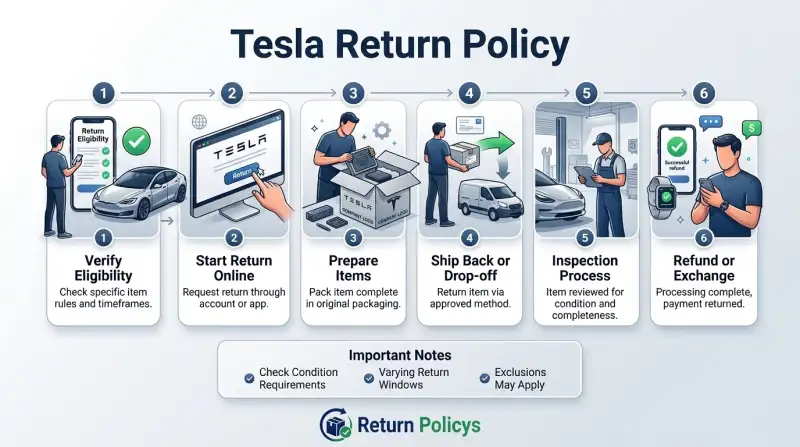
The Problem: Why Tesla’s Return Policy Isn’t as Simple as “7 Days”
A seven-day return sounds generous when most car dealerships offer zero return rights. But the fine print makes it a narrow path. Tesla’s policy is a voluntary cooling-off period, not a legal requirement.
Only a handful of states give you any right to cancel a car purchase without Tesla’s own rules.
The catch is that the clock starts ticking the moment you take delivery. That includes the day you sign paperwork and drive off the lot. If you take delivery on a Saturday, your return window ends the following Friday evening, no extensions for weekends or holidays.
Used Teslas complicate things further. You get no return period at all on pre-owned vehicles. That’s a hard rule buried in the purchase agreement.
And even for new cars, there are three main conditions that can kill your return before you’ve had a chance to think it through.
The Quick Answer — What You Actually Get (New vs. Used)
New Tesla: 7 days or 1,000 miles. Whichever comes first. No questions asked.
Full refund minus any damage deductions.
Used Tesla: Zero return. Final sale. No cooling-off period.
You own it the second you sign.
That’s the nutshell. Every other detail is just branching off these two facts.
For new cars, the policy applies to direct purchases from Tesla, not third-party dealers or used car lots. If you buy a new Model Y or Cybertruck from Tesla’s inventory, you’re covered. If you buy a used Model 3 from a Tesla location, you’re not.
The 1,000-mile limit is strict. The odometer reading is recorded at delivery and checked again at return. Even 1,001 miles voids the return.
The seven-day limit is calendar days, not business days. So plan carefully if you take delivery on a Friday or before a holiday.
The Three Gatekeepers That Kill Your Return (Miles, Damage, Time)
Three factors decide whether your return goes through or gets denied. Think of them as three gates. Fail any one and you’re stuck with the car.
Gate 1: Mileage
You must drive fewer than 1,000 miles total. That includes test drives, commutes, road trips, everything. Tesla reads the odometer electronically.
There’s no way to reset it or “forget” miles. If you drove 1,002 miles, the return is rejected. No negotiation.
Gate 2: Damage
The car must be returned in the same condition you received it. Normal wear and tear is fine, light dust, a few bugs on the bumper. But curb rash on a wheel, a cracked windshield, interior stains, or any damage beyond “clean and undamaged” gets deducted from your refund.
Tesla inspects the vehicle during the return process. They take photos and note any damage. You’ll get an itemized deduction list.
Gate 3: Time
You have seven calendar days from the moment you accept delivery. Not from the day you ordered. Not from the day you called to schedule.
From the moment you sign the delivery documents and drive away. If day seven lands on a Sunday, you still have only until midnight that day. No grace period.
Here’s a quick table to show how these gatekeepers work together:
| Condition | What Triggers Rejection | What You Lose |
|---|---|---|
| Miles | Over 1,000 miles | Full return voided |
| Damage | Curb rash, scratches, dents, stains | Deduction from refund |
| Time | Beyond 7 days | Full return voided |
If you pass all three, you can proceed with the return. If you fail even one, you’re normally stuck.
Decision Branch #1: You Bought a New Tesla
This branch covers anyone who bought a brand-new Model 3, Model Y, Model S, Model X, or Cybertruck directly from Tesla. The return policy is available, but only under specific conditions.
Under 1,000 miles and 7 days? Here’s Exactly How
If your odometer shows less than 1,000 miles and you’re still inside the seven-day window, you can return the car. Here’s the step-by-step process:
- Log into your Tesla account on the website. Go to your vehicle’s detail page.
- Find the “Return” option. It should be visible if you’re within the window.
- Submit a return request online. You’ll be asked to provide a reason (optional but helpful).
- Schedule a return appointment at your nearest Tesla service center or delivery hub.
- Bring the car in with all original accessories, keys, and paperwork. You’ll also need to bring any charging equipment that came with the vehicle.
- Sign the return documents during the appointment. Tesla will inspect the car on the spot.
- Wait for refund processing. It typically takes 5 to 10 business days for the refund to appear on your original payment method.
Tesla does not charge a restocking fee for new cars in most states. But if there’s damage, they deduct repair costs. They also cancel any trade-in deal you had.
If you traded in your old car, you either get it back (if still available) or receive a cash value as part of the refund.
You’re Over the Mileage or Days? You’re Stuck
If you’ve driven more than 1,000 miles or the seven-day window has passed, you cannot return the car under Tesla’s voluntary policy. You own it. Period.
Your only options at that point are:
- Sell the car privately to recoup as much cash as possible.
- Trade it in to Tesla or another dealer, but expect a lower offer than what you paid.
- Keep it and live with the decision.
Some owners try to negotiate an exception by calling Tesla support. In our research, that almost never works for mileage or time violations. Tesla is very strict on these limits because they need to resell the car as new within a certain window.
Decision Branch #2: You Bought a Used Tesla
This branch covers anyone who bought a pre-owned Tesla from Tesla’s official used inventory or a certified pre-owned listing. The rules are entirely different.
No Return, But Here’s What You Can Actually Do
Tesla’s used car sales are final. There is no cooling-off period, no return window, no exchange option. The moment you sign the purchase agreement and take delivery, you own the car.
That doesn’t mean you have zero protection. Used Teslas sold by Tesla come with a limited warranty (usually 1 year or 10,000 miles, whichever comes first). If the car has a mechanical defect during that period, Tesla will repair it under warranty.
But cosmetic issues, wear and tear, or “I changed my mind” are not covered.
If you’re unhappy with a used Tesla, your realistic options are:
- File a warranty claim if the issue is mechanical and within the warranty period.
- Sell the car privately or trade it in.
- Check your state’s lemon law, but lemon laws typically apply to new cars only, not used ones.
Some states have their own laws about used car returns. For example, California has a “cooling-off” rule for certain used car deals, but it only applies to dealers who offer their own return policies. Tesla’s used policy explicitly states no return, and state-specific exceptions are rare.
What About the “Used Inventory” Cars? Same Rules Apply
“Used inventory” is just Tesla’s term for pre-owned cars they’ve taken in on trade or lease returns. They’re sold through the same channel as certified pre-owned. The return policy is identical: no returns.
Don’t be fooled by the word “inventory.” These are not new cars. They’ve been driven, often by a previous owner. Tesla may recondition them, but they’re still used.
Once you buy one, you’re committed.
If you see a “used” Tesla listed on Tesla’s website with a lower price, assume you cannot return it. Budget a pre-purchase inspection before you buy, because your only safety net is the limited warranty.
Decision Branch #3: You’re in a State With Special Rules (California, NY, etc.)
State law can override or supplement Tesla’s return policy. If you live in California, New York, or a handful of other states, you may have additional rights.
California is the most notable. The state’s “cooling‑off” law for vehicle purchases is often misunderstood. California does not require any dealer to offer a return period for new cars.
But Tesla’s own policy applies there just like everywhere else. However, California has strict consumer protection laws for online purchases. Since Tesla sells cars online, you technically bought it without seeing it in person.
That can give you extra leverage if you push back on a denied return.
New York has a similar dynamic. The state’s General Business Law covers direct‑to‑consumer sales, but it doesn’t mandate a return window. Still, New York’s Attorney General has taken an interest in Tesla’s sales practices in the past.
If you’re in New York and Tesla denies a return within the seven days, it’s worth contacting the state consumer protection division.
Other states with note:
- Texas, No cooling‑off law for new cars. Tesla’s policy is your only option.
- Florida, No return right by law. Same as Texas.
- Massachusetts, Some protection for used car purchases (a 30‑day warranty for certain defects), but that’s not a return policy.
If you’re in any state, the safest bet is to assume Tesla’s voluntary policy is your only path. Don’t bank on state law saving you. But if you hit a wall, it’s worth checking your state’s consumer protection website.
The Step‑by‑Step Return Process (Start to Refund)
Here’s the exact workflow you’ll follow if you’re within the window and want to return.
Step 1: Confirm eligibility. Log into your Tesla account. Check the odometer reading and the delivery date. Make sure you’re under 1,000 miles and within 7 days.
Step 2: Submit the return request. In your account dashboard, find the vehicle page. Look for a “Return” or “Cancel” button. If it’s not there, call the delivery center.
Some regions hide the button until you call.
Step 3: Schedule the return appointment. You must bring the car to a Tesla service center or delivery hub. They don’t pick it up. Choose a time that fits within the 7‑day window.
If your appointment falls on day 7, that’s fine, but you can’t schedule it for day 8.
Step 4: Prepare the car. Remove all personal items. Include every accessory that came with the car: key cards, charging cable, J1772 adapter, floor mats, and any included luggage organizers. You must also return the license plates (if they were issued by Tesla) and the temporary registration.
Step 5: The inspection. A Tesla technician will walk around the car. They’ll note any damage, residual dirt, or missing parts. They’ll photograph the odometer.
You’ll sign a condition report. If there’s damage, they’ll show you the estimated repair cost and subtract it from the refund.
Step 6: Sign return paperwork. You’ll sign documents that transfer ownership back to Tesla. This includes a release of liability. You’ll also confirm that any trade‑in deal you had is reversed.
Step 7: Wait for refund. Tesla says refunds take 5 to 10 business days. In our research, most arrive in 7 to 14 days. The money goes back to your original payment method.
If you paid with a mix of cash and financing, the refund follows the same split.
Step 8: Cancel insurance. Once the return is confirmed, call your insurance company to cancel coverage. Don’t do it before, because the car is still yours until the paperwork is done.
The Hidden Costs: Restocking Fees, Damage Deductions, and Trade‑in Trouble
Most new Tesla returns are free of restocking fees. That’s true in the majority of states. But there are exceptions.
Some states allow dealers to charge a restocking fee even on voluntary returns. Our research indicates that California and New York do not permit such fees for cancelled vehicle sales. But if you’re in a state without that protection, Tesla could theoretically charge one.
In practice, they rarely do for new cars.
Used Tesla returns are a different story. There is no return, but if you somehow convinced Tesla to undo a used sale (unlikely), they would charge a restocking fee. That fee can be up to 15% of the purchase price.
Damage deductions are the real hidden cost. Even a minor curb rash can cost you $200 to $300. A cracked windshield could be $800 or more.
Tesla repairs are expensive because they use proprietary parts. Our review of owner forums shows that damage deductions typically range from $100 to $1,500 depending on severity.
Trade‑in trouble is another surprise. If you traded in your old car when buying the Tesla, returning the new car cancels the trade‑in deal. If your old car is still at Tesla’s lot, you get it back.
If they’ve already sold it, you get a cash value equal to the trade‑in credit. That cash is part of your refund, not an extra payment. But some owners report delays getting that cash because Tesla must reconcile the trade‑in sale.
Here’s a quick cost breakdown:
| Potential Deduction | Typical Amount |
|---|---|
| Curb rash (one wheel) | $200–$300 |
| Cracked windshield | $800–$1,200 |
| Interior stain | $100–$400 |
| Missing accessory (e.g., charging cable) | $150–$300 |
| Restocking fee (used, if applicable) | Up to 15% of price |
Common Mistakes That Void Your Return (and How to Avoid Them)
Mistake #1: Waiting too long. The seven‑day clock doesn’t pause. If you take delivery on a Saturday, day seven is the next Friday. Don’t assume weekends or holidays reset it.
The minute you drive over 1,000 miles or past day seven, the return is dead.
Mistake #2: Modifying the car. Any aftermarket changes, like window tint, PPF, floor mats, or accessory installations, void the return. Tesla requires the car in original factory condition. Even a phone mount left on the dash can be considered a modification.
Mistake #3: Not cleaning the car. Light dust is fine. But if you return the car with mud, food wrappers, or pet hair, Tesla may charge a cleaning fee. In extreme cases, they might refuse the return altogether.
Mistake #4: Losing accessories. The car must come with everything that was in the delivery. Missing the charging cable is a $250 deduction. Missing both key cards is another $150.
Keep all accessories in the trunk until you’re sure you’re keeping the car.
Mistake #5: Driving over 1,000 miles. This is the most common. People think “close enough” works. It doesn’t.
Tesla reads the exact mileage. 999 miles is fine. 1,000 is fine. 1,001 is not.
How to avoid them: Set a calendar reminder for day 5. Check your odometer daily. Don’t make any modifications until you’re certain.
Keep the car clean inside and out. Store all accessories in the original bag. If you drive a lot, track your miles from day one.
Real‑Life Scenarios — What Happens When You Try to Return
Scenario 1: The “I don’t like it” return. Buyer purchases a new Model Y. Drives 850 miles over six days. It’s not the car they expected.
They schedule a return at the service center. The inspection finds no damage. Tesla processes the refund in eight business days.
Total cost to the buyer: zero. This is the best‑case outcome and it works exactly as advertised.
Scenario 2: The 1,002 mile overrun. Buyer takes a road trip over the weekend. They check the odometer on day 6 and see 1,002 miles. They call Tesla.
The return is denied. They try to escalate. Tesla holds firm.
The buyer is now the owner of a car they wanted to return. Their only option is to sell it privately, likely at a loss.
Scenario 3: The curb rash surprise. Buyer wants to return a Model 3 after 500 miles. The service center inspection notes a curb rash on the right rear wheel. Tesla quotes $250 for a new wheel repair.
The buyer agrees. The refund goes through at the purchase price minus $250. The buyer still feels good about the outcome, but the deduction stung.
Scenario 4: The used car trap. Buyer purchases a used Model S from Tesla’s inventory. Drives it for three days. Realizes the range is lower than expected.
Tries to return it. Tesla’s policy clearly says no return. Buyer is stuck.
They end up selling the car to a third party a month later, taking a $4,000 loss.
These scenarios highlight one truth: the return policy is generous for new cars within the limits, but brutal outside them. Know where you stand before you act.
The Decision Guide: Should I Return It or Sell It Yourself?
If your return is still an option, take it. It costs you nothing and gets you a full refund minus damage. Selling privately is a hassle.
You’ll deal with listing fees, test drives, and a lower resale value than what you paid.
Use this quick decision table:
| Situation | Best Move |
|---|---|
| Under 1,000 miles, within 7 days, no damage | Return it |
| Over miles or past 7 days, car is new-ish | Sell privately |
| Used Tesla, no return possible | Sell privately or trade in |
| Minor damage, still within window | Return it (pay deduction) |
Selling privately means you keep the car until you find a buyer. That can take weeks. Return is instant and certain.
If both paths are open, return is the clear winner.
Frequently Asked Questions
Can I return a Tesla after 7 days?
No. Tesla’s policy is strict. Once the seventh calendar day passes, the return option is gone.
No exceptions. Your only recourse is to sell the car privately or trade it in.
Is there a restocking fee for returning a new Tesla?
In most states, no. Tesla does not charge a restocking fee for new vehicle returns. Some states allow fees, but Tesla rarely applies them.
Damage deductions are separate and can still apply.
What happens to my trade-in if I return my Tesla?
Your trade-in deal is cancelled. If Tesla still has your old car, you get it back. If they’ve sold it, you receive the trade-in value as part of your refund.
Expect some delay in processing.
Can I return a used Tesla from inventory?
No. Used Teslas sold directly by Tesla are final sale. No return period, no cooling-off window.
Your only protection is the limited warranty for mechanical defects.
How long does the refund take?
Tesla says 5 to 10 business days. Our research shows most refunds arrive within 7 to 14 days. Refunds go back to your original payment method, split the same way you paid.
What counts as damage that gets deducted?
Curb rash, scratches, dents, cracked glass, interior stains, and missing accessories all qualify. Normal light dirt or bugs are fine. Tesla inspects and photographs every return.